
Female Trekking Guides: Women at High Altitudes in Nepal
Winter trekking in Nepal is a seasonal Himalayan adventure that combines spectacular mountain panoramas, peaceful trails and authentic mountain culture with the challenges of cold temperatures, snowfall and high-altitude conditions. From the Everest and Annapurna regions to Langtang Valley, Nepal offers diverse winter trekking routes, including Everest Base Camp, Annapurna Base Camp, Ghorepani Poon Hill and Mardi Himal. The best route depends on elevation, weather conditions, trekking experience and the time of winter, as December, January and February each bring different opportunities and challenges.
A successful winter trek in Nepal requires careful route selection, proper acclimatization and preparation for temperatures that can fall below -20°C at higher elevations. Suitable winter clothing, insulated sleeping bags, reliable trekking equipment and guidance from experienced, licensed guides help trekkers manage snow-covered trails, altitude sickness and extreme mountain weather. Whether you are looking for a short Himalayan getaway or a challenging high-altitude adventure, understanding trekking routes, seasonal conditions, safety requirements and package costs will help you plan a rewarding winter journey in Nepal.
What Is the Role of Female Trekking Guides in Nepal?
A female trekking guide in Nepal leads trekkers on high-altitude routes, sets the daily pace, monitors altitude symptoms, arranges lodging and permits, and explains local culture. The role carries the same government license and legal responsibility as a male guide's.
Three questions define the role in 2026: why women enter the profession, which qualifications they hold, and what they add to Nepal's trekking industry.
Why Are More Women Becoming Trekking Guides in Nepal?
More women become trekking guides in Nepal because demand for female guides exceeds supply, training is free or subsidized, and guiding offers a wage outside farm work. Women-led agencies and government programmes opened a career path that the porter pipeline long closed to women.
The porter pipeline explains the gap. According to Heaven Himalaya's earlier field notes, 50 to 55% of Nepal's guides began as porters, and families kept women out of porter work. Fewer female porters produced fewer female guides decades later.
The first women-led response came from Lucky, Dicky, and Nicky Chhetri. According to a 2012 AFP report, the sisters founded Three Sisters Adventure Trekking in the mid-1990s after female guests described harassment by male guides. Clients then asked the sisters to guide, so the sisters built a training course covering English, high-altitude safety, and local flora and fauna.
Public programmes followed. According to Nepali Times reporting from 2019, 80 women enrolled in Nepal Mountain Academy (NMA) guide training, more than double the previous year, and the government allocated Rs 1 million yearly for female guide training. In November 2025, 28 women began a free 15-day residential course at the Academy's Garma campus in Solukhumbu, run with the Nepal Tourism Board and the UNDP Sustainable Tourism Project.
What Skills and Qualifications Do Female Trekking Guides Need?
Female trekking guides need a government guide license, a school-leaving qualification, first-aid and altitude-illness training, working English, navigation skill, and the stamina to lead at 5,000 m. Wilderness first aid and CPR certificates strengthen that baseline.
The license comes first. According to an August 2025 Kantipur report, the Trekking Agencies' Association of Nepal (TAAN) and the Nepal Academy of Tourism and Hotel Management (NATHM) ran a 28-day guide course in Pokhara for 221 candidates, and 24 failed. A passing certificate qualifies the graduate for a license from the tourism office.
The licensing course is the floor, not the ceiling. A Nepal-based risk-management trainer quoted by Viristar describes the course as relatively limited, which is why serious agencies add training. Five skills separate strong guides from merely licensed ones:
Route knowledge: trail conditions, teahouse quality, and bail-out points for every day of the itinerary
Altitude judgment: spotting early symptoms and deciding when to stop, rest, or descend
Medical competence: wilderness first aid, CPR, and oxygen and oximeter use
Client reading: matching pace to the weakest walker without making the group feel slowed
Logistics control: permits, flights, porter loads, and lodging in peak-season crowds
Two 2026 client reviews on our website praise guides who slowed the pace at altitude and checked in on how clients felt.
How Do Female Guides Contribute to Nepal's Trekking Industry?
Female guides contribute to Nepal's trekking industry by widening the licensed workforce, serving the women travellers who request them, and raising conduct and safety standards across agencies. They also route household income into mountain communities.
The workforce gap is measurable. At 886 of 17,164 licensed guides in 2019, women filled 5.2% of positions while trekking demand kept climbing. The Annapurna Conservation Area alone recorded 299,831 visitors in 2025, and 122,203 of them, or 41%, came from outside South Asia.
Standards rise through training exchange. Empowering Women of Nepal (EWN), directed by Lucky Chhetri, runs a Protector Training that teaches guides, assistant guides, and lodge staff to de-escalate aggressive behaviour.
What Challenges Do Female Trekking Guides Face at High Altitudes?
Female trekking guides face altitude illness, heavy physical load, menstrual hygiene constraints, gender stereotypes, and safety risks on remote trails. Most challenges overlap with those of male guides; sanitation, harassment, and social expectation add the gendered layer. Four sections below examine each.
How Do Female Guides Handle Altitude Sickness and High-Altitude Emergencies?
Female guides handle altitude sickness by checking symptoms every evening, halting ascent at the first signs of acute mountain sickness, and descending when symptoms worsen. Descent is the definitive treatment, backed by oxygen, a portable hyperbaric bag, and physician-prescribed medication.
Acute mountain sickness (AMS) is the mildest altitude illness, with headache, nausea, vomiting, fatigue, dizziness, and insomnia as symptoms. High altitude cerebral edema (HACE) is brain swelling, and high altitude pulmonary edema (HAPE) is fluid in the lungs. Both are life-threatening. According to Wilderness Medical Society (WMS) guidelines summarized by the American Academy of Family Physicians, unacclimatized people face high risk above 2,500 m, and AMS appears at altitudes as low as 2,000 m.
The response follows a fixed order. Guides score symptoms with the 2018 Lake Louise Score, which rates headache, gastrointestinal upset, fatigue, and dizziness and diagnoses AMS at 3 points or more with headache present. The group stops climbing at the first diagnosis. According to the WMS, descent of 300 to 1,000 m is the most important treatment, supplemental oxygen or a portable hyperbaric chamber covers delays, and dexamethasone is the more reliable drug for moderate to severe AMS and HACE.
The Himalayan Rescue Association (HRA), founded in 1973, staffs aid posts at Manang (about 3,550 m) and Pheriche (about 4,250 m) and has run an Everest ER medical camp at base camp since 2003. Weather limits helicopter rescue, so early descent remains the primary tool.
What Physical and Mental Challenges Do Women Face in High-Altitude Trekking?
Women face the same hypoxia, cold, and fatigue as men, plus menstrual-cycle disruption, iron-status concerns, and the pressure of leading in male-dominated lodges. Research on sex differences in altitude illness remains mixed.
A 2019 meta-analysis in Military Medical Research pooled 18 prospective studies with 7,669 participants, including 2,639 women, and found AMS prevalence 24% higher in women (relative risk 1.24). Newer work points the other way on hormones. According to Linda Keyes of the University of Colorado, presenting in June 2026, a prospective observation of 1,161 women trekkers found no difference in AMS risk by menstrual-cycle phase, menopausal status, or hormonal contraception. A 2023 Sports Medicine review concluded that higher female vulnerability is not unambiguously shown and prescribed the same remedies for everyone: slow ascent, full acclimatization, and preventive medication when a physician advises it.
Menstruation does change at altitude. A small expedition study published in April 2026 recorded longer cycles in all five premenopausal participants who reached about 5,000 m. Jenisha Karki, a Nepali female guide quoted in our earlier field notes, names menstrual hygiene as the main trail challenge, because pads need changing every 4 to 8 hours and private toilets are hard to find. Guides pack out used products, carry spare supplies, and plan tea-house stops around privacy. A pre-season ferritin test shows whether iron stores support acclimatization.
The mental load is responsibility. Altitude breaks sleep, a guide makes welfare decisions for 10 to 15 days straight, and many nights pass as the only woman in a lodge.
How Do Female Guides Overcome Gender Stereotypes in Nepal's Mountaineering Industry?
Female guides overcome gender stereotypes by earning the same license as men, proving competence on the trail, and joining agencies that hire and protect women. Completed treks and repeat clients replace doubt with reputation.
The stereotypes were concrete. According to a 2008 Women's eNews report on Three Sisters Adventure Trekking, the founders met a taboo on women wearing trousers, resistance to wives earning money, and a belief that women bring bad luck on mountains. A 2007 Christian Science Monitor profile recorded male guides who resented women taking their work.
Three forces shifted attitudes. The license applies one exam to everyone. Visible success followed, as clients rebooked and recommended female guides. Family economics did the rest: according to the 2012 AFP report, parents began encouraging daughters to join guide training once they saw a reliable income.
History supplies the strongest precedent. Pasang Lhamu Sherpa, a Solukhumbu mountaineer and trekking guide, became the first Nepali woman to summit Everest on 22 April 1993 and died on the descent. The Khumbu Pasang Lhamu Rural Municipality, whose permit every Everest trekker buys, carries her name.
What Safety Challenges Do Women Face While Guiding Remote Himalayan Treks?
Women guiding remote Himalayan treks face isolation, patchy communication, shared lodges, harassment risk, and weather and evacuation hazards. Agencies reduce those risks through team structure, room arrangements, check-in routines, and conduct training.
Lodge arrangements carry the gendered risk. A 2008 Women's eNews report described guides who often worked alone, ate as the only woman in crowded dining rooms, and slept near male staff. Two Aalborg University master's theses on Nepal's trekking sector list harassment, bullying, and menstrual sanitation among career barriers for women. EWN's Protector Training answers with de-escalation skills for guides, assistant guides, and staff.
Remote routes add logistics risk. Manaslu and Upper Mustang have patchy mobile coverage, so offline maps, agreed check-in times with the Kathmandu office, and a second staff member on the team matter. Insurance covering helicopter evacuation up to the route's maximum altitude completes the chain.
How Do Female Trekking Guides Prepare for High-Altitude Treks in Nepal?
Female trekking guides prepare through licensed training, first-aid and altitude certification, physical conditioning, route reconnaissance, and pre-season gear checks. Preparation falls into four areas: credentials, acclimatization planning, emergency skills, and weather readiness.
What Training and Certifications Are Required for Female Trekking Guides?
Nepal requires a government trekking guide license, earned by completing a 28-day course and passing an exam. Female guides sit the same course and exam as men, and many agencies add wilderness first aid and CPR certificates on top.
The following table compares the five training routes female guides use, including provider, duration, and focus.
Route | Provider | Duration | Focus |
Trekking guide license course | NATHM with TAAN | 28 days | First aid, altitude awareness, leadership, culture, conservation |
Porter-guide course | NATHM with TAAN | 15 days | Assistant guiding and porter skills |
Female trekking guide training | NMA with the Nepal Tourism Board and UNDP Sustainable Tourism Project | 15 days, free, residential (November 2025) | Technical trekking skills, security, first aid, conduct |
Women's guide training | EWN | About 1 month, free, twice yearly | English, safety, field practice |
Wilderness first aid and CPR | Private providers | Varies | Emergency care, evacuation decisions |
Every license carries a photo, a license number, and an expiry date. Only the lead guide must hold it. Porters and assistant guides work without one, so ask which person on your team is the licensed guide.
How Do Female Guides Manage Acclimatization and Altitude Risks?
Female guides manage acclimatization by limiting sleeping-altitude gain to 500 m per day above 3,000 m, adding a rest day every 3 to 4 days, and logging symptoms nightly. They descend when symptoms worsen.
According to the Wilderness Medical Society, sleeping altitude matters more than the highest point reached during the day. Acclimatization is the body's adjustment to lower oxygen pressure, and it takes days. Guides apply that rule through "climb high, sleep low" hikes. A daily routine looks like this:
Record resting pulse, oxygen saturation, and Lake Louise symptoms each morning and evening.
Hold the day's sleeping altitude inside the 500 m limit.
Hike high on rest days and return to sleep lower.
Drink fluids and eat light meals at every stop.
Stop the ascent for any symptom of AMS.
Real itineraries show the logic. On the Everest route, Namche Bazaar (3,440 m) and Dingboche (4,410 m) each get two nights. On the Annapurna Circuit, Manang (3,540 m) serves as the acclimatization stop before Thorong La (5,416 m). The mistake we see most often is trading the Namche rest day for an extra day in Kathmandu. Road access adds a second trap: according to HRA statistics from autumn 2016, more than half of the altitude-illness patients at its Manang post had reached the village by motor vehicle.
What Survival, Navigation, and First-Aid Skills Are Essential for High Altitude Trek?
Essential high-altitude skills include altitude-illness recognition, wilderness first aid, offline navigation, emergency shelter, and evacuation coordination. Female guides build these through licensing courses, first-aid certificates, and annual refreshers.
Five skill sets cover the emergencies that occur above 4,000 m:
First-aid competence: pulse oximeter, thermometer, oxygen, and a portable hyperbaric bag for cases where descent is delayed
Navigation skill: offline GPS maps, a paper map, and a compass for whiteouts above 5,000 m
Shelter skill: emergency bivouac with insulation, headlamp, whistle, and spare layers
Evacuation coordination: helicopter requests that carry GPS coordinates, patient details, a passport copy, and the insurance policy number
Cold-injury care: recognition and treatment of hypothermia and frostbite
Pulse oximeter readings support the decision to descend but never replace it. Symptoms decide.
How Do Female Guides Prepare for Extreme Himalayan Weather Conditions?
Female guides prepare for extreme Himalayan weather by planning around the two trekking seasons, checking forecasts daily, carrying layered insulation, and building buffer days into itineraries. March to May and September to November offer the most stable conditions.
According to the Annapurna Conservation Area Project, peak seasons run from September to November and from March to May. December and January nights at Lobuche (4,910 m) and Gorak Shep (5,164 m) fall to -15°C or lower. The monsoon, from June to August, brings landslides, leeches, and flight cancellations to southern valleys. Afternoon winds build on Thorong La, so crossing parties leave High Camp (4,800 m) before dawn.
Buffer days absorb delays. One client review on our website describes adding buffer days for bad weather and taking a helicopter back to Kathmandu after base camp. Our guides to Everest Base Camp Trek in December 2026: Weather & Tips and Best Time to Trek in Nepal cover season detail by region.
Which Popular Nepal Treks Are Led by Female Trekking Guides?
Licensed female guides work on trails across the Everest, Annapurna, Langtang, Manaslu, and Mustang regions. Availability depends on season, group size, and the agency's roster, so early booking secures a match. The table below compares six popular routes by altitude, duration, and permit context.
Trek | Highest point | Duration | Permit context |
Everest Base Camp | 5,364 m (Kala Patthar 5,545 m) | 14 days | Sagarmatha National Park and Khumbu Pasang Lhamu permits |
Annapurna Circuit | Thorong La, 5,416 m | 15 days | ACAP permit and TIMS card |
Annapurna Base Camp | 4,130 m | 15 days | ACAP permit and TIMS card |
Manaslu Circuit | Larkya La, 5,106 m | 14 days | Restricted area, MCAP, and ACAP permits |
Langtang Valley | Kyanjin Gompa, 3,870 m | 10 days | Langtang National Park permit |
Upper Mustang | Lo Manthang, 3,840 m | 18 days | Restricted area permit |
Heights are standard trail altitudes, and durations follow Heaven Himalaya's published itineraries.
Can Female Guides Lead the Everest Base Camp Trek?
Yes, licensed female guides lead the Everest Base Camp trek. The license, permits, and route access are identical for male and female guides. The route covers about 130 km round trip from Lukla (2,860 m) to base camp (5,364 m).
Two permits apply on the Everest Base Camp Trek. The Sagarmatha National Park permit costs NPR 3,000 plus 13% VAT, and the Khumbu Pasang Lhamu permit costs NPR 3,000. Both are checked at the Monjo gate. In peak season, flights to Lukla sometimes depart from Ramechhap instead of Kathmandu, which adds an early-morning transfer.
The Nepal Mountain Academy trains its female guides at Garma, a Solukhumbu village that serves as a gateway to the Everest region. One edge case deserves a note: female porters remain scarce, so an all-female team of guide and porter requires an advance request. According to our earlier field notes, few agencies run all-female teams.
Are Female Guides Available for the Annapurna Circuit Trek?
Yes, female guides are available for the Annapurna Circuit, Nepal's best-known high-altitude loop. The route climbs to Thorong La (5,416 m) across 15 days and runs through the region where women-led agencies in Pokhara built the first female guiding teams.
According to a 2017 Kathmandu Post report, Pokhara had more than 150 women trekking guides, and about 50 women entered guide training there each year. The Annapurna Circuit Trek requires an Annapurna Conservation Area Project (ACAP) permit at NPR 3,000 for foreign nationals.
Manang (3,540 m) hosts the HRA aid post, which gives a daily altitude talk during the trekking season. Jeep roads now reach the upper valley, and a guide who insists on walking days protects the acclimatization schedule that a vehicle ride skips.
Can Women Guide Treks in the Manaslu and Langtang Regions?
Yes, women can guide treks in Manaslu and Langtang because the guide license carries no gender restriction. Manaslu is a restricted area that requires a licensed guide hired through a registered agency. Langtang lies inside a national park covered by the 2023 licensed-guide rule.
From 1 April 2023, the Nepal Tourism Board banned solo trekking, requiring licensed guides on all TIMS-applicable routes nationwide. On the Manaslu Circuit Trek, the restricted area permit costs $100 for the first 7 days from September to November and $75 from December to August, plus $15 or $10 per extra day. The Manaslu Conservation Area permit and the ACAP permit each cost NPR 3,000. Larkya La stands at 5,106 m. Published sources differ on whether a two-trekker minimum still applies, so the agency confirms the current rule at booking. Langtang Valley Trekking tops out at Kyanjin Gompa (3,870 m), with Tserko Ri (4,984 m) as the optional high point.
Which High-Altitude Treks Offer Opportunities to Meet Female Guides?
The Everest, Annapurna, Langtang, and Mustang regions offer the best chances to meet female guides, particularly in the March to May and September to November seasons. Booking a guide in advance is more reliable than hoping to meet one on the trail.
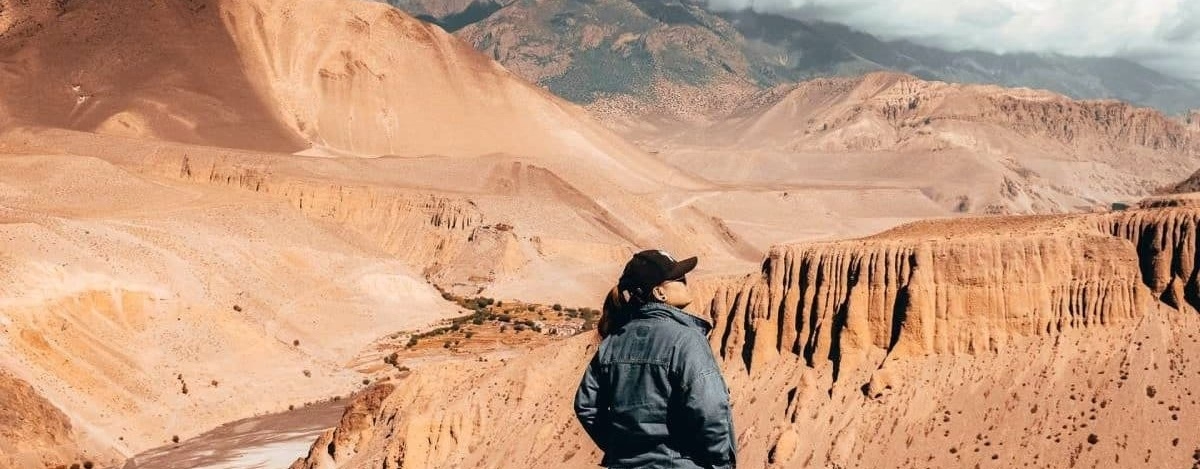
Three routes lead to a meeting. Pokhara hosts the largest concentration of women-led agencies and female guides. Kathmandu pre-trek briefings let a traveller meet the assigned guide before departure. Upper Mustang, where our own image archive shows a female guide leading a group, rewards early requests because rosters fill by season.
Our guide to the Top 10 High Altitude Challenging Treks in Nepal Over 4000 M lists further routes above 4,000 m for travellers who want a stronger challenge.
Why Should Trekkers Choose Female Trekking Guides in Nepal?
Trekkers choose female guides for comfort, communication, safety awareness, and cultural access, especially when travelling solo or in all-female groups. A female guide is a preference, not a safety requirement. License, training, and agency standards decide competence.
Do Female Guides Provide Better Support for Women Travellers?
Female guides provide different support for women travellers, not universally better support. The difference shows in menstrual-health conversations, room arrangements, comfort discussing symptoms, and ease of raising concerns early.
According to Nepali Times, women trekkers tend to prefer female guides because the guides seem to understand their needs better. The evidence on the other side is equally real. A June 2026 review on our website, written by a solo female trekker, credits her male guide with finding the cleanest rooms and checking on her at every altitude gain. Attentiveness matters as much as gender.
Three decision rules follow from this:
Choose a female guide for menstrual-health discussions, all-female groups, and personal comfort
Choose by credentials when the license, first-aid training, and itinerary quality differ between candidates
Choose both preferences together by asking the agency for female guides who hold current first-aid certificates
How Do Female Guides Improve Trekking Safety and Communication?
Female guides improve safety and communication when clients report symptoms, menstrual issues, or discomfort sooner. Earlier reports shorten the gap between first symptom and first response, and WMS guidance halts ascent at the first AMS symptoms.
Early reporting protects both the client and the itinerary. A client who mentions a headache at 3,800 m on day 4 loses an afternoon. A client who hides it until 4,900 m risks HAPE, HACE, or an emergency helicopter.
Communication also covers language. EWN training includes English and safety content, and the Chhetri sisters' original course taught both. The evidence on guide gender and safety outcomes is experiential: we found no published study that compares outcomes by guide gender, so claims in either direction rest on field reports.
Can Female Guides Help Solo Female Travellers Feel More Confident?
Yes, female guides help solo female travellers feel more confident by providing companionship, practical advice, and a trusted contact across 10 to 20 days on remote trails. Since 1 April 2023, solo foreign trekkers on all TIMS-applicable routes must hire a licensed guide in any case, so "solo" means a private guide, not walking alone.
Four steps build confidence before arrival:
Request the guide's profile, license number, and first-aid credentials.
Schedule a video call to check communication style and English level.
Complete a pre-trip gear check, including hired items such as a sleeping bag and trekking poles.
Confirm room arrangements at each night's lodge.
Our Packing List for Trekking in Nepal covers the gear check in detail.
What Cultural Insights Can Female Guides Share About Himalayan Communities?
Female guides share cultural insights on household life, women's roles, festival customs, and food traditions in Sherpa, Gurung, Thakali, and Tibetan-influenced communities. Conversations in family-run kitchens and tea houses open access that formal tours skip.
Scholars have documented this role. Anthropologist Sherry Ortner wrote a chapter on Sherpa women trekking guides in 1999, and a Fulbright researcher working with EWN found that female guides redefine the boundaries of Nepali womanhood through visible wage labour.
Each region adds its own layer. Khumbu is Sherpa country, with monasteries at Tengboche and Pangboche. The Annapurna valleys hold Gurung and Thakali villages, where dal bhat arrives with a story about who grew the lentils. Manaslu's upper valleys carry Tibetan-influenced traditions, including mani walls and gompas.
How Are Female Trekking Guides Empowering Women in Nepal?
Female trekking guides empower women in Nepal by creating wage employment, building leadership skills, shifting household decision-making, and giving girls a visible professional path. Training programmes and women-led agencies multiply the effect.
How Does Female Employment Support Women's Economic Independence?
Female guiding employment supports economic independence through daily wages of $25 to $35, tips of $5 to $10 per day, and seasonal contracts that fund households and savings. A 14-day Everest Base Camp trek pays a guide $350 to $490 in fees plus $70 to $140 in tips.
The arithmetic scales with the season. A guide who leads 6 such treks in a year earns $2,520 to $3,780 in fees and tips combined, an illustrative figure based on 2026 market rates. A Tribhuvan University dissertation on female guides in Pokhara notes that women's participation in income-generating work away from home remains very low in Nepal, so a wage earned on the trail changes a household's decisions about schooling, savings, and independence.
Income concentrates in two seasons, which leaves an off-season gap. EWN's Digital Apps Training for female trekking guides addresses part of it by building skills that carry into the quiet months.
What Organizations Support Women in Nepal's Trekking Industry?
Five organizations support women in Nepal's trekking industry: Nepal Mountain Academy, Three Sisters Adventure Trekking, Empowering Women of Nepal, the Nepal Tourism Board with the UNDP Sustainable Tourism Project, and the Trekking Agencies' Association of Nepal. The table below shows each organization's role and the evidence behind it.
Organization | Role | Evidence |
Nepal Mountain Academy | Government academy, established 30 May 2002, that pioneered women-only guide training | 291 female and 1,890 male guides trained, so about 13% of graduates are women |
Three Sisters Adventure Trekking | Women-run Pokhara agency that hires and trains women | Founded in the mid-1990s; more than 100 guides and porters by 2012 |
Empowering Women of Nepal | Non-profit that trains female guides and porters | Free month-long course twice yearly; Protector and Digital Apps trainings |
Nepal Tourism Board with UNDP Sustainable Tourism Project | Funders of the 2025 Garma course | 28 women, 15 days, November 2025 |
Trekking Agencies' Association of Nepal | Agency association that co-runs the 28-day guide course with NATHM | 221 candidates in the 2025 Pokhara course, all genders |
TAAN's course is open to all genders, so it widens the pipeline without targeting women specifically.
How Are Female Guides Inspiring the Next Generation of Himalayan Women?
Female guides inspire the next generation by working visibly on trails, in villages, and in training halls, so girls see guiding as a licensed profession rather than an exception. Role models, free training, and agency hiring together widen the pipeline.
NMA's president recalled in 2019 that male colleagues once questioned why the Academy trained women at all. By 2025, the Academy ran a free residential course for women.
Work remains. According to The Himalayan Times, NMA asked local governments in Solukhumbu to recommend participants for the November 2025 course and had to recruit women from other districts because local applicants were too few. The gap is awareness and access, not ability. Free training, local recommendation, mentorship from working guides, and agency hiring close it one step at a time.
How Can You Hire a Female Trekking Guide for Your Nepal Adventure?
To hire a female trekking guide in Nepal, choose a registered agency, state your preference at inquiry, verify the guide's license and first-aid credentials, and confirm acclimatization days in writing. Book early for March to May and September to November, when demand peaks.
What Should You Check Before Hiring a Female Trekking Guide?
Before hiring, check the guide's license, the agency's registration, first-aid training, the acclimatization plan, evacuation insurance, and room arrangements. The table below lists each check, the proof to request, and the reason it matters.
Check | Proof to request | Why it matters |
Guide license | Photo, license number, expiry date | Only licensed guides lead foreign trekkers in national parks |
Agency registration | Company registration, Nepal Tourism Board license, tax registration, TAAN membership | Restricted area permits such as Manaslu issue only through registered agencies |
First-aid training | Wilderness first aid or CPR certificate; oximeter and oxygen on the team | The license course is a baseline |
Acclimatization plan | Written itinerary with sleeping altitudes and rest days | Rapid ascent drives altitude illness |
Evacuation cover | Insurance policy covering helicopter evacuation to the maximum altitude | Rescue costs fall on the trekker |
Rooms and team | Guide's room arrangement; second staff member; porter loads | Welfare and conduct protect everyone on the trek |
The most common mistake is choosing the lowest quote. A package price that leaves no room for a $25 to $35 daily guide fee, permits, and lodging signals an unlicensed or underpaid guide. Our guide How to Choose the Best Trekking Company for the Everest Cho La Pass Trek? applies the same checks to one demanding route.
How Much Does Hiring a Female Trekking Guide in Nepal Cost?
Hiring a licensed trekking guide in Nepal costs $25 to $35 per day in 2026, and female guides typically fall in the same range. A 14-day Everest Base Camp trek carries $350 to $490 in guide fees before tips, permits, and flights. The table below lists typical 2026 line items.
Item | 2026 cost | Note |
Licensed guide | $25 to $35 per day | Typical agency rate |
Porter | $18 to $25 per day | Carries up to the agreed load |
Guide tip | $5 to $10 per day | Customary, paid at trek end |
Sagarmatha National Park permit | NPR 3,000 plus 13% VAT (about $23 to $26) | Everest region |
Khumbu Pasang Lhamu permit | NPR 3,000 (about $23) | Mandatory local government fee |
Manaslu restricted area permit | $100 first 7 days (September to November); $75 (December to August) | $15 or $10 per extra day |
MCAP and ACAP permits | NPR 3,000 each | Manaslu route |
Kathmandu–Lukla return flight | $416 to $516 | Everest route |
Some agencies add a premium for female guides because supply is limited, so request the rate in writing. Package prices bundle these items, so compare packages line by line.
Can Heaven Himalaya Arrange Experienced Female Trekking Guides in Nepal?
Yes, Heaven Himalaya arranges female trekking guides on its Nepal treks, subject to availability on your travel dates. Request a female guide at inquiry so the team can confirm the match for your route and season.
Heaven Himalaya is a Kathmandu-based, government-registered trekking company affiliated with the Nepal Tourism Board, TAAN, and Nepal Mountain Academy. Tripadvisor lists a 5.0 rating across 160 reviews, with Travelers' Choice awards from 2021 to 2025. We match porter loads to each porter's ability, and we publish prices openly. Current listings in November 2026:
Everest Base Camp Trek: 14 days, $1,399 to $1,499 depending on the offer
Annapurna Circuit Trek: 15 days, $1,279
Annapurna Base Camp Trek: 15 days, $1,250
Manaslu Circuit Trek: 14 days, $1,399
Langtang Valley Trekking: 10 days, $760
Upper Mustang Trek: 18 days, $2,499
Plan a trek with a female guide
Send your route, dates, and group size through Plan Your Trip, or message Ram on WhatsApp at +977 985 1273867. Email: info@heavenhimalaya.com. Office: Gitanjali Chowk, Dathu Sadak, Kathmandu, Nepal.
What Should You Know About Female Trekking Guides in Nepal Before Your Next Himalayan Adventure?
Female trekking guides in Nepal hold the same license as male guides, manage the same altitude risks, and lead the same routes, yet women made up only 5.2% of licensed guides in 2019. Training pipelines expanded in 2025, and demand keeps rising.
Five points carry the most weight when you plan:
Verify the license, agency registration, and first-aid credentials before paying a deposit
Match the guide to the route, because experience on Everest, Annapurna, and Manaslu differs
Request a female guide at inquiry, since rosters fill in March to May and September to November
Check the itinerary for a sleeping-altitude gain of 500 m or less per day above 3,000 m
Budget $25 to $35 per day for the guide, plus tips, permits, and flights
The 2026 evidence on women at high altitudes supports one protocol for everyone. According to the June 2026 findings on 1,161 women trekkers, menstrual-cycle phase, menopause, and hormonal contraception did not change AMS risk, and slow ascent protects every trekker. Female trekking guides in Nepal apply that protocol, and they bring a growing professional community to every trail from Lukla to Manang.