

Everest Base Camp Trek Guide: Cost, Itinerary & Permits

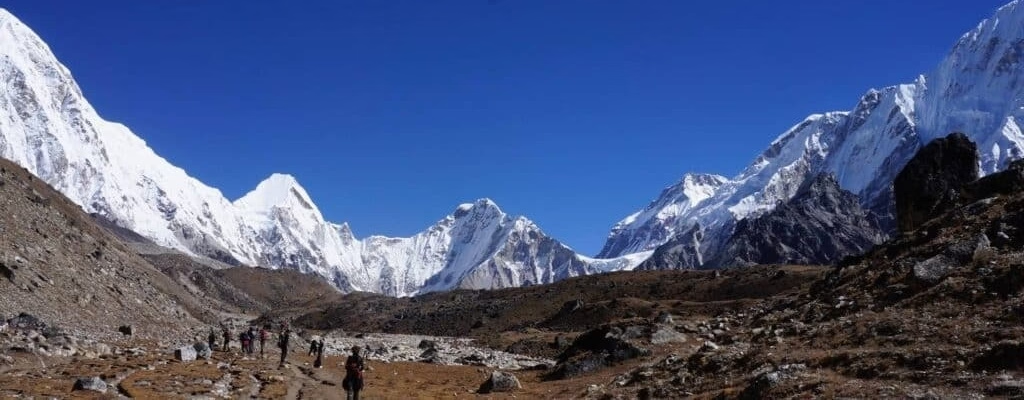
The Everest Base Camp Trek is one of Nepal's most iconic high-altitude trekking adventures, taking hikers through the heart of the Khumbu region to 5,364 m on the Khumbu Glacier, beneath Mount Everest. The 130 km round-trip journey from Lukla passes through traditional Sherpa villages, Buddhist monasteries, alpine landscapes and Sagarmatha National Park, with spectacular views of Everest, Lhotse, Nuptse and Ama Dablam.
Planning an Everest Base Camp Trek involves choosing the right route and itinerary, understanding trekking costs and permit requirements, and preparing for altitude, weather and challenging mountain conditions. This comprehensive guide by Heaven Himalaya covers everything from Lukla flights, accommodation and seasonal trekking conditions to acclimatization, altitude sickness, safety, training and essential packing advice to help you plan a rewarding Himalayan adventure.
Everest Base Camp Trek at a Glance
The Everest Base Camp trek takes 12 to 14 days from Kathmandu, covers about 130 km round trip from Lukla, reaches 5,364 m at Base Camp and 5,545 m at Kala Patthar, and costs US$1,200 to US$2,000 per person on a guided teahouse itinerary.
Fact | Detail |
Duration | 12 to 14 days (our program: 14 days, 11 trekking days) |
Start / trailhead | Kathmandu (1,400 m) / Lukla (2,860 m) |
Destination | Everest Base Camp (5,364 m) |
Highest viewpoint | Kala Patthar (5,545 m) |
Distance | About 130 km round trip from Lukla |
Highest sleeping point | Gorakshep (about 5,164 m) |
Accommodation | Teahouses, twin-share rooms |
Difficulty | Challenging; no technical climbing |
Best seasons | March to May, September to November |
Permits | Two permits, about NPR 6,390 combined |
Guide | Not enforced in Khumbu; strongly advised |
Budget | US$1,200 to US$2,000 guided; our 2026 group rates US$1,199 to US$1,580 |
The altitude profile climbs in steps of 400 to 550 m per night after Namche Bazaar, with two rest days at Namche and Dingboche.
Where Is Everest Base Camp and How Do You Get There?
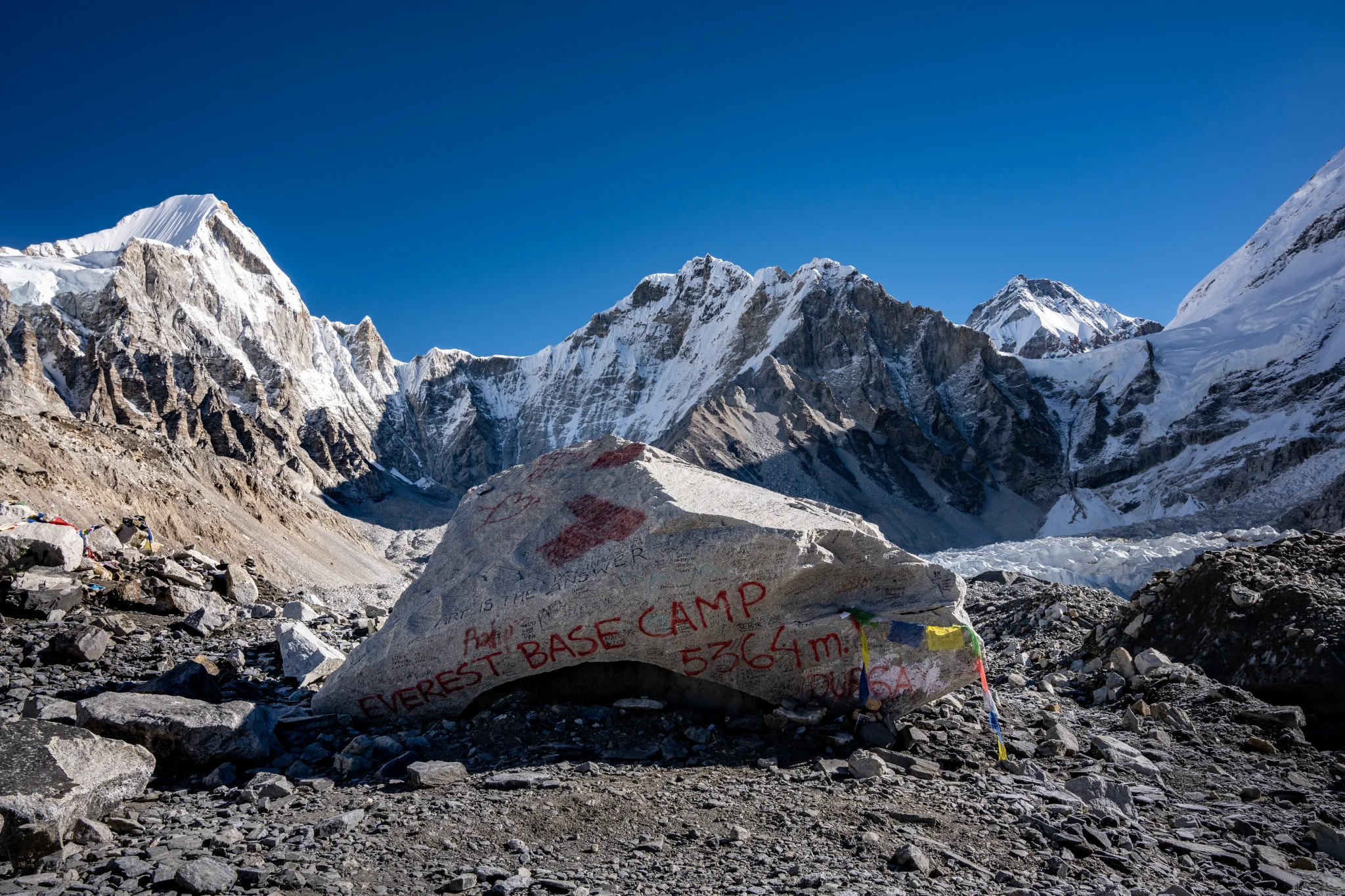
Everest Base Camp lies in Nepal's Solukhumbu District, 5,364 m above sea level on the Khumbu Glacier. Trekkers fly from Kathmandu or Ramechhap to Lukla, then walk about 65 km north over 8 trekking days.
Where Is Everest Base Camp Located?
Base Camp sits inside Sagarmatha National Park on the Khumbu Glacier moraine, below the Khumbu Icefall. The trail passes Phakding, Namche Bazaar, Tengboche, Dingboche, Lobuche and Gorakshep, the last settlement. Base Camp and Kala Patthar are different places. Base Camp is a climbers' tent site with no summit view, because Nuptse blocks Everest. Kala Patthar (5,545 m) is a ridge above Gorakshep and the best trekking viewpoint.
How to Reach Everest Base Camp from Kathmandu
Trekkers fly to Lukla in 20 to 35 minutes, walk 8 days up to Gorakshep and Base Camp, climb Kala Patthar, and descend to Lukla in 3 days. The return flight lands in Kathmandu or Ramechhap, depending on the season.
Kathmandu vs Ramechhap (Manthali) Flights
Ramechhap (Manthali) handles Lukla flights in peak months because Kathmandu's airport cannot absorb the traffic. Passengers drive about 130 km to Manthali, 4 to 5 hours, leaving between 1:00 and 3:00 a.m. Kantipur reported on 4 October 2026 that Manthali-Lukla flights increased from late September, with nine flights on one Saturday, and that authorities are preparing Kathmandu-Ramechhap flights.
Weather rules everything. Lukla's 527 m runway has no instrument approach, so fog grounds flights for hours or days. Morning flights leave first, afternoon flights cancel first, and helicopters often fly when fixed-wing aircraft cannot. We hold one buffer day on every itinerary.
Everest Base Camp Trek Route and Itinerary
The standard route runs Lukla, Phakding, Namche Bazaar, Tengboche, Dingboche, Lobuche, Gorakshep and Base Camp, then returns on the same trail in 14 days, with acclimatization days at Namche Bazaar and Dingboche.
What Is the Standard Everest Base Camp Trek Route?
The trail follows the Dudh Koshi valley, then the Khumbu Glacier valley, in 9 stages:
Lukla to Phakding (2,610 m): 3 to 4 hours
Phakding to Namche Bazaar (3,440 m): 5 to 6 hours, 830 m of climbing
Namche Bazaar to Tengboche (3,860 m): 5 to 6 hours
Tengboche to Dingboche (4,410 m): 5 to 6 hours
Dingboche to Lobuche (4,910 m): 5 hours
Lobuche to Gorakshep (5,164 m): 3 hours
Gorakshep to Everest Base Camp (5,364 m): 3 hours each way
Kala Patthar (5,545 m) sunrise hike: 2 to 3 hours up
Return to Lukla: 3 days via Pheriche and Namche
How Many Days Does the Everest Base Camp Trek Take?
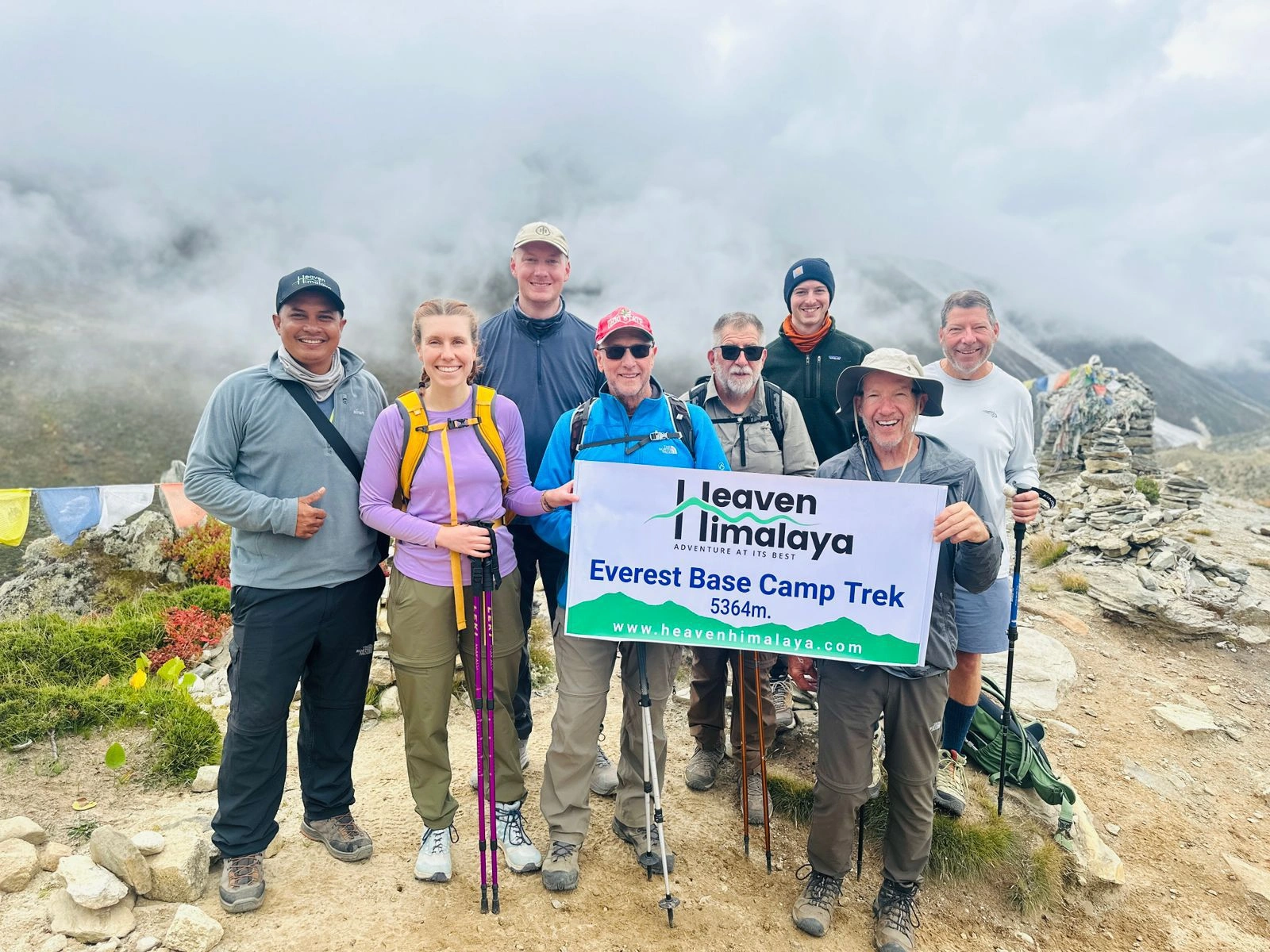
The standard trek takes 14 days including Kathmandu arrival and departure. Short versions of 11 to 12 days compress the rest days, and 15 to 17 day versions add a second rest stop. The Wilderness Medical Society advises sleeping no more than 500 m higher each night above 3,000 m, with a rest day every 3 to 4 days. Short itineraries break that guidance.
14-Day Everest Base Camp Trek Itinerary
The table shows our standard 14-day itinerary. The final plan matches the booked package and includes contingency days.
Day | Route | Main activity |
1 | Kathmandu | Arrival and preparation |
2 | Kathmandu-Lukla-Phakding | Flight and first trek |
3 | Phakding-Namche | Trek to Namche |
4 | Namche | Acclimatization |
5 | Namche-Tengboche | Monastery and mountain views |
6 | Tengboche-Dingboche | Trek into higher elevations |
7 | Dingboche | Acclimatization hike |
8 | Dingboche-Lobuche | Continue towards Everest |
9 | Lobuche-Gorakshep-EBC | Reach Base Camp |
10 | Kala Patthar-Pheriche | Sunrise viewpoint and descent |
11 | Pheriche-Namche | Return trek |
12 | Namche-Lukla | Final trekking day |
13 | Lukla-Kathmandu | Return flight |
14 | Kathmandu | Departure or buffer day |
Day 9 is the longest, at 7 to 8 hours. Day 10 starts at 4:30 a.m.
Everest Base Camp Trek Route Map and Elevation Profile
Sleeping altitudes run Phakding 2,610 m, Namche 3,440 m, Tengboche 3,860 m, Dingboche 4,410 m, Lobuche 4,910 m and Gorakshep 5,164 m. The biggest single climb is Phakding to Namche (830 m). Rest days fall at Namche and Dingboche.
Alternative Everest Base Camp Trek Routes
Classic route: 12 to 14 days, as above.
Gokyo Lakes and EBC: 15 to 18 days, crossing Cho La (5,420 m) to Gokyo Ri (5,357 m).
Three High Passes: 18 to 21 days.
Short EBC itineraries: 9 to 11 days with fewer rest days.
How Much Does the Everest Base Camp Trek Cost?
The trek costs US$900 to US$1,200 on a budget basis, US$1,200 to US$2,000 guided and US$2,500 to US$5,000 at premium lodges. Our 2026 group rates run US$1,199 to US$1,580 per person.
Average Everest Base Camp Trek Cost
Budget (US$900 to US$1,200): basic teahouses, shared guide, minimal extras.
Standard guided (US$1,200 to US$2,000): guide, porter, permits, flights and Kathmandu hotel.
Premium and luxury (US$2,500 to US$5,000): upgraded lodges, private guide; see luxury trek operators.
Group vs private: groups cost less per person; private trips cost more and flex on pace and dates.
Our 14-day program prices by group size: US$1,580 for 1 trekker, US$1,499 for 2 to 4, US$1,399 for 5 to 8, US$1,299 for 9 to 14 and US$1,199 for 14 to 20.
What Determines the Total EBC Trek Cost?
Nine items set the price: Lukla flights (US$450 return), accommodation, meals and water, guide and porter fees, permits (about NPR 6,390), transport including the Ramechhap drive, insurance, personal expenses and tips, and an emergency reserve of US$500.
Additional Expenses to Budget For Everest Base Camp Trek
Cash extras add US$250 to US$450 over 12 days: Wi-Fi and charging (US$2 to US$8), hot showers (US$4 to US$8), snacks and drinks, rented gear, extra Kathmandu nights after delays, and helicopter or transport backups. Prices rise with altitude because porters carry everything.
Is the Everest Base Camp Trek Worth the Cost?
The trek rewards trekkers who want a high-altitude walk, Sherpa culture and local logistics. A flight-only view suits those with less than 14 days.
Everest Base Camp Trek Permits and Entry Requirements
Everest Base Camp requires two permits: the Sagarmatha National Park permit (NPR 3,000 plus 13 percent VAT) and the Khumbu Pasang Lhamu Rural Municipality permit (NPR 3,000). TIMS is not required in Khumbu. Combined cost: about NPR 6,390.
What Permits Do You Need for Everest Base Camp?
The park permit is issued at Monjo gate or the Department of National Parks counter in Bhrikuti Mandap, Kathmandu. The Khumbu permit (Trek Card) is issued at Lukla or Monjo, never in Kathmandu. Bring passport and visa copies and passport photos. Checkpoints at Monjo and Lukla verify permits. Our packages include both; see Everest Base Camp Trek Permits and Associated Costs.
Everest Base Camp Trek Permit Cost
Foreign trekkers: NPR 3,390 (park with VAT) plus NPR 3,000 (Khumbu), roughly US$45 to US$50.
SAARC nationals and Indian trekkers: NPR 1,500 plus VAT (park) and NPR 3,000 (Khumbu).
Pay the Khumbu fee in Nepalese rupees. Fees change by notification, so confirm them with your operator before departure.
Do You Need a Visa to Visit Nepal?
Every nationality except Indian citizens needs a visa. Tribhuvan Airport issues tourist visas on arrival: US$30 for 15 days, US$50 for 30 days and US$125 for 90 days. Passports must be valid for 6 months beyond departure, and US dollars in cash work best. Restricted nationalities apply at an embassy.
Can You Trek to Everest Base Camp Without a Guide in 2026?
Yes, Khumbu authorities permit independent trekking in 2026, and Khumbu checkpoints do not demand a guide. The rule is contested: the Nepal Tourism Board mandated licensed guides nationally in April 2023, and the Khumbu municipality rejected that mandate within its area. On 6 April 2026, Nepal formed a high-level committee on enforcement in the Everest region, with stricter guide and agency licensing among planned reforms.
Independent trekkers lose three things: someone to coordinate a rescue, someone to read altitude symptoms, and someone to rebook a cancelled Lukla flight.
How Difficult Is the Everest Base Camp Trek?
The trek is challenging because of altitude, not terrain. Trekkers walk 5 to 8 hours a day for 11 days on rocky trails and finish at 5,364 m, where the air holds roughly half the oxygen of sea level.
Is Everest Base Camp Trek Suitable for Beginners?
Beginners finish the trek every season when they train 8 to 12 weeks and choose a 14-day itinerary. Sustained walking fitness matters more than trekking experience. Walking days run 5 to 6 hours, Day 9 runs 7 to 8 hours, and Day 10 starts at 4:30 a.m. The steepest stretches are the Namche climb (830 m in one day) and Kala Patthar's final 380 m.
Altitude, Elevation and Physical Challenges
Five factors set the difficulty: sleeping altitude rising from 2,610 m to 5,164 m, thin air, long walking days, nights of -10 °C or lower at Gorakshep, and uneven stone steps and moraine.
How Fit Do You Need to Be?
Four qualities count: cardiovascular fitness for 5 hours of walking, leg strength for 800 m climbs, endurance for 11 consecutive days and hiking experience with a pack. A reliable benchmark is a 6-hour hike with 800 m of climbing and an 8 kg pack, finished without exhaustion.
Can Beginners Trek to Everest Base Camp?
Yes, with a training plan, an itinerary with 2 acclimatization days and a guide who tracks symptoms.
Is Everest Base Camp Harder Than Other Popular Treks?
EBC is harder than Annapurna Base Camp (4,130 m) and Langtang because it climbs 1,200 m higher and lasts 4 to 5 days longer. It is easier than Island Peak or the Three High Passes, which add glacier travel and 5,400 m passes. Section 17 compares them.
Everest Base Camp Trek Training and Physical Preparation
Training takes 12 weeks and combines hiking, cardio, leg strength and endurance. Build to 3 to 4 sessions a week, with weekend hikes of 5 to 6 hours carrying 8 kg.
How to Prepare for the Everest Base Camp Trek
Hiking: weekly hills or stairs in your trek boots
Cardio: 30 to 60 minutes of cycling, running or swimming, 2 to 3 times a week
Strength: squats, lunges, step-ups and calf raises, twice a week
Endurance: back-to-back long days on weekends
12-Week Everest Base Camp Training Plan
Weeks 1 to 4 (foundation): 3 sessions weekly, 30 to 45 minutes of cardio, one 2-hour hike.
Weeks 5 to 8 (endurance and strength): 4 sessions weekly, a 3 to 4 hour hike with 500 m of climbing.
Weeks 9 to 12 (specificity): 5 to 6 hour hikes with 800 m of climbing, an 8 kg pack and a second day back-to-back. Taper in the final 7 days.
Mental Preparation for High-Altitude Trekking
Manage fatigue by eating every 2 to 3 hours. Hold a steady pace: the Sherpa phrase "bistari, bistari" (slowly, slowly) means breathe through the nose and never race. Carry a shell for weather swings. Stay motivated by splitting each day into three hour-long segments.
Best Time to Trek to Everest Base Camp
The best times are spring (March to May) and autumn (September to November), when weather, visibility and Lukla flights are most reliable. October is the peak month and April the peak for flowers.
Weather, visibility, temperature, trail conditions and flight reliability change across the year. See this: Best Time to Visit Everest Base Camp.
Spring Season (March-May)
Daytime highs reach 10 to 20 °C at Namche, with night lows near -10 °C at Gorakshep. Rhododendrons bloom below 3,800 m in April. Mornings are clear, afternoons cloud over, and expedition tents fill Base Camp in April and May.
Autumn Season (September-November)
Post-monsoon air is the clearest of the year. October brings the heaviest trail traffic and full lodges. Mani Rimdu, a Sherpa masked-dance festival, will take place at Thame Monastery on November 5, 6, and 7 in 2026.
Summer and Monsoon (June-August)
Daily rain, cloud and leeches below Namche define the monsoon. Trails turn to mud, flights cancel often and views are rare, but the valleys are green and quiet.
Winter (December-February)
Gorakshep nights fall to -20 °C or lower and snow covers high trails. Trails are quiet, many days are clear, and some lodges above Dingboche close. Pack a -20 °C sleeping bag and book flexible flights.
Month-by-Month Everest Base Camp Trek Guide
The table summarizes conditions by month.
Month | Main conditions |
January | Coldest period and quieter trails |
February | Late winter and changing snow conditions |
March | Start of spring trekking |
April | Rhododendrons and climbing season |
Warmer conditions and summit activity | |
June | Pre-monsoon transition |
July | Peak monsoon conditions |
August | Late monsoon and changing visibility |
September | Post-monsoon transition |
October | Peak autumn trekking season |
November | Clear skies and colder nights |
December | Winter conditions and quieter trails |
Each season and month has a dedicated guide on our site.
Altitude Sickness and Acclimatization on Everest Base Camp Trek
Altitude sickness is illness from rapid ascent above 2,500 m. It includes Acute Mountain Sickness (AMS), high-altitude pulmonary edema (HAPE) and high-altitude cerebral edema (HACE). Slow ascent, rest days and early descent prevent serious cases.
What Is Altitude Sickness?
AMS is the mild form: headache plus nausea, fatigue or dizziness. HAPE is fluid in the lungs, marked by breathlessness at rest, a wet cough and blue lips. HACE is fluid around the brain, marked by confusion, poor balance and slurred speech. HAPE and HACE demand immediate descent.
Common Symptoms of Altitude Sickness
Six symptoms recur: headache, nausea, dizziness, loss of appetite, fatigue and disturbed sleep. A headache plus one other symptom after arriving at a new altitude means AMS. Report it to your guide at once, because early AMS reverses and ignored AMS escalates.
How Does Acclimatization Work?
The body adapts to thin air through faster breathing and more red blood cells, taking 24 to 48 hours per altitude band. Four habits help: ascend gradually, take rest days, drink 3 to 4 litres of fluid a day and report warning signs. "Climb high, sleep low" means hiking above bed height on rest days.
Acclimatization Stops on the EBC Route
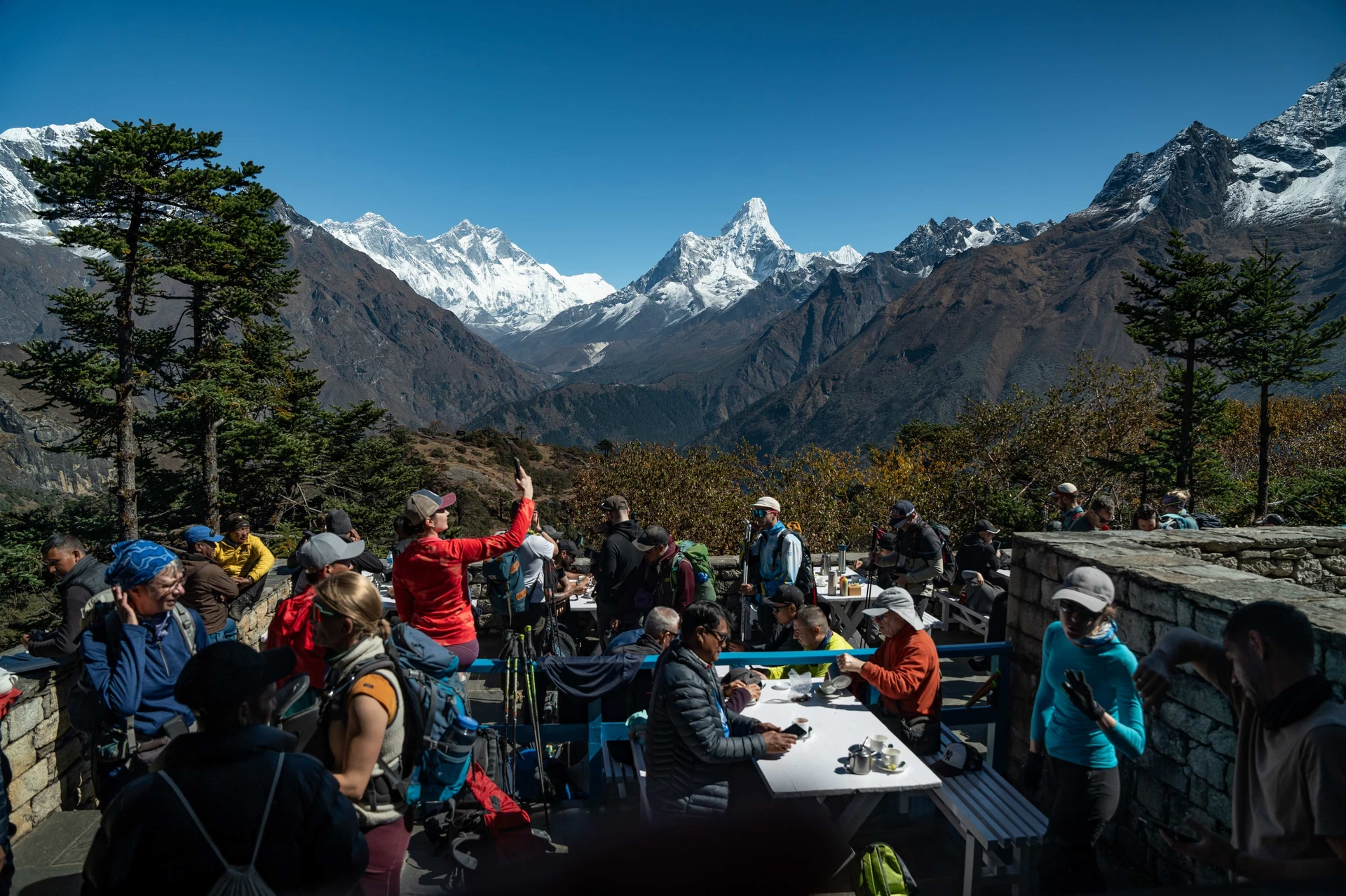
Namche Bazaar (3,440 m) offers a hike to Everest View Hotel (3,880 m). Dingboche (4,410 m) offers Nangkartshang Hill (about 5,100 m). Himalayan Rescue Association volunteers give daily altitude talks at Pheriche (4,371 m) in trekking season.
Using a Pulse Oximeter at High Altitude
A pulse oximeter reports SpO2, the percentage of hemoglobin carrying oxygen. Warm your hand, rest 5 minutes, hold still and read the stable number. Typical resting readings run 90 to 95 percent at Namche, 83 to 90 at Dingboche and 78 to 85 at Gorakshep. Cold fingers, nail polish and movement distort readings. An SpO2 of 82 with no symptoms differs from 82 with a pounding headache, so guides act on symptoms and trends first.
Do You Need Diamox for Everest Base Camp?
Diamox (acetazolamide) is a prescription drug that speeds acclimatization by raising breathing rate. The Wilderness Medical Society lists 125 mg twice daily as the preventive dose for higher-risk trekkers. Discuss it with a doctor before departure. It supports slow ascent and never replaces it.
Is Everest Base Camp Trek Safe? Risks and Emergency Situations
The trek is safe for prepared trekkers with a slow itinerary, a guide and adequate insurance. The main risks are altitude illness, weather, slippery trails, exhaustion and flight disruption. Helicopter evacuation is available along the route.
Is Everest Base Camp Trek Dangerous?
Five hazards define the risk: altitude illness, sudden weather, icy or rocky trails, exhaustion and Lukla flight disruption. Autumn 2026 showed the weather factor: heavy snow covered the route until the weather improved on Sunday, 1 November. Most incidents trace back to ascending too fast, ignoring symptoms or hiking alone.
Travel Insurance and Helicopter Evacuation
Insurance must cover trekking to 6,000 m and emergency helicopter evacuation, because Kala Patthar sits at 5,545 m. Check the altitude limit, evacuation cover without a hospital-admission condition, pre-existing condition exclusions and the 24-hour assistance number. Carry the policy number and a printed copy.
Helicopter Rescue: How Does It Work?
A guide reports symptoms, your insurer or assistance company approves the evacuation, and a helicopter flies from Lukla or Kathmandu to the nearest landing point. Evacuation applies when a trekker cannot walk, shows HAPE or HACE signs or suffers a serious injury. On 3 November 2026, two helicopters collided while landing at Pheriche (4,200 m), killing one person and injuring two.
Fraud has also affected rescues. On 24 March 2026, a charge sheet named 32 people in an alleged fake-rescue network, with insurance claims totaling approximately US$19.3 million. On 6 April 2026, the tourism ministry formed a committee for zero-tolerance enforcement, joint monitoring and a rescue management system.
Protect yourself in four ways: call your insurer's emergency line yourself, confirm medical need with a doctor, keep copies of every form you sign and refuse an evacuation your symptoms do not justify.
Common Health Problems on the EBC Trail
Khumbu cough: dry cough from cold air; wear a buff and suck lozenges.
Colds: shared lodges spread germs; wash hands.
Stomach bugs: avoid meat above Namche; use sanitizer.
Dehydration: drink 3 to 4 litres daily.
Seek care for a cough with blood, a fever lasting 48 hours or diarrhea lasting over 2 days.
What Happens If You Get Sick During the EBC Trek?
The guide assesses symptoms, the group rests, and descent begins when symptoms worsen. Dropping 300 to 500 m often resolves AMS. Clinics operate at Namche and Pheriche, and helicopters evacuate serious cases.
What Happens If Your Lukla Flight Is Cancelled?
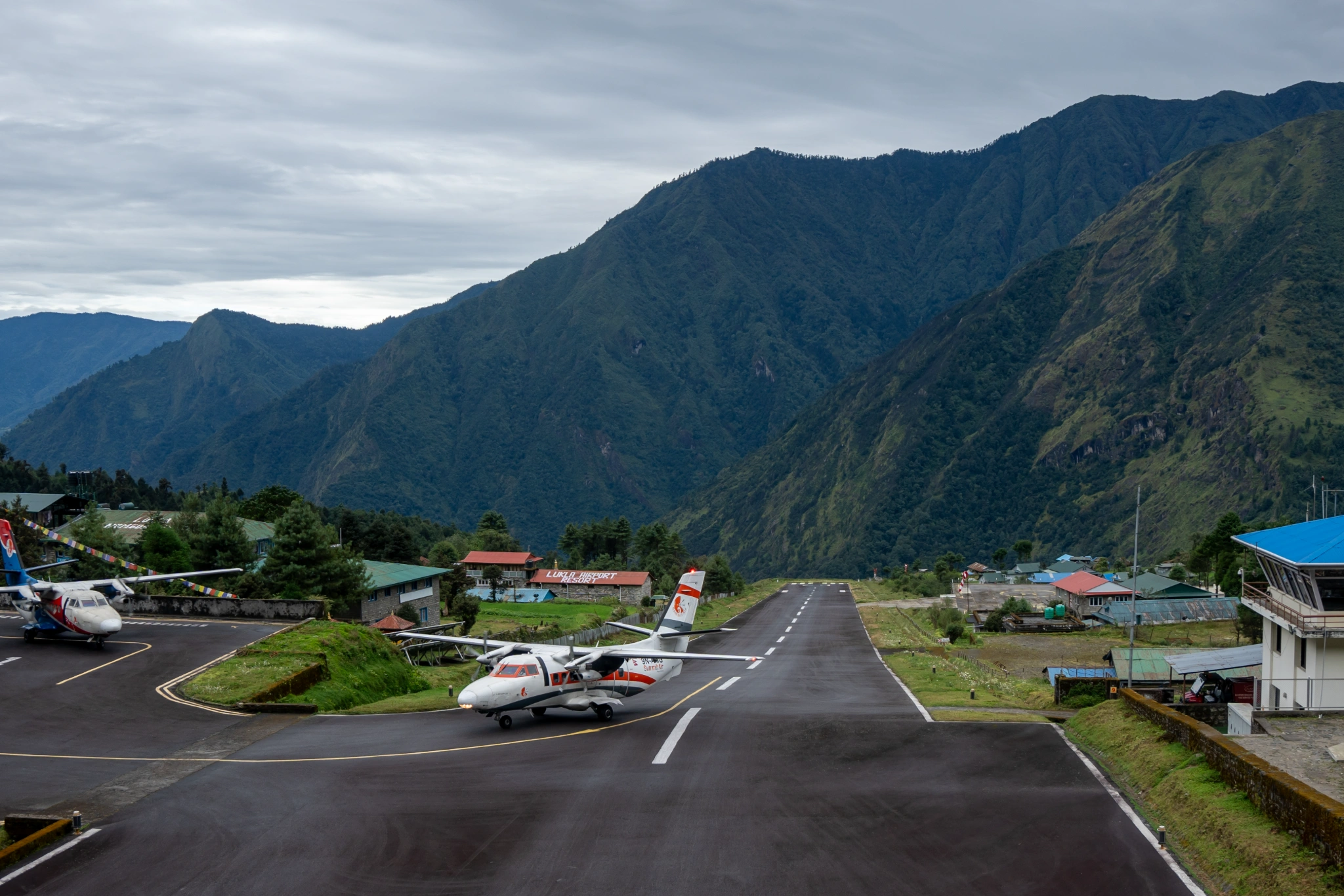
Cloud and fog cancel flights for hours or days. The operator rebooks, charters a helicopter or adds nights in Lukla or Kathmandu. Protect your international connection by keeping 2 extra days after the trek.
Guides, Porters and Choosing an EBC Trekking Company
A guide leads navigation, monitors altitude symptoms and coordinates logistics. A porter carries your duffel. Neither is legally required in Khumbu, yet guided groups handle emergencies, weather and flight changes faster.
Do You Need a Guide and Porter for Everest Base Camp?
A guide handles route-finding, acclimatization decisions, lodge bookings and emergency coordination. A porter carries the duffel so you walk with a 5 to 8 kg daypack. Independent trekking is permitted in 2026, but you carry the full load and make every altitude decision alone.
What Does an EBC Guide and Porter Carry?
Our program assigns one porter per two trekkers, carrying 20 to 25 kg total (10 to 12 kg per trekker). The guide carries a first-aid kit and pulse oximeter. Responsible operators cap loads, supply warm clothing and cover insurance.
How to Choose the Best Everest Base Camp Trekking Company
Check seven points: government registration, Khumbu experience, licensed guides with altitude training, a documented evacuation plan, a written inclusion list, independent reviews, and group size and flexibility. Price alone is a poor filter.
How Much Should You Tip Your Guide and Porter?
A common benchmark is US$10 to US$15 per day for a guide and US$5 to US$8 per day for a porter, pooled across the group and given on the last evening. Tips scale with trek length, service quality and group size.
What to Pack for Everest Base Camp Trek
Pack for temperatures from about 20 °C in Lukla to -20 °C at Gorakshep across seven categories: clothing, footwear, sleeping gear, accessories, hygiene, first aid and electronics. Keep the duffel at 10 to 12 kg.
Essential Everest Base Camp Trek Packing List
Clothing: base layers, fleece, down jacket (rated to -15 °C), waterproof shell, trekking trousers, gloves, warm hat
Footwear: broken-in waterproof boots, camp shoes, 4 pairs of merino socks
Sleeping: a -15 °C sleeping bag and liner
Accessories: poles, 30 to 35 L daypack, headlamp, category 4 sunglasses, sunscreen
Hygiene: wet wipes, toilet paper, sanitizer, SPF lip balm
First aid: blister plasters, rehydration salts, painkillers, personal medicines
Electronics: power bank, cables, waterproof phone case
What Should You Bring, Rent or Buy in Kathmandu?
Bring boots, socks, base layers and medicines from home. Rent a sleeping bag, down jacket and poles in Thamel. Buy purification tablets, snacks and a buff locally. Invest first in boots and a sleeping bag.
Special Packing Considerations for Female Trekkers
Add a supportive sports bra, sanitary products with waste bags (the trail has no disposal), a urination funnel and biodegradable toiletries. Layer with moisture-wicking tops.
Everest Base Camp Pre-Departure Checklist
Confirm six items two weeks out: passport (valid 6 months) and visa funds, permits and printed documents, insurance, cash in dollars and rupees, equipment, and flight and hotel confirmations.
Accommodation, Food and Facilities on the EBC Trail
Trekkers sleep in teahouses: twin-share rooms with mattress and blankets, heated dining rooms and shared toilets. Facilities thin out above Namche, and Wi-Fi, charging and hot showers cost extra in cash.
What Are Teahouses Like on Everest Base Camp Trek?
Rooms hold two wooden beds and thin mattresses, and are unheated, so a sleeping bag is essential. Private rooms with attached bathrooms exist at lower villages, and shared facilities dominate above Dingboche. Lodges fill in October and April, so operators pre-book.
Food and Drinking Water on the EBC Trail
Menus offer dal bhat (rice and lentils with refills), noodles, momos, eggs and pasta. Vegetarian food is safer and cheaper at altitude. Drink boiled, filtered or treated water. Khumbu Pasang Lhamu Rural Municipality restricts small single-use plastic bottles, so carry a reusable bottle.
Wi-Fi, SIM Cards and Mobile Network Coverage
Nepal Telecom and Ncell SIMs work in Lukla and Namche, and coverage drops above Dingboche. Lodges sell Wi-Fi cards for US$3 to US$10, and charging costs US$2 to US$5.
Toilets, Hot Showers and Laundry Facilities
Lower villages have flush toilets, and higher lodges use squat toilets in sheds. Hot showers cost US$4 to US$8 and become rare above Dingboche. Laundry is available in Namche and Lukla; wet wipes work above 4,000 m.
How Much Cash Should You Carry?
ATMs operate in Lukla and Namche and fail without warning, and few lodges take cards. Daily spend runs US$20 to US$35 on a package with meals. Carry NPR 35,000 to NPR 60,000 (US$250 to US$450) plus US$300 in reserve.
Important Villages and Attractions Along the Everest Base Camp Route
Seven stops define the route: Namche Bazaar, Everest View Hotel, Tengboche, Dingboche, Lobuche, Gorakshep and Base Camp, with Kala Patthar as the final viewpoint.
Namche Bazaar - The Gateway to Everest
Namche Bazaar (3,440 m) is the Sherpa capital, built in a horseshoe bowl, with bakeries, gear shops, a Saturday market, ATMs and a health post. Trekkers spend 2 nights here.
Everest View Hotel - A Popular Acclimatization Hike
Everest View Hotel (3,880 m) sits 440 m above Namche, 1.5 to 2 hours uphill. Its terrace frames Everest, Lhotse, Nuptse and Ama Dablam, and the hike follows the "climb high, sleep low" rule.
Tengboche Monastery - Spiritual Centre of the Khumbu
Tengboche (3,860 m) is the Khumbu's largest monastery, founded in 1916 and rebuilt after the 1934 earthquake and a 1989 fire. Ama Dablam rises behind it, and sunrise photographs work best from the meadow below.
Dingboche and Nangkartshang (Nagarjun) Hill
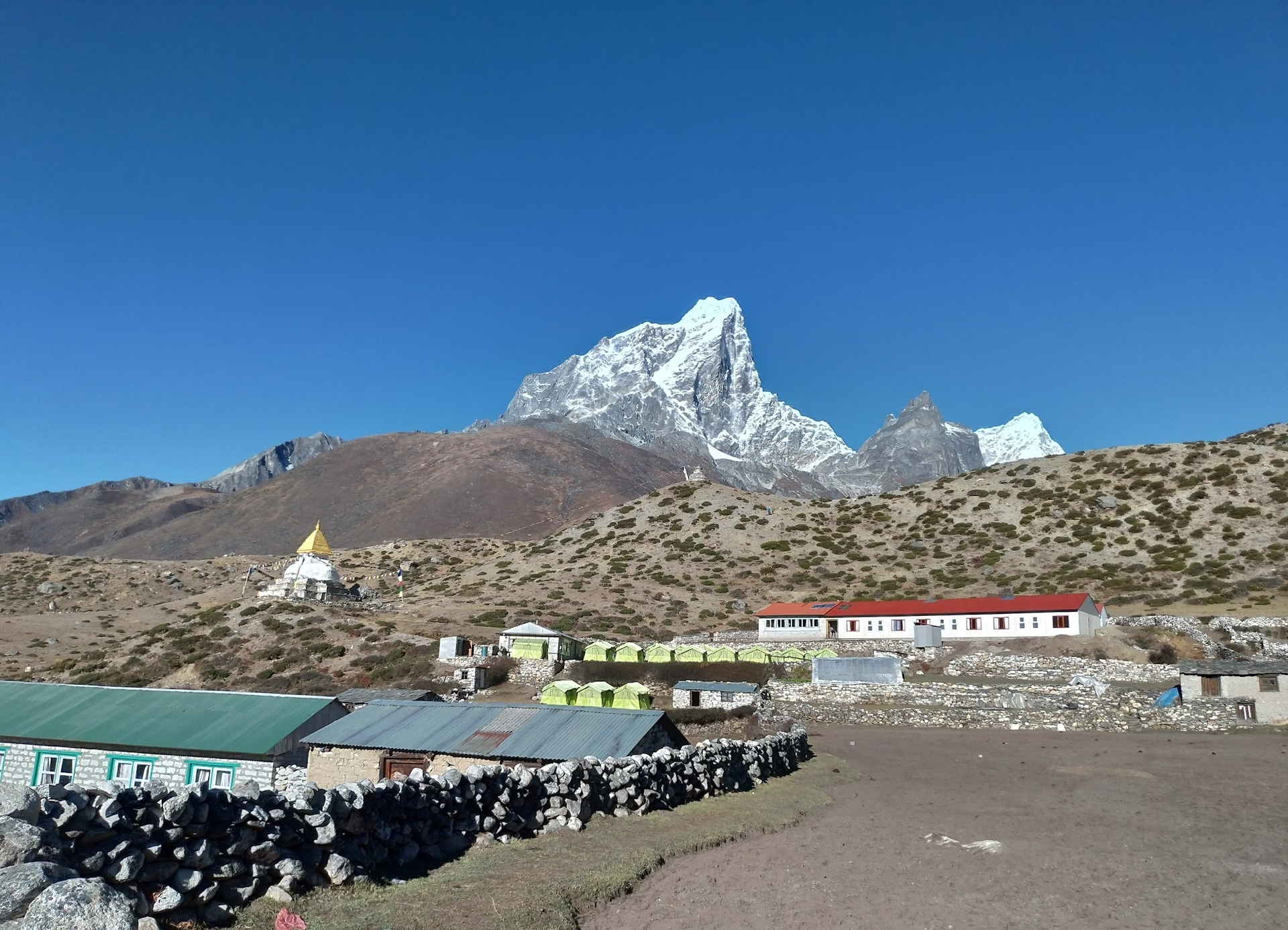
Dingboche (4,410 m) is a stone-walled farming village and the second rest-day stop. Nangkartshang Hill (about 5,100 m) rises about 700 m behind it, 4 to 5 hours round trip, with views of Makalu, Lhotse and Ama Dablam. Turn back at the first headache.
Lobuche and Gorakshep - The Last Settlements Before Base Camp
Lobuche (4,910 m) and Gorakshep (5,164 m) hold the highest lodges: basic rooms, cold nights and weak appetite. Gorakshep gives access to Base Camp and Kala Patthar.
Everest Base Camp - Reaching the Destination
Base Camp (5,364 m) is a rocky camp beside the Khumbu Glacier with icefall views. Hundreds of expedition tents fill it in spring, and prayer flags mark it empty in autumn. Nuptse hides Everest's summit, so Base Camp is not the best viewpoint of Mount Everest. Most trekkers stay 30 to 45 minutes.
Kala Patthar - The Best Viewpoint of Mount Everest
Kala Patthar (5,545 m) is a black ridge above Gorakshep with a full panorama of Everest, Lhotse, Nuptse and Pumori. The sunrise hike starts near 4:30 a.m., takes 2 to 3 hours, and meets temperatures near -15 °C. Photographs peak 30 minutes after sunrise.
Sherpa Culture, Monasteries and Photography on the EBC Trail
Sherpa culture shapes the trail through Buddhist customs, festivals and hospitality. Monasteries at Tengboche and Pangboche anchor Khumbu spiritual life, and seven viewpoints yield the best photographs.
Understanding Sherpa Culture in the Everest Region
Sherpas are a Tibetan-origin people who settled the Khumbu around 500 years ago. They practice Tibetan Buddhism, farm potatoes and barley and herd yaks. Walk clockwise around mani stones and chortens, keeping them on your right. Festivals include Mani Rimdu and Losar. Ask before photographing people and spend money in local lodges.
Important Monasteries Along the Everest Base Camp Route
Tengboche is the largest. Pangboche, below Ama Dablam, is among the oldest, with 17th-century origins. Smaller gompas stand at Namche, Khumjung and Thame. Remove hats and shoes before entering.
Best Photography Spots on the Everest Base Camp Trek
Seven spots lead: Namche from the Syangboche ridge, Tengboche at sunrise, Ama Dablam from the Pangboche trail, Dingboche's stone-walled fields, Lobuche's moraine ridge, Base Camp's icefall and Kala Patthar at sunrise. Cold drains batteries in minutes, so keep spares inside your jacket.
Who Can Trek to Everest Base Camp?
Healthy adults, solo travelers, seniors and carefully supervised children have reached Base Camp, with different preparation for each. Fitness, acclimatization time and medical clearance matter more than age.
Can Beginners Trek to Everest Base Camp?
Beginners reach Base Camp with 12 weeks of training, extra rest days and a guide. A 14 or 15 day itinerary beats a short one. See Sections 6 and 7.
Solo and Solo Female Everest Base Camp Trek
Solo trekkers choose between independent trekking, hiring a guide or joining a group departure. Solo women use the same busy, social lodges as everyone else. A guide or group solves flight rebooking, altitude monitoring and emergencies.
Everest Base Camp Trek for Seniors (60+)
Seniors succeed with a medical check-up covering heart, blood pressure and lungs, 12 weeks of training, a slower pace and 1 to 2 extra acclimatization days.
Everest Base Camp Trek with Kids
Children trek when they are fit, mature enough to report symptoms and supervised constantly. Adults watch for irritability, poor appetite and unusual sleepiness, because children describe altitude illness poorly. Choose a 15-day plan and consult a pediatrician.
Everest Base Camp Trek for Indian Trekkers
Indian citizens need no visa and enter with a valid passport or voter ID card. They pay the SAARC rate (NPR 1,500 plus VAT for the park, NPR 3,000 for Khumbu). Nepal restricts large-denomination rupee notes, so carry Nepalese rupees. Our 2026 group rates convert to roughly ₹1.1 to ₹1.4 lakh at an exchange rate near ₹88 to ₹90 per US dollar.
Everest Base Camp Trek Comparisons: Which Trek Should You Choose?
Choose Everest Base Camp for a long, culturally rich walk to 5,364 m. Choose Kilimanjaro for a short summit push, Annapurna Base Camp for lower altitude, a helicopter tour for a half-day view and the Three High Passes for the hardest Khumbu route.
Everest Base Camp vs Kilimanjaro
Kilimanjaro (5,895 m) takes 5 to 9 days with a summit push of 10 to 15 hours. EBC ends at 5,364 m (5,545 m at Kala Patthar) over 12 to 14 days. Kilimanjaro ascends faster and carries higher altitude illness rates, while EBC has a slower profile and deeper culture.
Nepal Everest Base Camp vs Tibet (North) Everest Base Camp
Tibet's North Base Camp (5,150 m) is reachable by vehicle. It requires a Chinese visa, a Tibet travel permit and a pre-booked tour, and it gives a direct north-face view. Nepal's route is a trek through Sherpa villages.
Everest Base Camp vs Annapurna Base Camp
Annapurna Base Camp (4,130 m) takes 7 to 11 days through rhododendron forest, at lower altitude and cost. EBC climbs 1,200 m higher over 12 to 14 days. Choose ABC for a first Himalayan trek.
Everest Base Camp Trek vs Everest Base Camp Helicopter Tour
A helicopter tour takes 3 to 4 hours, costs roughly US$1,000 to US$1,500 per seat and lands near Kala Patthar or Gorakshep when weather permits. It skips acclimatization and demands little fitness, while the trek takes 14 days and delivers the experience.
14-Day EBC Trek vs 11-Day Short EBC Trek
The 14-day trek holds 2 rest days and 5 to 6 hour walking days. The 11-day trek drops a rest day and lengthens daily distances, and a single flight delay consumes its buffer.
Everest Base Camp vs Three High Passes Trek
The Three High Passes trek lasts 18 to 21 days and crosses Kongma La (5,535 m), Cho La (5,420 m) and Renjo La (5,360 m). It is remote and physical, and suits trekkers with prior 5,000 m experience. See the Everest Three High Passes Trek.
Common Mistakes and Practical Tips for Everest Base Camp Trek
The 12 most common mistakes are a short itinerary, skipped acclimatization, fast walking, low hydration, heavy packing, underestimated cold, thin insurance, low cash, ignored symptoms, no training, no flight buffer and price-only operator choice.
12 Common Mistakes Everest Base Camp Trekkers Make
Choosing an overly short itinerary, ignoring acclimatization, walking too fast, drinking under 3 litres daily, carrying unnecessary weight, underestimating cold, holding insurance with a 4,500 m limit, carrying too little cash, ignoring symptoms, skipping training, booking no flight contingency and choosing a company on price alone.
Practical Tips for a Successful EBC Trek
Walk at a pace that allows conversation
Follow your guide's advice on rests and descents
Keep snacks, a shell and water in your daypack
Clean hands before every meal
Pack for weather that changes within an hour
Hold 1 to 2 buffer days at the end
Everest Base Camp Trek Experiences, Reports and Real Stories
Heaven Himalaya records trek reports, guide interviews and traveler stories from groups we lead to Base Camp. This section summarizes each source, and each dedicated article holds the detail.
Everest Base Camp Trek Report 2026
Our trek report records group completion, trek duration, acclimatization observations and the SpO2 readings guides take along the route.
Interview with an Experienced Everest Base Camp Trek Guide
One of our guides, with 100+ trips on the route, covers common trekker challenges, safety advice, local knowledge and memorable moments.
Real Trekking Experiences and Customer Stories
Our travelers rate us 5.0 across 160 reviews, and Tripadvisor listed us as a Travellers' Choice from 2021 to 2025. One story follows a solo female trekker who reached Base Camp on her birthday.
Case Study: Bad Weather at Lukla and Helicopter Backup
The case study covers a weather-grounded Lukla departure and the helicopter backup that kept a group's international flights on schedule: what happened, how the team responded and what future trekkers learn.
Latest Everest Base Camp Trek News and Trail Updates
Three autumn 2026 events matter:
Snow: heavy snow covered the route until conditions improved on 1 November.
Dingboche fire: a fire broke out at Hotel Good Luck in Dingboche at about 11 a.m. on 30 October; police reported a possible cooking gas cylinder explosion as the preliminary cause.
Pheriche collision: two helicopters collided while landing at Pheriche on 3 November, killing one Indian tourist and injuring two.
Frequently Asked Questions About Everest Base Camp Trek
How many days does it take to trek to Everest Base Camp?
The standard trek takes 14 days including arrival and departure, with 11 to 12 trekking days. Short versions take 11 days and extended versions 15 to 17.
How much does Everest Base Camp trek cost?
Guided treks cost US$1,200 to US$2,000 per person; our 2026 group rates run US$1,199 to US$1,580. See How Much Does Everest Base Camp Trek Cost?
What is the highest altitude reached during the EBC trek?
Kala Patthar at 5,545 m. Base Camp sits at 5,364 m and the highest sleeping point is Gorakshep at about 5,164 m.
How difficult is Everest Base Camp trek?
Challenging, mainly because of altitude. The terrain demands no technical skills.
Can beginners complete Everest Base Camp trek?
Yes, with 12 weeks of training, a 14-day itinerary and a guide.
What is the best month to trek to Everest Base Camp?
October, followed by April, May and November.
Do you need a guide for Everest Base Camp?
No rule enforces one in Khumbu in 2026. A guide improves safety, altitude monitoring and flight logistics.
What permits are required for Everest Base Camp?
The Sagarmatha National Park permit and the Khumbu Pasang Lhamu permit, about NPR 6,390 combined.
Is altitude sickness common on Everest Base Camp?
Yes, mild AMS symptoms are common above 3,500 m. Slow ascent and early reporting prevent severe cases.
Can you see Mount Everest from Everest Base Camp?
No. Nuptse hides the summit; Kala Patthar gives the best view.
Is Everest Base Camp trek safe for solo female trekkers?
Yes, with a guide or group, valid insurance and a slow itinerary.
Can you trek to Everest Base Camp in winter?
Yes. Expect -20 °C at Gorakshep, quiet trails and some closed lodges above Dingboche.
Is there mobile network coverage on the EBC trail?
Nepal Telecom and Ncell work in Lukla and Namche; coverage drops above Dingboche. Lodge Wi-Fi costs US$3 to US$10.
Are ATMs available along the Everest Base Camp route?
In Lukla and Namche, and they fail without warning. Carry cash from Kathmandu.
Can you take a shower during the EBC trek?
Yes, in most lodges up to Dingboche, for US$4 to US$8.
What happens if your Lukla flight gets cancelled?
Your operator rebooks, adds a night or charters a helicopter.
How much should you tip your guide and porter?
A common benchmark is US$10 to US$15 a day for guides and US$5 to US$8 for porters.
Do you need Diamox for Everest Base Camp?
No rule requires it. Many trekkers carry it after medical advice, and it never replaces slow acclimatization.
Can you reach Everest Base Camp without trekking?
Yes, by helicopter tour with a short landing near Kala Patthar, or by road to Tibet's North Base Camp.
What happens if you get sick during the EBC trek?
Your guide assesses symptoms, the group rests or descends, and a helicopter evacuates serious cases.
Plan Your Everest Base Camp Trek with Heaven Himalaya
Heaven Himalaya is a Kathmandu-based, government-registered operator with 13+ years of experience and more than 1,000 trekkers guided to Everest Base Camp. Local licensed English-speaking guides lead every group, with an assistant guide for groups of 6 or more.
Our 14-day program includes the Kathmandu-Lukla flight, both permits, teahouse accommodation, meals on trek days, one porter per two trekkers, an oximeter and a first-aid kit, with acclimatization days at Namche Bazaar and Dingboche. Group departures hold up to 20 people, and private departures follow your dates. We build in flight buffers and acclimatization planning, and we advise insurance covering helicopter evacuation to 6,000 m.
Explore the Everest Base Camp Trek Package
Questions before booking? Write to info@heavenhimalaya.com or message +977 985 1273867 on WhatsApp or Viber. Our office is at Gitanjali Chowk, Dathu Sadak, Kathmandu.