

How to Choose the Best Company for a Mount Everest Helicopter Tour?

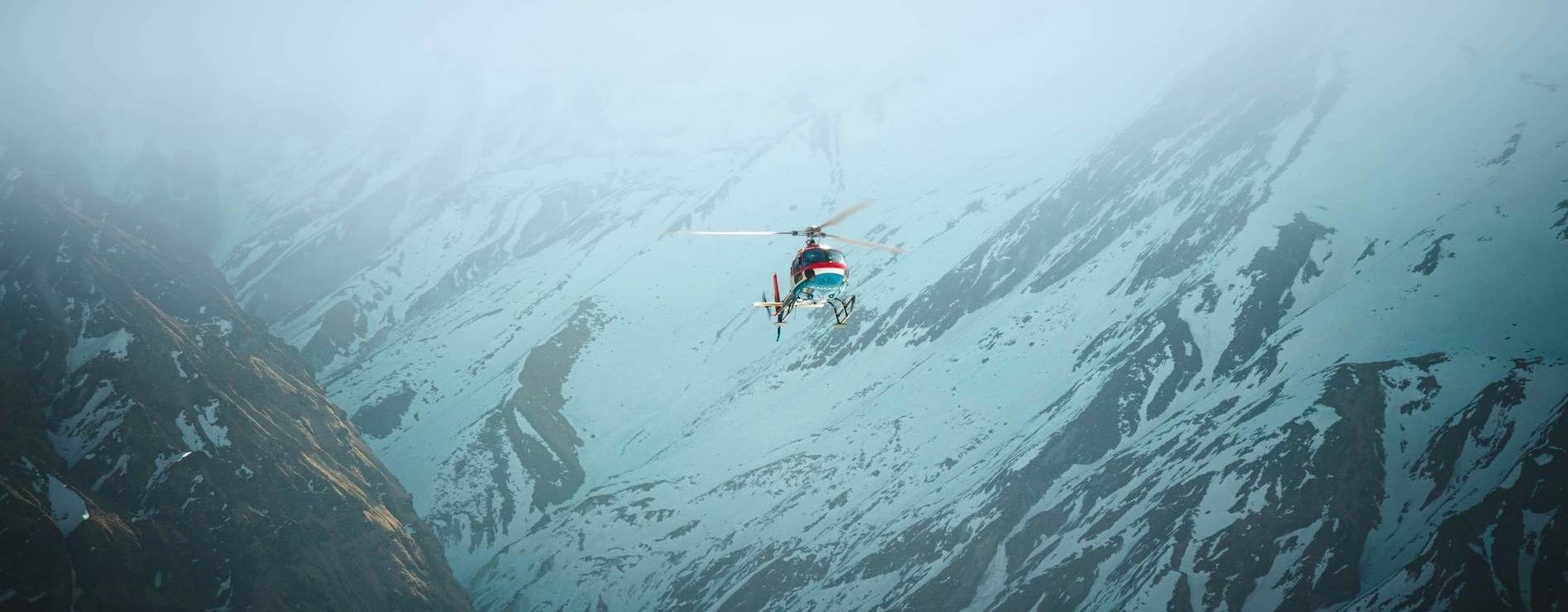
Choosing the best Mount Everest helicopter tour company requires evaluating aviation safety, operator experience, package inclusions, and booking transparency before making a reservation. A reliable Everest helicopter tour operator works with a properly licensed Nepali air operator, employs qualified high-altitude pilots, maintains compliant aircraft, and provides clear information about flight routes, landing permissions, and weather restrictions.
Travellers should verify the operator’s Civil Aviation Authority of Nepal (CAAN) credentials, understand the differences between a shared helicopter tour and a private Everest helicopter charter, and confirm whether the itinerary includes Kala Patthar, an Everest Base Camp flyover, and breakfast at Hotel Everest View in Syangboche.
The cost of a Mount Everest helicopter tour depends on passenger numbers, landing options, flight arrangements, season, and package inclusions. Comparing itemized quotes helps travellers identify the actual cost of Kathmandu transfers, permits, taxes, meals, and potential additional charges rather than choosing a company based on advertised prices alone. Equally important are written weather cancellation and refund policies, secure payment procedures, and travel insurance covering emergency helicopter evacuation at altitudes of at least 6,000 metres.
This guide explains how to assess Everest helicopter tour companies, compare prices and itineraries, evaluate safety standards, and verify essential booking conditions to choose an operator that prioritizes passenger safety, transparent service, and a realistic Himalayan sightseeing experience.
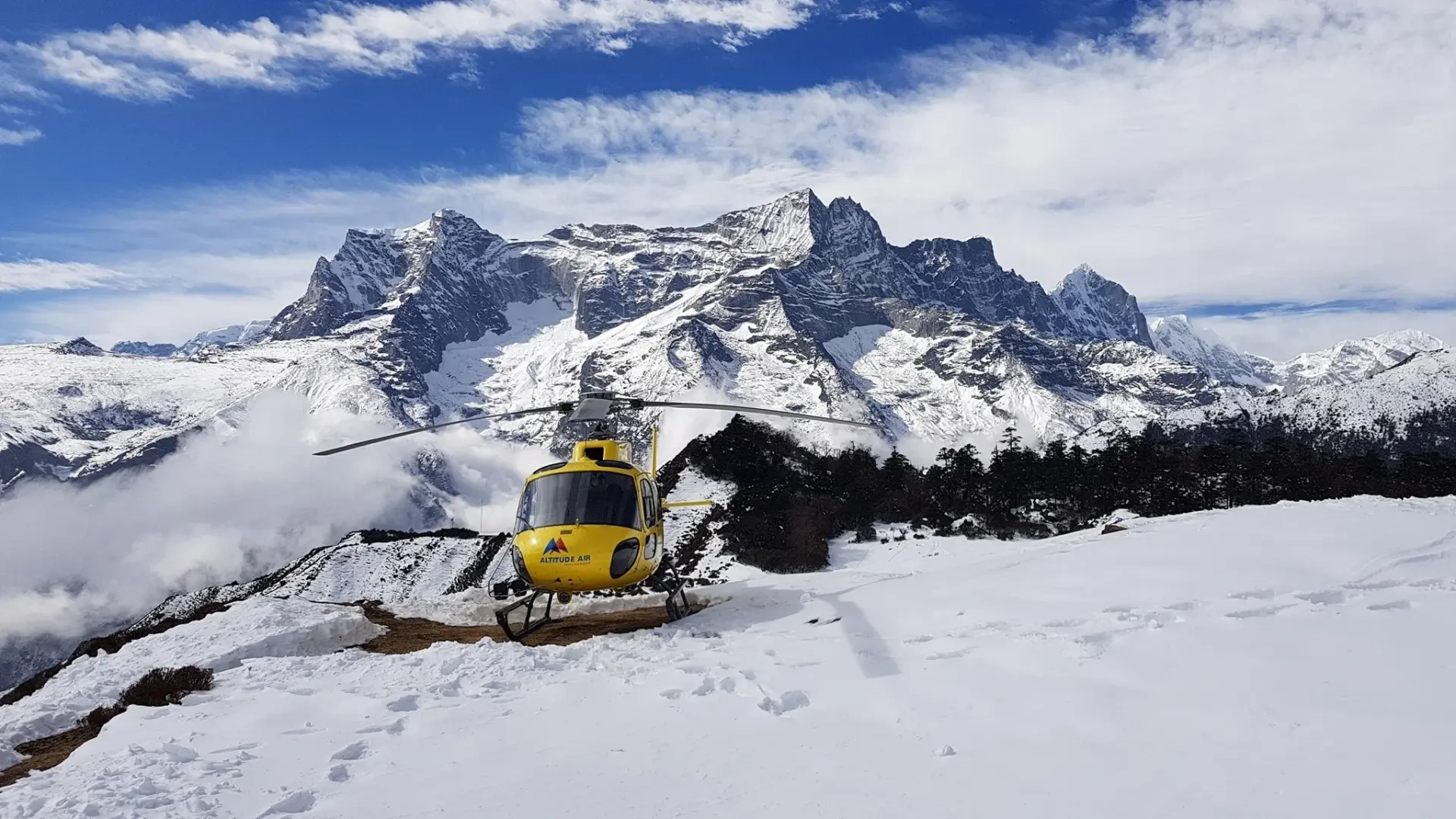
What Should You Look for in a Mount Everest Helicopter Tour Company?
Look for 4 qualities: a verifiable Nepali operating license, a documented high-altitude flying record, a transparent itemised price, and written weather and refund policies. A company with all 4 proves its claims on paper before you pay. A company missing 1 asks you to take its word.
Most Everest helicopter tours are sold by travel agencies, not by the owners of the aircraft. The agency charters seats or a full helicopter from a licensed Nepali air operator. Two parties therefore carry responsibility: the seller, who holds your contract, and the operator, who holds your safety. Verify both. A common mistake we see is a traveller who studies the agency's website for an hour and never learns which aircraft will fly them.
What Experience Should an Everest Helicopter Tour Operator Have?
An Everest helicopter tour operator must show 3 types of experience: seasons of flying in the Khumbu region, pilots holding high-altitude ratings from the Civil Aviation Authority of Nepal (CAAN), and aircraft built for thin air. Experience closes the performance gap between a flat-ground flight and a landing at 5,545 m.
Apply 3 benchmarks when you screen a company:
Khumbu seasons: Ask how many spring (March to May) and autumn (September to November) seasons the operator has flown the Lukla, Syangboche, and Kala Patthar routes. Five or more seasons indicates routine rather than novelty.
Pilot ratings: According to Nepal's September 2026 information paper to ICAO, CAAN certifies specialised pilot ratings for high-altitude and long-line operations. Ask whether your pilot holds one.
Aircraft type: The same paper describes the Airbus AS350 as a light helicopter engineered for high-altitude starts and hovers. Confirm the type in writing.
Thin air explains why. According to the same paper, low atmospheric pressure reduces rotor lift and engine performance, so a rescue helicopter at Camp 2 on Everest (6,400 m) lifts only 1 person at a time. Kala Patthar sits lower, yet the physics is identical.
Why Are Nepal Government Licenses and Aviation Certifications Important for an Everest Helicopter Tour?
CAAN issues the Air Operator Certificate, the Certificates of Airworthiness, and the pilot and maintenance licences that make an Everest flight lawful and inspectable. A flight without them runs outside regulatory oversight and leaves no accountability trail after an incident.
Three documents form the core of a legal operation:
Air Operator Certificate (AOC): CAAN's authorisation for a company to carry passengers by air for payment.
Certificate of Airworthiness: Per-aircraft proof that a helicopter meets design and maintenance standards. Nepali-registered aircraft carry registrations beginning with 9N.
Pilot and maintenance licences: CAAN licenses both the pilots and the engineers who sign off the aircraft, according to the ICAO paper.
A second layer covers the seller. According to the same paper, the Department of Tourism oversees commercial trekking agencies, and provincial governments issue licences and permits to travel agencies. Ask the agency for its registration number and check it with the issuing office.
A third layer sits on the ground, and it changes. Sagarmatha National Park and the Khumbu Pasang Lhamu Rural Municipality govern landings in the Everest region. In December 2024 the park announced a ban on commercial helicopter flights from 1 January 2025, operators suspended Everest flights in early January, and the park office reversed the decision within days, according to Himal Press. Rules move, so ask your company to confirm current park and municipality permissions in the week of departure.
Action: Request 4 items in writing before you pay: the operator's name, its AOC status, the agency's registration number, and the aircraft type and registration once assigned.
How Can You Verify a Helicopter Tour Company's Reputation?
Verify a helicopter tour company's reputation through 3 independent channels: official registration records, dated third-party reviews, and direct references from travellers who flew in the last 60 days. Each channel catches what the others miss.
Registration records confirm the company holds the licences it claims. Dated reviews show its performance in a specific season. References answer what no website answers: what happened when the weather turned?
In real-world use, the reference call is the strongest signal. A company confident in its cancellation handling gives you 2 names without hesitation.
What Do Customer Reviews Reveal About Everest Helicopter Tours?
Customer reviews reveal 5 operational facts: whether the landing happened, how the company handled weather delays, how closely the final bill matched the quote, how the ground team behaved, and how quickly refunds arrived. Generic praise reveals none of them.
Read in this order:
Three-star and four-star reviews first: They contain the specifics that five-star reviews skip.
Reviews from your travel month: A May review says nothing about October handling, because pilots, aircraft, and demand all shift between seasons.
Outcome sentences: "We stood at Kala Patthar for about 12 minutes" and "they rebooked us for the next morning at no charge" carry information. "Amazing experience!" carries none.
What most people overlook is the pattern across complaints. Travellers rarely criticise the flight itself. They criticise the surprise: a landing that never happened, a breakfast charge, a refund that took 6 weeks. Count the surprises per company.
How Important Are Helicopter Safety Standards for Everest Tours?
Helicopter safety standards outrank price, route, and breakfast because Everest-region flying removes the margin that forgives mistakes at lower altitude. CAAN sets the minimum rules, and operators differ in how far beyond that minimum they fly.
According to Nepal's ICAO paper, helicopters flew approximately 2,000 rescue flights in 2025, and the paper reports that clear skies abruptly turn into whiteouts, severe downdrafts, and wind shear. Your sightseeing flight shares that airspace.
What Safety Certifications Should an Everest Helicopter Operator Have?
An Everest helicopter operator must hold a CAAN Air Operator Certificate, a Certificate of Airworthiness for each aircraft, CAAN-licensed pilots and engineers, and passenger liability insurance. The first 3 are regulatory requirements; the fourth protects you financially after an incident.
Ask for 4 documents: the AOC, the current Certificate of Airworthiness for your aircraft, the pilot's licence category, and the insurance certificate. Then test knowledge of current directives. CAAN issued Circular 12/2025 on 30 October 2025 after an Airbus B3 crash-landed at Lobuche during a rescue mission, with the pilot escaping uninjured. According to The Himalayan Times, the circular bars commercial flights in whiteout or fog and directs operators to assign marshallers to busy high-altitude operations wherever possible. CAAN's Monsoon Circular 2026 took effect on 15 June and remains in force until the monsoon ends. According to The Kathmandu Post, it requires 2 pilots on every helicopter flight except stretcher medical evacuations, and it requires operators to identify alternative landing sites before departure.
One piece of context: in August 2026 Nepal's civil aviation minister told parliament the government is still working to remove Nepali airlines from the European Union Air Safety List, according to eKantipur. That list restricts Nepali carriers in EU airspace. It does not ban Everest flights, so it measures national oversight, not any single operator. Decide on operator-level documents.
What Weather Conditions Can Affect an Everest Helicopter Tour?
Whiteout, fog, afternoon cloud build-up, strong wind, and monsoon rain are the 5 weather conditions that delay, divert, or cancel Everest helicopter tours. Visibility decides most outcomes.
According to Nepal's Aeronautical Information Publication, flights to Everest-region helicopter landing areas operate strictly under Visual Flight Rules (VFR); the mountainous terrain lacks instrument navigation infrastructure, meaning clear visibility is a non-negotiable safety requirement with no exceptions. Visual Flight Rules require the pilot to see terrain, so a cloud-filled valley means a grounded aircraft. This explains why tours depart between 06:00 and 07:30, before cloud builds in the Khumbu valleys.
Season matters as much as hour. According to The Kathmandu Post, monsoon and pre-monsoon periods bring heavy rainfall, thunderstorms, low visibility, wind shear, and icing at altitude. In July 2023, during the monsoon, a sightseeing helicopter carrying 5 Mexican tourists and a Nepali pilot crashed near Likkhu in Solukhumbu, killing all 6, according to Reuters. The operator said take-off conditions were good. Conditions at departure do not guarantee conditions along the route.
What Emergency Procedures Should a Tour Company Follow?
A reliable tour company follows 5 emergency procedures: a pre-flight safety briefing, alternative landing sites chosen before departure, radio contact with air traffic services, an altitude-sickness response plan, and a rescue and evacuation arrangement. All 5 exist before the rotors turn.
Check each procedure against what you hear:
Safety briefing: Passengers learn seatbelt use, aircraft approach, and tail-rotor position.
Alternative sites: The Monsoon Circular 2026 requires operators to identify alternative landing sites before departure; a good company applies the habit all year.
Air traffic contact: The circular also requires pilots to report significant weather deviations to air traffic control.
Altitude response: The pilot descends when a passenger shows symptoms.
Evacuation arrangement: The company names its medical contact and how your insurer is notified.
On the ground at Kala Patthar, follow the pilot's signals: approach or leave the aircraft only on the pilot's signal, stay in the pilot's sight line, secure hats and poles, and keep clear of the tail rotor.
How Do You Compare Mount Everest Helicopter Tour Packages?
Compare Mount Everest helicopter tour packages on 5 variables: landing inclusion, route, seat arrangement, date flexibility, and the full inclusions list. Price alone ranks packages incorrectly because 2 listings at similar prices often describe different products.
The 2026 listings prove the point. Advertised fares between US$1,599 and US$1,980 cover both landing and non-landing flights. One group-departure listing at US1,800 states in its published answers that the group fare excludes a Kala Patthar landing, while a listing at US 1,980 sells that landing as its centrepiece. A US$180 gap separates two very different afternoons of photographs.
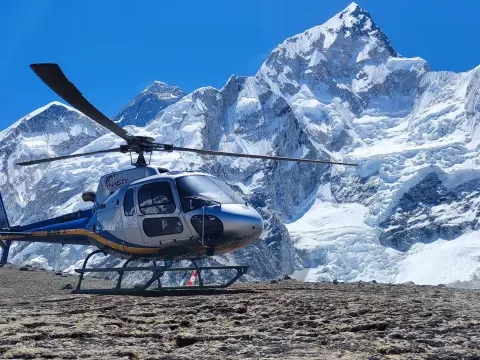
What Is Included in a Standard Everest Helicopter Tour Package?
A standard Everest helicopter tour package includes hotel pick-up and drop-off in Kathmandu, a flight from the domestic terminal of Tribhuvan International Airport, a refuelling stop at Lukla, breakfast at Hotel Everest View in Syangboche, and Everest-region permits for landing tours. Everything else is a variable.
The table below separates the items operators usually include from the items you confirm in writing, with notes drawn from 2026 listings.
Item | Usually included | Remarks |
Kathmandu hotel transfers | Yes | Pick-up time, typically 06:00 to 06:30 |
Return helicopter flight | Yes | Aircraft type and passengers per aircraft |
Breakfast at Hotel Everest View | Yes, one meal | Cost of any extra food; one 2026 listing charges US$30 per person beyond the included breakfast |
Everest View Point entry | Varies | Admission fee; one 2026 listing states it is payable |
Sagarmatha National Park and rural municipality permits | Yes, for landing tours | A line in the quote naming both permits |
Travel insurance | No | Coverage to 6,000 m (see the insurance section) |
Every row marked "Varies" becomes a charge at the airport when left unconfirmed. Settle each one before you pay.
How Do Landing Tours Compare With Everest Mountain Flight Tours?
Landing tours put you on the ground at Kala Patthar (5,545 m) for roughly 10 to 15 minutes, while Everest mountain flights keep you airborne in a fixed-wing aircraft for about 1 hour at a fraction of the price. In Nepal, a "mountain flight" means that fixed-wing scenic flight from Tribhuvan International Airport, not a helicopter.
The table below compares the 2 products across 5 features, using 2026 listing data.
Feature | Helicopter landing tour | Fixed-wing mountain flight |
Aircraft | Light turbine helicopter, such as the Airbus AS350 | Fixed-wing airliner |
Time commitment | 3 to 5 hours, hotel to hotel | 1 hour in the air; roughly 3 to 4 hours with transfers |
Ground time at altitude | 10 to 15 minutes at Kala Patthar, plus breakfast at Syangboche | None |
Advertised 2026 price | US1,599toUS2,700 per person | About US165toUS275 per person |
Best suited to | Travellers who want to stand beneath Everest | Travellers who want a skyline view on a modest budget |
A helicopter day tour at US$1,599 costs nearly 6 times the top mountain-flight fare of US $ 275. The premium buys the landing, the breakfast at 3,880 m, and a closer line of sight to the summit. A landing is never guaranteed: one 2026 listing describes a 10 to 12 minute Kala Patthar stop for photography only, and weather shortens or cancels it.
Which Everest Helicopter Tour Routes Offer the Best Views?
The best-viewing route runs Kathmandu, Lukla, Pheriche, Kala Patthar, Everest Base Camp, Syangboche, Lukla, and back to Kathmandu, because it passes the 3 strongest vantage points: Kala Patthar, Everest Base Camp, and Syangboche. Each point shows a different Everest.
Kala Patthar (5,545 m) delivers the summit. Everest Base Camp (5,364 m) sits below the Nuptse ridge and does not show the top of the mountain, which surprises many travellers. Kala Patthar clears the ridge, so the summit rises in full view beside Nuptse and Lhotse.
Everest Base Camp (5,364 m) delivers the Khumbu Icefall and the scale of the glacier. Pilots decide between a flyover and a landing based on permissions and conditions.
Syangboche and Hotel Everest View (about 3,880 m) deliver the panorama: Everest, Lhotse, and Ama Dablam framed together over Sherpa villages.
Ask for the order of stops. Kala Patthar first presents the summit in morning light before cloud forms.
How Do Group and Private Everest Helicopter Tours Differ?
Group tours split one helicopter among 4 to 5 passengers at a lower per-person fare, while private tours reserve the whole aircraft, fix the schedule around your party, and prioritise the Kala Patthar landing. Group fares in 2026 listings run US$1,599 to US$1,900, and private tours with a guaranteed landing start at US$2,700 per person.
One 2026 group listing states that the Kala Patthar landing is possible only on private tours, while another sells a landing at a group-style price. Confirm the landing for your specific booking.
Three traveller types choose differently:
Solo travellers: A group departure splits the cost and delivers the same views.
Families of 4 or more: Request a private aircraft quote and 4 group fares, then compare totals.
Photographers: A private flight lets the pilot hold at vantage points and wait for a cloud to pass, which a shared departure does not allow.
What Is the Best Time of Year for an Everest Helicopter Tour?
The best time for an Everest helicopter tour is autumn (late September to November) and spring (March to May), when morning visibility peaks and monsoon rain is absent. Autumn delivers the clearest skies after the monsoon washes the air.
The table below lists 4 seasons with their flying conditions.
Season | Months | Conditions for helicopter tours |
Autumn | Late September to November | Sharpest visibility, stable mornings, highest demand |
Spring | March to May | Warmer air, good mornings, haze increasing toward May |
Winter | December to February | Crisp views, severe cold at Kala Patthar, stronger winds |
Monsoon | June to September | Sightseeing flights banned by CAAN; only emergency, medical, and cargo operations are permitted |
Autumn and spring concentrate demand, so book 4 to 8 weeks ahead. Monsoon departures are not legally permitted; CAAN banned all commercial sightseeing and mountain helicopter flights during the monsoon months (June to September) following a July 2023 crash.
How Much Does a Mount Everest Helicopter Tour Cost?
A Mount Everest helicopter tour costs US 1,599 to US 1,980 per person on shared day tours and from US$2,700 per person on private tours with a landing, according to 2026 listings. Multi-day packages that add Kathmandu sightseeing start at US$4,250.
The table below shows 4 advertised 2026 price points, each describing a different product.
Product | Advertised price per person (US$) |
Shared day tour, Lukla and Everest View, no landing | 1,599 to 1,900 |
Day tour listing a Kala Patthar landing | 1,680 to 1,980 |
Private day tour with a guaranteed Kala Patthar landing | 2,700 |
Multi-day tour with Kathmandu, Dhulikhel, Everest Base Camp, and Namche | 4,250 |
Use the first 3 rows to benchmark a single-day quote; none of these prices include travel insurance or tips.
What Factors Influence Everest Helicopter Tour Prices?
Six factors set Everest helicopter tour prices: flight time, landing inclusion, seat sharing, fuel logistics, season, and package extras. Each factor traces to a real operating cost.
Flight time: Kathmandu to Lukla takes about 45 minutes each way.
Landing inclusion: A Kala Patthar landing adds permits, ground time, and a higher pilot workload.
Seat sharing: One aircraft split among 4 to 5 passengers drops the fare per head; a private party carries the whole aircraft cost.
Fuel logistics: According to the ICAO paper, helicopter companies preposition fuel depots at strategic helipads, and that logistics chain sits inside every fare.
Season: Autumn and spring demand lifts prices. (Monsoon discounts no longer apply, as commercial sightseeing operations are legally banned during those months).
Package extras: Kathmandu sightseeing, hotel nights, and meals add cost without adding flight time.
Altitude adds a hidden factor: thin air lowers payload, which cuts passengers per aircraft and raises the cost per seat.
Are Airport Transfers, Permits, and Taxes Included in the Price of an Everest Helicopter Tour?
Most reputable packages include Kathmandu hotel transfers and Everest-region permits in the quoted price, and the quote states whether value-added tax and service charges are included. Never assume; request the line item.
Transfers cover the drive from your Kathmandu hotel to the domestic terminal at Tribhuvan International Airport and the return. Permits cover Sagarmatha National Park entry and the Khumbu Pasang Lhamu Rural Municipality fee for landing tours; each costs a modest per-person fee in the tens of US dollars.
Taxes deserve a direct question. Nepal's standard value-added tax rate is 13%. On a US 1,900 tour, a quote that excludes VAT hides US 247. Ask: "Is the price you quoted my final total, with every tax?"
Are There Hidden Charges in Everest Helicopter Tour Packages?
Yes: 6 charges commonly surface after booking, including extra breakfast, viewpoint entry, excess-weight fees, card surcharges, Kathmandu waiting costs, and re-flight fees after a weather cancellation. Two appear in 2026 listings: a US$30 per person charge for breakfast beyond the included meal, and an admission fee for Everest View Point.
Test for hidden charges with one written question: "Give me the total I pay in US dollars from hotel pick-up to hotel drop-off, with every tax and fee." Keep the reply.
The remaining 4 charges deserve targeted questions:
Excess-weight fee: Ask whether a passenger above the per-seat limit pays for a second seat.
Card surcharge: Ask for the percentage on credit-card payments.
Waiting costs: Ask who pays for an extra Kathmandu night when weather delays the flight.
Re-flight fee: Ask whether a weather reschedule costs anything.
How Do You Compare Everest Helicopter Tour Prices Without Compromising Safety?
Compare prices only between quotes that name the same aircraft type, landing points, passenger count, and inclusions, and rank safety documents before price.
Follow 4 steps:
Request quotes from 3 companies for the same date and group size.
Rewrite each quote into one template: aircraft type, route, landing time, seats per aircraft, inclusions, and refund terms.
Remove every quote that lacks an AOC copy or a named operator.
Compare the remaining totals per person in US dollars.
What Should You Know About Everest Helicopter Tour Itineraries?
A standard Everest helicopter itinerary runs Kathmandu, Lukla, Pheriche, Kala Patthar, Syangboche, Lukla, and Kathmandu in 3 to 5 hours, with 3 to 4 landings. Landing points and their order separate one itinerary from another.
How Long Does a Mount Everest Helicopter Tour Take?
A Mount Everest helicopter tour takes 3 to 5 hours from Kathmandu hotel pick-up to drop-off, including about 45 minutes of flight to Lukla, a refuelling stop, a 10 to 15 minute Kala Patthar landing, and a 30 to 60 minute breakfast. One 2026 listing schedules pick-up at 06:00 to 06:30 and hotel drop-off between 11:00 and 12:00.
Budget the whole morning and schedule nothing before 13:00, because a weather hold slides every later plan.
Which Destinations and Landing Points Should the Everest Helicopter Tour Itinerary Include?
The itinerary includes 4 core points: Lukla (about 2,850 m) for refuelling, Kala Patthar (5,545 m) for the summit view, Hotel Everest View in Syangboche (about 3,880 m) for breakfast, and an Everest Base Camp (5,364 m) flyover. Pheriche is a mandatory operational shuttle point for group tours; because high-altitude weight limits prevent a helicopter from carrying 4 to 5 passengers to Kala Patthar at once, the pilot must split the group at Pheriche and run two separate summit shuttle flights.
Ask which landings are fixed and which are "subject to permission and weather," because landing points inside Sagarmatha National Park depend on park permissions. Some operators list Kala Patthar at 5,644 m; most surveys give 5,545 m, so match your insurance altitude limit to the higher figure.
How Do Breakfast Stops and Kala Patthar Landings Affect the Everest Helicopter Tour Experience?
Breakfast at Hotel Everest View adds a 30 to 60 minute pause at about 3,880 m, and the Kala Patthar landing delivers the 10 to 15 minute summit view at 5,545 m. Together they form the emotional peak and the recovery of the tour.
The order matters. Routes that land at Kala Patthar first and then descend to Syangboche place the highest exposure early and the descent right after it. At Kala Patthar, move slowly, drink water, and photograph from where you stand. Confirm that the hotel breakfast is reserved for your group.
What Happens If Weather Conditions Cause Delays or Cancellations?
When weather blocks the flight, a reliable company holds departure in Kathmandu, reroutes to a lower viewpoint, reschedules to the next available morning, or refunds according to its written policy. The pilot makes the call; the contract decides the money.
Three outcomes occur most often. A Kathmandu hold delays take-off until visibility opens. A reroute swaps Kala Patthar for Syangboche when cloud covers the high ground, which delivers a reduced product. A cancellation moves you to the next morning or triggers a refund. Ask whether a rerouted flight earns a partial refund, and keep 1 spare day in Kathmandu.
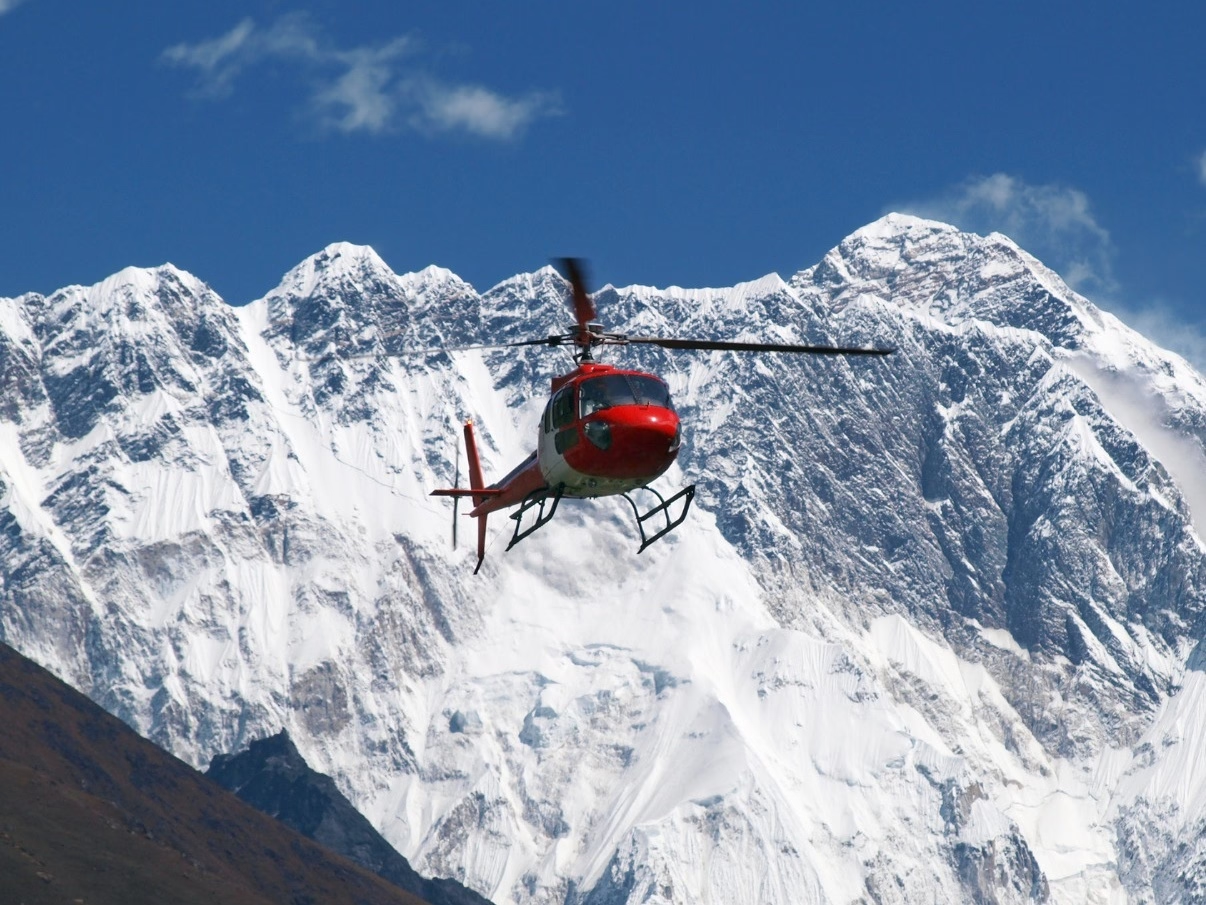
What Should You Check Before Booking an Everest Helicopter Tour?
Before booking an Everest helicopter tour, check 4 areas: the questions you ask the company, its cancellation and refund terms, your insurance coverage, and your health at altitude. Complete all 4 before paying a deposit.
What Questions Should You Ask Before Making a Reservation?
Ask 10 questions before reserving, and require written answers. The questions below cover operator identity, aircraft, pilot, landing terms, and money.
Who operates the aircraft, and which AOC does that operator hold?
Which aircraft type and registration will fly my date?
How many Khumbu seasons has the assigned pilot flown?
Which landings are fixed, and what does "guaranteed" mean if cloud blocks Kala Patthar?
How many passengers share the aircraft?
What is the total price in US dollars, with every tax, permit, and fee?
What does the Hotel Everest View stop include?
What is the weather cancellation and refund policy, in days?
Which company account receives my payment?
Which insurance certificate must I carry?
A company that answers all 10 in writing within 24 hours is organised enough to run the flight.
What Cancellation, Refund, and Rescheduling Policies Should You Review?
Review 4 policies: weather cancellation, guest cancellation, rescheduling, and partial-flight refunds. Each policy decides who carries the cost of the mountain's unpredictability.
Weather cancellation must end in a free reschedule or a full refund. Guest cancellation sets deadlines and percentages. Rescheduling states the number of free date changes. Partial-flight refunds cover the case where the pilot cannot land at Kala Patthar. 2026 platform listings show minimum deposits of 20% to 25% for distant departure dates, with full payment required as the date approaches.
Read the force majeure clause too: the January 2025 suspension showed that a local dispute can ground the whole Everest region. Ask for the refund timeline in days.
What Travel Insurance Coverage Do You Need for an Everest Helicopter Tour?
Buy travel insurance that covers medical treatment and emergency helicopter evacuation up to at least 6,000 m, because Kala Patthar sits at 5,545 m and many standard policies cap cover far lower. Nepal trekking guides report standard caps between 2,500 m and 4,000 m.
A 500 m buffer above your highest point protects you from elevation disputes. An evacuation without cover costs US$3,000 to US$10,000 per rescue, according to industry guides, and one insurer comparison notes that policies often exclude Mount Everest trips outright. Read the exclusions list.
Confirm 3 points in writing: the altitude limit, helicopter evacuation cover, and sightseeing flights on a licensed commercial helicopter. Buy before you leave home and send the policy number to your tour company.
What Altitude and Health Considerations Should You Discuss With the Everest Helicopter Tour Operator?
Discuss 4 health topics with the operator: heart and lung conditions, pregnancy, recent illness, and any past altitude sickness. Kala Patthar at 5,545 m delivers roughly half the oxygen pressure of sea level.
According to the CDC Yellow Book, altitude illness occurs above about 2,500 m, and rapid ascent is the main risk factor. A helicopter lifts you from Kathmandu (about 1,400 m) to 5,545 m in about 90 minutes with no acclimatisation. The short 10 to 15 minute exposure limits risk without removing it.
Watch for 4 symptoms: headache, nausea, dizziness, and shortness of breath. Tell the pilot at once, because descent is the treatment. Avoid alcohol the night before and wear layers; Kala Patthar sits well below freezing on autumn mornings.
How Can You Identify Unreliable Everest Helicopter Tour Companies?
Unreliable Everest helicopter tour companies share 3 traits: they avoid documents, they price below the market without explanation, and they push payment through channels you cannot trace. Spot one trait and test for the other two.
What Warning Signs Suggest a Helicopter Tour Operator Is Untrustworthy?
Six warning signs mark an untrustworthy operator: no named air operator, no aircraft registration, a "guaranteed" landing without weather terms, pressure to pay within hours, payment to a personal account, and refusal to put terms in writing. Any 2 together justify walking away.
A seventh sign hides in the sales language: a company that promises to "fly in any weather" overrules its pilots, and a pilot under pressure is the weakest link in aviation safety.
Why Should You Be Cautious of Prices That Seem Too Low?
Prices far below the 2026 floor of about US$1,599 signal removed components: no landing, excluded permits, dropped breakfast, or a thinner safety file. A helicopter's cost per flight hour is fixed, so a discount comes from somewhere.
Savings hide in 4 places: a landing removed from a landing-priced product, permits left for the airport, a dropped meal, and a cheaper operator. Ask for a line-item breakdown. A US1,295 quote against aUS1,599 floor leaves a 19% gap to explain.
How Can You Verify Booking Confirmations and Payment Security?
Verify a booking by matching 4 details: the registered company name on the invoice, the payee name on the payment account, a written itinerary with date and aircraft class, and a confirmation sent from a business email domain. All 4 must agree.
Pay by credit card or through a platform that offers dispute rights wherever possible. For bank transfers, send funds to an account in the registered company name, never a personal wallet. Request the company's Permanent Account Number from Nepal's Inland Revenue Department, and keep every message. Reconfirm pick-up time, terminal, and contact number 24 hours before the flight.
How Can Heaven Himalaya Help You Choose the Right Mount Everest Helicopter Tour?
Heaven Himalaya is a Kathmandu-based trekking and expedition company. Its one-day Mount Everest Helicopter Tour leaves from the domestic terminal of Tribhuvan International Airport, flies via Lukla into the Everest region with views of Everest, Lhotse, Nuptse, and Ama Dablam, and returns to Kathmandu in the same helicopter. The company recommends autumn and spring for the clearest views.
Every check in this guide applies to us too. Ask us the 10 questions above, and we answer them in writing before you pay.
Can Heaven Himalaya Help You Find a Safe and Memorable Everest Helicopter Tour?
Yes: Heaven Himalaya plans your Everest flight around your date, group size, and landing preference, and sends a written itinerary, inclusions list, and refund terms before you pay. We handle the Kathmandu hotel transfer from pick-up to drop-off.
Plan your flight. Review the Mount Everest Helicopter Tour itinerary, then send us your dates, group size, and landing preference. We reply with a written quote that answers every question in this guide.
What Should You Remember When Choosing the Best Mount Everest Helicopter Tour Company?
Remember 5 rules: verify the licence, confirm the aircraft and pilot, compare identical inclusions, expect weather to decide the schedule, and pay only against written terms. The best Mount Everest helicopter tour company welcomes each of those checks.
Complete this final checklist before your deposit:
Collect the operator's name, AOC status, and aircraft registration.
Confirm the Kala Patthar landing terms and the weather refund policy.
Obtain a total price in US dollars with all taxes and permits.
Buy insurance covering helicopter evacuation up to 6,000 m.
Pay a registered company account and keep the confirmation.
Reserve 1 spare day in Kathmandu.
The mountain keeps its own schedule, and the right company plans around that fact. Choose the Mount Everest helicopter tour company that shows its documents, answers in writing, and respects its pilots' decisions, and the hours above Khumbu become the easy part.