

Panch Pokhari Trek in November 2026: Weather & Trail Guide

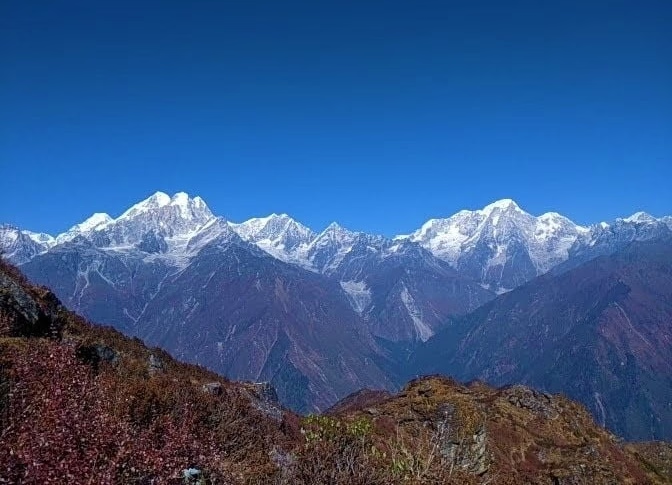
The Panch Pokhari Trek in November is a 4–5-day high-altitude trekking adventure in Sindhupalchok, Nepal, leading to five sacred glacial lakes at 4,100 m beneath the Jugal Himal. The post-monsoon season brings clear Himalayan panoramas, golden and red autumn forests, crisp mornings, and quieter trails outside major pilgrimage periods.
Trekkers can enjoy views of Dorje Lakpa, Phurbi Chhyachu, and surrounding Himalayan ranges, with an additional climb to the 4,300 m viewpoint overlooking the lake basin. However, freezing nights, occasional snowfall, icy stone steps, strong afternoon winds, and limited daylight make November a season that demands proper preparation.
Planning a successful Panch Pokhari trek in November requires choosing the right departure dates, following a suitable itinerary, and preparing for cold and altitude. This guide explains the Chhimti trekking route, daily walking distances, elevation gains, weather conditions, temperature variations, and acclimatization strategies, alongside essential clothing, trekking equipment, sleeping gear, teahouse accommodation, meals, drinking water, and estimated 2026 costs.
It also covers transportation from Kathmandu, permits and guide requirements for Nepali and international trekkers, lodge reservations, altitude sickness prevention, emergency responses, and weather-related delays. Whether you are planning an independent trip or a guided trek with Heaven Himalaya, use this guide to compare your options, prepare for sub-zero temperatures, and build a safer itinerary for reaching the five alpine lakes.
What Is Panch Pokhari and Where Is It Located?
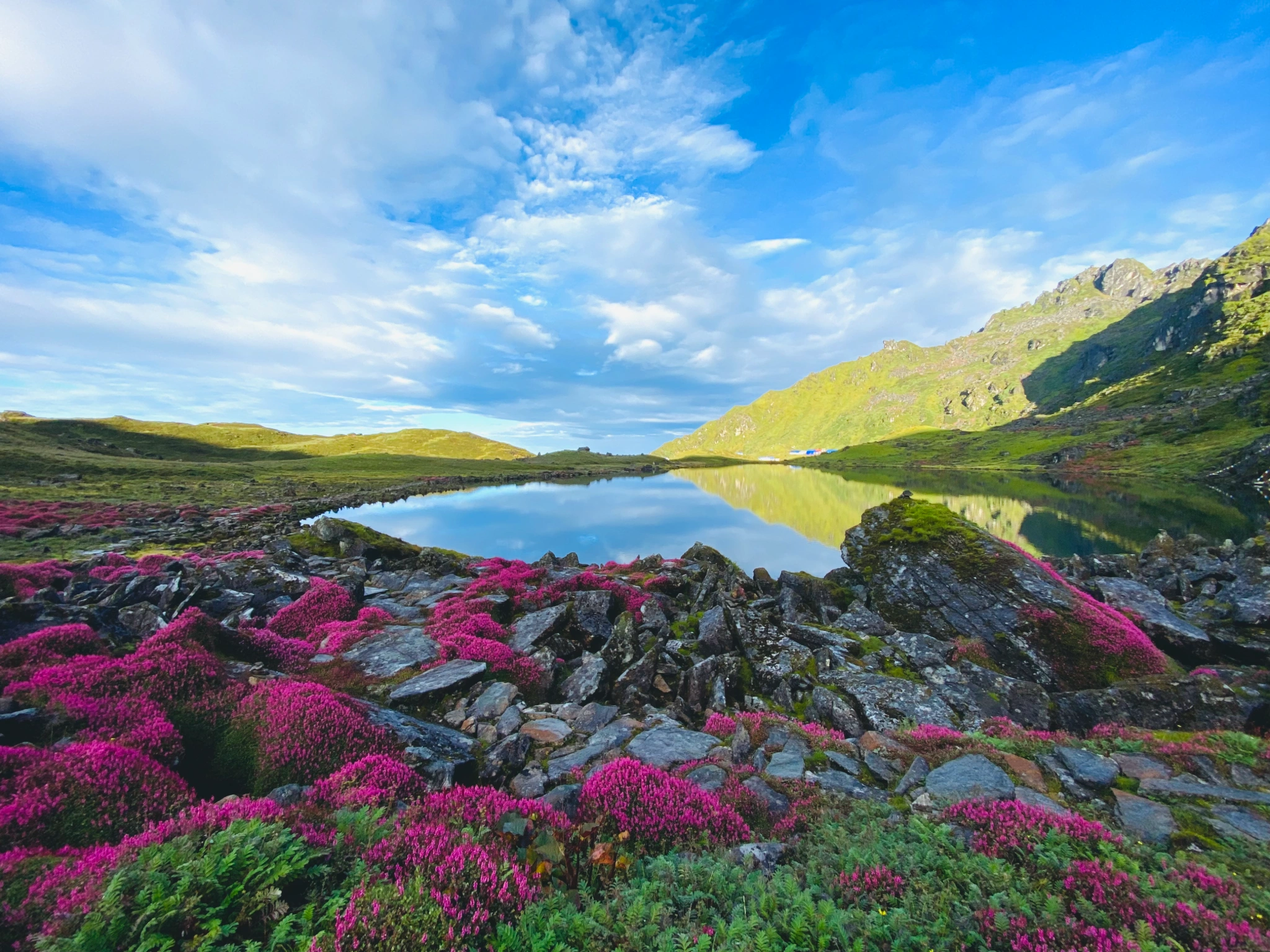
Panch Pokhari is a group of five glacial lakes at 4,100 m in Sindhupalchok District, Bagmati Province, Nepal. The lakes sit below the Jugal Himal, a 5–7 hour drive from Kathmandu to the Chhimti trailhead, followed by 2 days of walking.
"Panch" means five and "Pokhari" means pond in Nepali. Panchpokhari Thangpal Rural Municipality administers the area. The lakes include Surya Kunda, Ganesh Kunda, and Naag Kunda, and the largest lake sits at the centre with the other four around it.
A Shiva temple stands beside the lakes. Hindu and Buddhist pilgrims bathe here during Janai Purnima, the August full moon festival. Local accounts describe the lakes as a source of the Indrawati River.
The trek typically starts at Chhimti or Bhotang (approx. 1,800 m), accessible via Melamchi in Sindhupalchok District. Dorje Lakpa (6,966 m) rises above the lake basin. Dudh Pokhari lies one day beyond the lakes, and Tilman's Pass sits more than 1,000 m higher.
Why Is November a Good Time to Trek to Panch Pokhari?
November is a good time because the post-monsoon air is dry and stable, mountains stand sharp against deep blue skies, trails are firm, and leeches disappear. Kathmandu receives about 10 mm of rain in November, compared with roughly 370 mm in July.
Three conditions make the month work: low rainfall, high visibility, and thinner crowds than September–October. The trade-off is cold. Nights above 3,700 m fall below freezing, and daylight shrinks to about 10.5 hours, with sunrise near 6:25 am and sunset near 5:15 pm.
Early November and late November behave differently. Early November (1–15) is 3–4°C warmer and overlaps with Tihar, the festival of lights, which falls around 8 November in 2026 and fills lodges with domestic visitors. Late November (16–30) is colder, quieter, and offers the sharpest views, with a higher chance of a light snowfall at the lakes.
Choose 10–20 November for the best balance of visibility, temperature, and lodge availability. Trekkers who want a longer comparison of Nepal's seasons will find one in Best Time to Trek in Nepal.
What Makes Panch Pokhari Special in Late Autumn?
Late autumn gives Panch Pokhari red and yellow forest foliage, thin ice on the pond edges, glassy lake reflections, and star-dense night skies. These four features appear together only between late October and early December.
A trekker who walked the route in November 2025 reported red and yellow leaves across the lower forest, thin ice sheets on the ponds at dawn, and a clear Milky Way above the lakes (Kathmandu Post, 22 November 2025). The new moon falls around 9 November 2026, so the first half of the month delivers the darkest skies.
Wind drops at dawn, and the five lakes hold still water for the first 90 minutes after sunrise.
Can You See Himalayan Peaks Clearly in November?
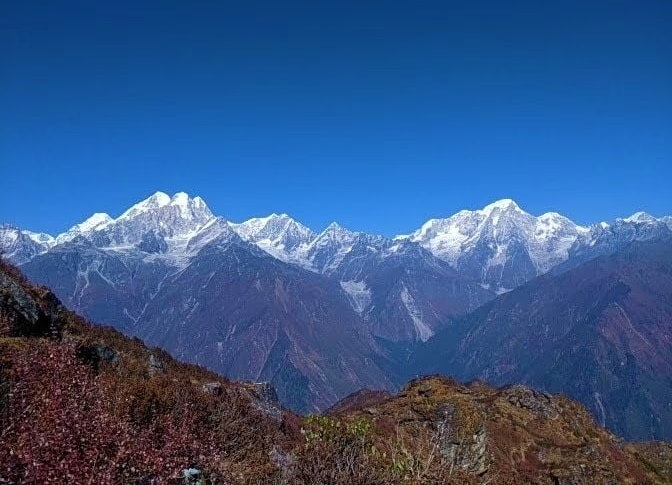
Yes. November has the best peak visibility of any month, with views of Dorje Lakpa (6,966 m), Phurbi Chhyachu (6,637 m), Madiya (6,257 m), and the Jugal, Langtang, and Rolwaling ranges from the 4,300 m viewpoint.
Gauri Shankar (7,134 m) appears on clear mornings toward the east. The panoramic viewpoint, locally known as Furkemani Danda, sits 30–60 minutes above the lakes at 4,300–4,350 m and offers a complete 360-degree vista of all five ponds and surrounding peaks.
Visibility peaks between 6:30 and 9:30 am. Valley cloud builds after 11 am and covers the lower ridges by noon. The same Kathmandu Post trekker lost her sunrise to cloud on one morning, so plan two mornings at the lakes whenever the schedule allows.
Is Panch Pokhari Less Crowded in November?
Panch Pokhari is less crowded in November than in August (Janai Purnima) and during Dashain, but weekends stay busy. Domestic visitor numbers are rising, and lodges at the lakes filled completely in late November 2025.
According to Kantipur's business desk on 1 November 2025, the number of tourists visiting Panch Pokhari is increasing, with domestic visitors leading the growth. A November 2025 trekker also described a crowded Kathmandu bus, shared rooms at the lakes, and frequent trail company.
Foreign trekkers remain rare on this route, so international visitors share the trail mostly with Nepali hikers and pilgrims. Tuesday to Thursday arrivals find open beds, empty viewpoints, and faster meal service.
Avoid the Tihar holiday window (about 8–12 November 2026) unless you book lodges 3–5 days ahead by phone. Friday and Saturday nights at Nosyam Pati and Panch Pokhari carry the highest risk of full rooms.
What Is the Weather Like at Panch Pokhari in November?
Panch Pokhari weather in November is dry, sunny, and cold. Mornings are clear, clouds build above 3,500 m after 11 am, ridge wind strengthens after noon, and nights drop below freezing from Nosyam Pati upward.
Temperature falls about 6.5°C for every 1,000 m of climb, according to the standard atmosphere model used by the World Meteorological Organization. Kathmandu (1,400 m) averages roughly 22°C by day and 7°C by night in November. The lakes sit 2,700 m higher, which puts them 17°C colder than the capital at the same hour.
Midday feels mild in a t-shirt, and temperature drops 8–10°C within 30 minutes of the sun leaving a slope. That swing defines November trekking.
What Are the Daytime and Nighttime Temperatures of Panch Pokhari Trek in November?
Expect 15–20°C by day and 5–8°C at night at Chhimti, falling to 3–8°C by day and −8 to −3°C at night at the lakes (4,100 m). Late November runs 3–4°C colder than early November.
The table below lists typical November temperatures at the five main stops, calculated from Kathmandu's November averages and the 6.5°C per 1,000 m lapse rate. A cold snap shifts any day by 5°C.
Stop | Altitude | Daytime | Nighttime |
Chhimti | 1,800 m | 15–20°C | 5–8°C |
Tuppi Danda | 2,320–2,400 m | 12–16°C | 1–4°C |
Rato Mato | 2,950 m | 9–13°C | −2 to 1°C |
Nosyam Pati | 3,661–3,700 m | 5–10°C | −6 to −2°C |
Panch Pokhari | 4,100 m | 3–8°C | −8 to −3°C |
Nights at Nosyam Pati and the lakes freeze water bottles and lodge taps.
Does It Snow at Panch Pokhari in November?
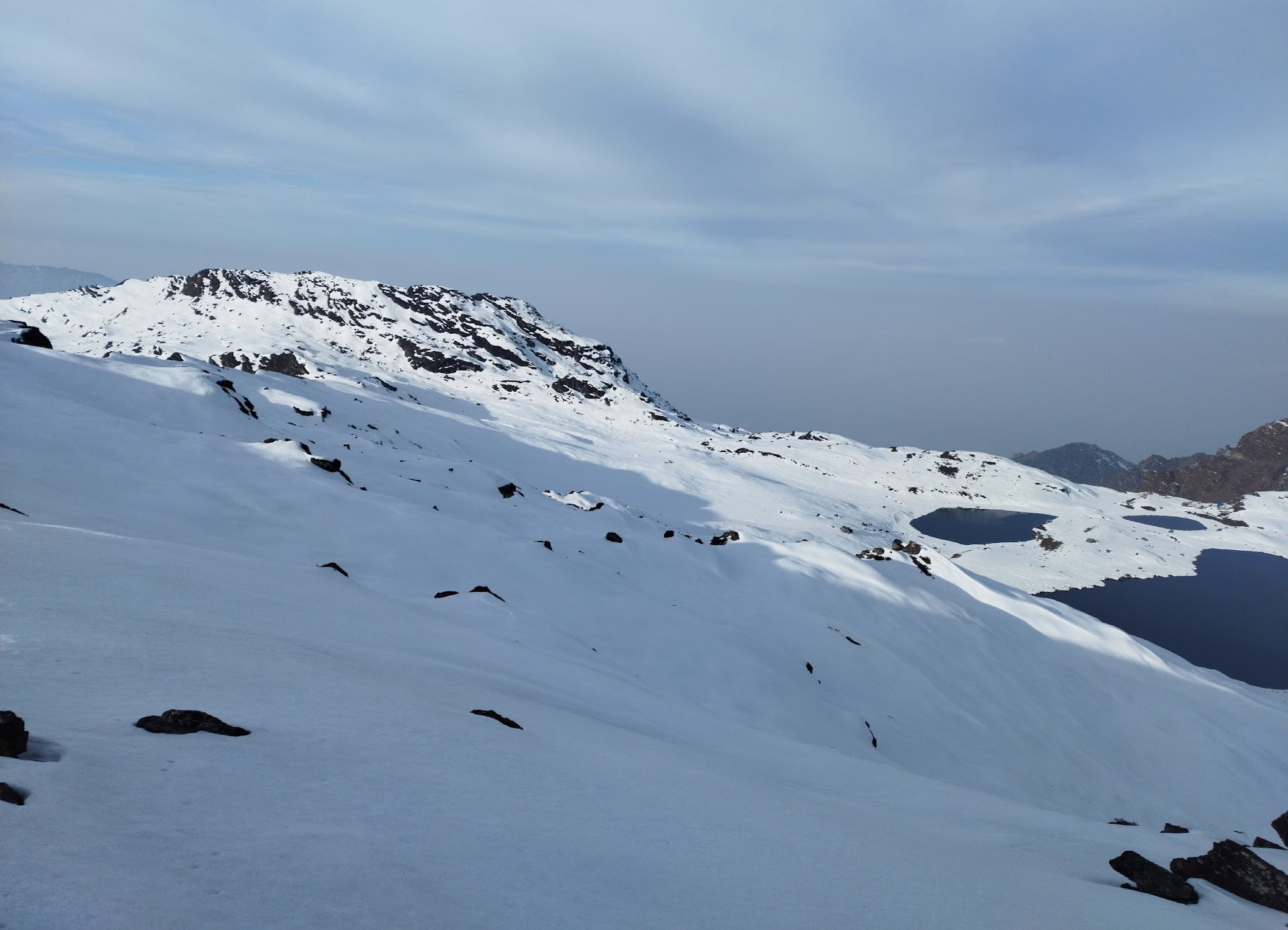
Light snow at Panch Pokhari in November is occasional, and heavy snow is uncommon. Fresh snow most often dusts the surrounding hills and the upper trail above 3,700 m rather than settling deep at the lakes.
Reports from the past 2 years show the pattern. A mid-November account recorded snow at Panch Pokhari itself. A late-November 2025 trekker saw fresh snow on surrounding hills on the final morning, but none on the lakes. Doma Sherpa, a Deurali resident, told a December 2024 report that snow had not reached Deurali (2,000 m) in 3 years.
Snow patterns have shifted. Rising temperatures and unpredictable weather make the old rule, "snow arrives in December," less reliable. A November cold front still delivers a dusting to several centimetres of snow above 3,700 m in some years.
Snow turns the steep steps between Nosyam Pati and Lauribina slippery, and descending on fresh snow is harder than climbing it.
How Cold Does It Get at Panch Pokhari?
Panch Pokhari reaches −8°C at night in November, and wind chill at the 4,300 m viewpoint feels like −13°C or colder in a 30 km/h breeze. A sleeping system rated to −10°C comfort is the standard requirement.
At −5°C with a 30 km/h wind, exposed skin feels about −13°C, according to the Canadian and US wind chill formula. Wind chill below −10°C demands full coverage of face, hands, and ears.
Lodge rooms are unheated. Dining halls warm around a stove from 5 pm to 9 pm, and a hot-water bottle from the kitchen transforms the first hour of sleep.
The coldest hour is 5:30–6:30 am, right before sunrise. Plan the viewpoint climb for that window with insulated gloves, a warm hat, and a down jacket on top.
What Are the Chances of Rain, Snow, and Strong Winds on Panch Pokhari Trek in November?
Rain chances are low, snow chances are low-to-moderate above 3,700 m, and strong wind chances are moderate-to-high on exposed ridges after noon. Most November trek days are dry and clear.
The table below rates each hazard using November climate norms and recent trekker reports. These are planning ratings, not forecasts.
Hazard | Chance | Where it hits | Best response |
Rain | Low | Below 3,000 m, usually late month | Carry a waterproof shell |
Snow | Low-to-moderate | Above 3,700 m | Hold a buffer day, carry microspikes |
Strong wind | Moderate-to-high | Chokhar Danda ridge, viewpoint | Start early, finish ridge crossings by noon |
Fog and cloud | Moderate | Valleys after 11 am | Hike views in the morning |
Ice | Moderate | Pond edges, shaded steps | Wear boots with stiff soles |
A November 2025 trek ended with rain and fresh snow on the hills. The group descended carefully because the author judged the steep rocky trail dangerous in those conditions. Check the Department of Hydrology and Meteorology (Nepal) forecast 48 hours before departure, then again each evening on the trail.
What Does the Panch Pokhari Trek Look Like in November?
A November Panch Pokhari trek runs 4–5 days: a 5–7 hour drive to Chhimti, two days of steep forest ascent to 4,100 m, one morning at the lakes and viewpoint, and a long descent back to the road.
The route climbs through terraced farmland, oak and rhododendron forest, and juniper scrub to open alpine slopes. Walking days last 3–8 hours, and the longest day is the descent.
What Is the Typical Panch Pokhari Trek Route?
The typical route climbs from Chhimti (1,800 m) through Deurali, Tuppi Danda, Rato Mato, Chokhar Danda, and Nosyam Pati to Panch Pokhari (4,100 m), then returns on the same trail.
The standard stage list, in order, reads: Chhimti (1,800 m), Deurali (2,000 m), Dukhang Kharka (2,100 m), Tuppi Danda (2,320–2,400 m), Tangu Khola, Rato Mato (2,950 m), Chokhar Danda (3,100 m), Tap Kharka, Nosyam Pati (3,661 m), Saat Ghumti (3,800 m), Lauribina, and Panch Pokhari (4,100 m).
A second route starts at Chautara and crosses Sano Okhreni, Kami Kharka, Pauwa Bas, Hile Bhanjyang, and Narsim Pati. That ridge route takes 10–12 days round trip, has no springs on the main ridge, and suits trekkers who want solitude and a longer acclimatization.
Most November trekkers use the Chhimti route because lodges concentrate there.
How Many Days Does the Panch Pokhari Trek Take?
The Panch Pokhari trek takes 3–5 days from Kathmandu on the Chhimti route and 10–12 days on the Chautara route. Five days is the safest November choice because it adds one acclimatization night at 3,700 m.
The table compares four itinerary lengths and who each one fits.
Duration | Route | Best for |
3 days | Chhimti up and down | Fit Nepali hikers, weekend trips |
4 days | Chhimti, sleep at the lakes | Trekkers with prior altitude experience |
5 days | Chhimti, sleep at Nosyam Pati, then the lakes | First-time high-altitude trekkers, November |
10–12 days | Chautara ridge route | Photographers, solitude seekers |
The 4-day plan gains 1,700 m between Tuppi Danda and the lakes in one long day, ending at 4,100 m. The 5-day plan splits that gain across two nights and limits the final sleeping gain to 400 m, within the Wilderness Medical Society guideline of about 500 m per night above 3,000 m.
In November, add the buffer day for weather before dropping the acclimatization night.
What Is the Daily Walking Distance and Elevation Gain of Panch Pokhari Trek?
The 5-day plan covers about 38 km round trip with 2,300 m net elevation gain. Daily walking runs 5–16 km, and the biggest single climb is 1,300 m between Tuppi Danda and Nosyam Pati.
The table below summarizes the recommended 5-day itinerary. Distances are approximate and rounded from operator route data.
Day | Route | Walk | Distance | Gain / loss | Sleep |
1 | Kathmandu – Chhimti – Tuppi Danda | 3–4 h | 5 km | +600 m | 2,400 m |
2 | Tuppi Danda – Nosyam Pati | 5–6 h | 9 km | +1,300 m | 3,700 m |
3 | Nosyam Pati – Panch Pokhari | 3–4 h | 5 km | +400 m | 4,100 m |
4 | Viewpoint (4,300 m), descend to Tuppi Danda | 7–8 h | 16 km | +200 m / −1,900 m | 2,400 m |
5 | Tuppi Danda – Chhimti – Kathmandu | 1–2 h walk, 5–7 h drive | 5 km | −600 m | Kathmandu |
Day 2 is the hardest, with steady steps and no lodges between Tuppi Danda and Nosyam Pati for 4–5 hours. Day 4 tests the knees, and a 2025 trekker reported sore ankles and bruised toenails after the descent. Trim toenails before departure.
What Are the Major Attractions Along the Panch Pokhari Trek?
The 6 major attractions are the five lakes, the Shiva temple, the 4,300 m viewpoint, oak and rhododendron forest, Himalayan wildlife, and the Jugal Himal skyline.
The five lakes: Surya Kunda, Ganesh Kunda, Naag Kunda, and two further ponds form a connected basin at 4,100 m.
The Shiva temple: The shrine beside the lakes has a freshwater spring and hosts August pilgrims.
The viewpoint: The ridge at 4,300 m gives a full panorama in 30–60 minutes of climbing.
The forests: Oak, pine, juniper, and rhododendron change colour in late autumn.
The wildlife: Langurs, mountain deer, and the danphe (Himalayan monal, Nepal's national bird) live in the forest zone.
The skyline: Dorje Lakpa, Madiya, Phurbi Chhyachu, and Gauri Shankar frame the view.
How Difficult Is the Panch Pokhari Trek in November?
The Panch Pokhari trek in November is moderate to strenuous. It involves 2,300 m of net ascent in 2–3 days, steady stone steps, a 4,100 m sleeping altitude, and sub-zero nights, but it demands no technical climbing skills.
Cold adds one difficulty level compared with October. Panch Pokhari sleeps 230 m higher than Kyanjin Gompa (3,870 m) in the Langtang Valley, and its stairs are steeper than most Langtang trail sections.
Is Panch Pokhari Suitable for Beginner Trekkers?
Yes, Panch Pokhari suits beginner trekkers with 8–12 weeks of fitness preparation, a 5-day itinerary, and a licensed guide. It is a poor first trek for anyone with heart, lung, or untreated blood-pressure conditions.
A beginner here means someone with no multi-day trekking record. The route needs 4–6 hour hikes with 1,000 m of climbing on consecutive days. Prepare with 3 sessions per week: stair climbing for 45 minutes, hill walks with a 6–8 kg pack, and one weekend hike above 2,000 m, such as Shivapuri or Nagarkot.
Children under 12 and travellers over 65 need a doctor's clearance. Choose the 5-day plan, not the 3-day sprint.
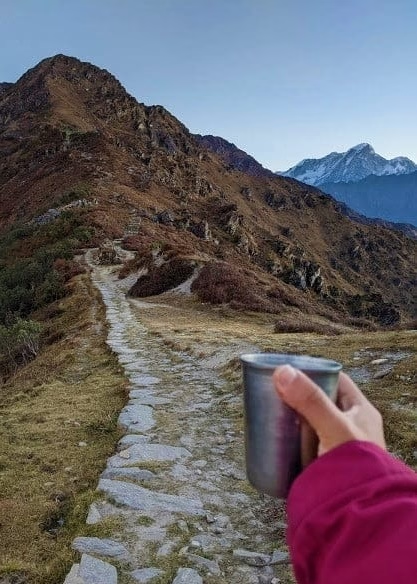
What Are the Main Challenges of Panch Pokhari Trekking in November?
The 7 main November challenges are freezing nights, early darkness, no lodges between Tuppi Danda and Nosyam Pati, steep stone steps, limited water, scarce phone power, and trail navigation errors.
Freezing nights: Lodge rooms stay unheated at −3°C or below.
Early darkness: Light fades by 5:15 pm. A 2025 trekker reached the lakes at 7:30 pm, in the dark.
Lodge gap: The 4–5 hour stretch from Tuppi Danda to Nosyam Pati has no lodge.
Steep steps: Long runs of stone steps strain knees on the descent.
Limited water: Ridge sections have no springs, and taps freeze overnight.
Scarce power: Solar charging runs only a few hours each evening and is shared across groups.
Navigation errors: Two trekker accounts describe losing the trail, once near prayer flags and once under snow cover.
Landslides block the Melamchi road in some years, so keep a flexible return day.
How Can Trekkers Prepare for High Altitude of Panch Pokhari Trek?
Prepare for the altitude with 8–12 weeks of cardio training, a 5-day itinerary, steady pacing, 3–4 litres of water daily, and a doctor's consultation about acetazolamide. Sleeping altitude, not walking altitude, drives risk.
The Wilderness Medical Society recommends a sleeping-altitude gain of no more than 500 m per night above 3,000 m. The 5-day plan stays close to that limit: the night at 3,700 m crosses the 3,000 m threshold in one day, and the night at 4,100 m adds 400 m. Altitude-sensitive trekkers add a night at Rato Mato (2,950 m). Walk slowly on Day 2.
Use the "climb high, sleep low" pattern. Walk to the 4,300 m viewpoint after a night at the lakes, then descend. Carry a fingertip pulse oximeter. Readings of 85–90% at 4,100 m are typical, and a reading under 80% with a headache calls for rest or descent.
Avoid alcohol and sleeping pills on the trail, since both depress breathing at night.
What Should You Pack for Panch Pokhari Trek in November?
Pack for −10°C nights and 3–8°C days: a four-layer clothing system, insulated boots, a −10°C comfort sleeping bag, two insulated bottles, a headlamp, purification tablets, and a 20,000 mAh power bank. Total pack weight stays under 10 kg.
Heaven Himalaya's Packing List for Trekking in Nepal gives a general checklist. This section adds November-specific cold-weather choices. Kathmandu's Thamel district rents sleeping bags, down jackets, and trekking poles, which saves international trekkers from carrying bulky gear.
What Clothing and Layers Are Essential for Cold Weather of Panch Pokhari Trek?
Four layers handle November on Panch Pokhari: a moisture-wicking base layer, a fleece mid layer, a down or synthetic insulated jacket, and a waterproof, windproof shell. Add gloves, a warm hat, a neck buff, and three pairs of wool socks.
Base layer: Merino or synthetic top and leggings, two sets.
Mid layer: Fleece or grid fleece for walking and evenings.
Insulation: A down jacket with 650+ fill or a synthetic equivalent.
Shell: A hooded, breathable waterproof jacket and trousers.
Hands and head: Liner gloves, insulated gloves, a wool beanie, and a sun hat.
Face and eyes: A neck buff and category 3–4 sunglasses with side shields.
Layer on the trail, not at the lodge. Remove the mid layer before a climb starts, and add the down jacket at every rest stop. Sweat that freezes inside a base layer causes more chills than the outside air.
Which Trekking Boots and Accessories Should You Bring for Panch Pokhari Trek?
Bring waterproof mid-cut trekking boots with stiff soles, trekking poles, lightweight microspikes, a headlamp with spare batteries, two 1-litre insulated bottles, purification tablets, sunscreen SPF 50, and cash in small notes.
Break boots in over 40–50 km. Stiff soles grip frozen steps, and mid-cut ankles stabilise stone stairs. Poles reduce knee load on the descent. Microspikes (about 400 g) help on icy lake edges and on fresh snow.
Cold drains batteries in minutes. Sleep with the headlamp and power bank inside the sleeping bag. Carry NPR notes of 100 and 500, because no ATMs operate above Melamchi and lodges rarely carry change.
Add a first-aid kit with blister plasters, ibuprofen, oral rehydration salts, and any personal prescriptions.
What Camping and Sleeping Gear May Be Necessary for Panch Pokhari Trek in November?
A sleeping bag rated −10°C comfort and a thin liner are necessary. Tents are optional, because lodges operate at the main stops. Locals advised against camping in mid-November because of the cold.
Lodges supply blankets and foam mattresses, and those blankets rarely suffice below −5°C. A −10°C comfort bag (about −15°C limit rating) and a fleece or silk liner add 3–5°C of warmth. Most trekkers need nothing more.
A mid-November team account recorded that guides left tents behind after locals warned about the cold. Camping makes sense only for organised groups with four-season tents, insulated sleeping mats (R-value 3.5 or higher), and a cook crew.
What Are the Accommodation and Food Options on the November Panch Pokhari Trek?
Accommodation on the November Panch Pokhari trek means basic lodges at Deurali, Tuppi Danda, Rato Mato, Nosyam Pati, and Panch Pokhari. Food is simple Nepali fare: dal bhat, noodles, eggs, and hot drinks.
Rooms contain two single beds with a mattress, pillow, and blanket. Bathrooms are shared, and showers are cold or unavailable above 3,000 m. Rates start near NPR 450 at lower stops and climb with altitude.
November sits in the shoulder period between the August festival rush and winter closure, so service levels vary stop by stop.
Are Teahouses and Lodges Open in November?
Yes, lodges open in November at the main stops, but off-season operation thins out above Rato Mato. Call ahead, because owners at Nosyam Pati leave during heavy snow.
The table below shows the typical status of each stop in November, based on operator route data and 2024–2025 trekker accounts.
Stop | Altitude | November status |
Deurali | 2,000 m | Open; food and bed about NPR 450 (mid-November record) |
Tuppi Danda | 2,320–2,400 m | One lodge; order meals in advance |
Rato Mato | 2,950 m | Open through the off-season |
Nosyam Pati | 3,700 m | Many lodges, capacity above 100; call ahead |
Panch Pokhari | 4,100 m | Two pilgrim houses and dining halls; full on late-November weekends |
Viewpoint | 4,300 m | A small seasonal shop and hotel in off-season |
Reserve beds 2–3 days ahead by phone with each lodge, and confirm again the morning of arrival. A Plan B for heavy snow is to stay one more night at the last open lodge below.
What Meals and Drinking Water Are Available Along the Panch Pokhari Trek Route?
Lodges serve dal bhat, noodle soup, fried rice, eggs, Tibetan bread, and tea. Meals cost USD 5–10 each at altitude. Boiled drinking water costs USD 1–3 per litre, and ridge sections have no springs.
Dal bhat with potato and spinach curry is the standard dinner and includes free refills. Local mountain-cow ghee and pickles add flavour. Evenings bring tongba, a warm fermented millet drink served in a wooden mug with a bamboo straw.
Carry 2 litres of water for the Tuppi Danda to Nosyam Pati stretch. Use purification tablets, because taps and streams near the lakes can freeze and boiled water runs short at busy lodges. Bring 400–600 g of high-calorie snacks per day: nuts, chocolate, energy bars, and rehydration salts.
How Much Does the Panch Pokhari Trek Cost in November?
The Panch Pokhari trek costs NPR 7,000–10,000 per person for independent Nepali trekkers and USD 550–1,150 for foreign trekkers on a guided 4–6 day package. Longer Chautara-route trips reach USD 1,700.
Costs reflect operator pricing and published budgets in 2025–2026. At NPR 140 per USD, the independent Nepali budget equals roughly USD 50–70.
Item | Cost |
Public bus, Kathmandu to Chhimti | NPR 300–650 one way |
Private jeep, round trip to Chhimti | about NPR 30,000 |
Private vehicle, Kathmandu to Chautara | USD 120–150 one way |
Lodge bed | NPR 450 at Deurali; USD 5–20 at altitude |
Meals | USD 5–10 per meal |
Licensed guide | USD 30–40 per day |
Porter | USD 20–30 per day |
Panchpokhari Rural Municipality entry permit (foreigners) | NPR 1,000–2,000 (approx. USD 8–15) |
e-TIMS card (foreigners) | NPR 2,000 (about USD 15) |
A shared jeep splits the NPR 30,000 transport cost across 5–6 riders, which cuts the per-person transport figure to about NPR 5,000–6,000.
What Factors Affect the Total Trekking Cost of Panch Pokhari Trek?
Eight factors set the total: group size, transport type, trek length, guide and porter hire, lodge tier, gear rental, permits, and insurance. Group size and transport shift the price most.
Group size: Group joining costs about USD 550 per person, couples about USD 500, and solo trekkers about USD 600 on published rates.
Transport: Public bus costs one-tenth of a private jeep.
Trek length: Each extra day adds guide, lodge, and meal costs of USD 50–70.
Support staff: A porter adds USD 20–30 per day and protects knees on Day 4.
Lodge tier: Weekend and festival nights cost more.
Gear rental: Thamel rentals replace purchases for single-trip trekkers.
Permits: Foreign permits add about USD 37–40.
Insurance: Cover to 4,500 m with helicopter evacuation costs about USD 150 for 30 days.
Tips commonly run 10–15% of the package cost for guides, porters, and drivers, and the total sits outside most package prices.
Do You Need a Guide, Permits, or Other Trekking Documents for Panch Pokhari Trek?
Foreign trekkers need a licensed guide, an e-TIMS card, and the Panchpokhari Thangpal Rural Municipality entry permit. Nepali trekkers need a national ID or citizenship card and pay the local municipality entry fee. A guide is strongly recommended for everyone in November.
Nepal's guide rule took effect on 1 April 2023 and requires foreign trekkers in national parks and conservation areas to hire a licensed guide through a registered agency. One guide leads up to 7 trekkers under 2026 rules. Operators arrange permits for this route, and the rules differ by nationality and checkpoint, so confirm requirements when you book.
Carry these documents on the trail:
Passport and visa: One photocopy of each, plus passport photos.
Permits: Panchpokhari Thangpal Rural Municipality entry permit and e-TIMS card.
Insurance: A policy covering trekking to 4,500 m and helicopter rescue.
Identity for Nepalis: Citizenship certificate or national ID card.
SAARC nationals pay a reduced fee for the e-TIMS card (NPR 1,000), while the local rural municipality entry fee remains standard. Guides also solve the trail's navigation problem, since two trekker accounts describe losing the trail, once near prayer flags and once under snow cover.
How Can You Stay Safe During the Panch Pokhari Trek in November?
Stay safe with 5 rules: sleep no more than 500 m higher each night, start walking by 6:30 am, finish ridge crossings by noon, carry a full cold-weather layer set, and descend immediately when symptoms worsen.
Cold, altitude, and darkness drive November risk. A guide, a shared plan with each lodge, a charged phone with offline maps, and an insurance policy number in the top pocket close most gaps.
How Can You Prevent Altitude Sickness and Hypothermia?
Prevent altitude sickness with slow ascent, hydration, and early descent; prevent hypothermia with layering, dry clothes, warm food, and shelter. The first sign of either condition calls for stopping, not pushing on.
Altitude sickness symptoms include headache, nausea, dizziness, loss of appetite, and poor sleep. According to the Himalayan Rescue Association, a headache with any second symptom at altitude signals acute mountain sickness. Rest at the same altitude for 24 hours, and descend 300–500 m when symptoms worsen. Confusion, loss of balance, or breathlessness at rest means immediate descent.
Hypothermia symptoms are uncontrolled shivering, slurred speech, clumsy hands, and drowsiness. Add dry layers, move the person indoors, and give warm sweet drinks. Alcohol never helps.
Layer up within two minutes of every rest stop, because sweat followed by a halt triggers most chills.
What Should You Do if Snow or Bad Weather Disrupts the Panch Pokhari Trek in November?
When snow or bad weather disrupts the trek, stay at the nearest open lodge, wait for midday melt, and descend only on firm trail. Contact your guide and operator, and use the buffer day.
Follow this sequence:
Stop at the nearest lodge when snow settles on steep steps.
Check the forecast and update the guide, lodge owner, and operator.
Wait until 10 am to noon, when sun softens icy sections.
Descend in the middle of the day, with poles and microspikes.
Switch to the lower lodge if visibility drops below 50 m.
Notify the insurer if a delay exceeds 24 hours.
A late-November 2025 trek ended with rain and fresh snow. The group judged the descent unsafe and used extra time. A weather delay costs one extra lodge night, and a rushed descent on ice costs far more.
How Can You Plan Your Panch Pokhari Trek in November with Heaven Himalaya?
Heaven Himalaya plans a November Panch Pokhari trek with a 5-day acclimatization itinerary, permits, transport, lodge bookings, and a built-in buffer day. Planning starts 3–4 weeks before departure for the best lodge availability.
Heaven Himalaya Treks & Expedition is a Kathmandu agency with a 5.0 rating from 160 Tripadvisor reviews and Travelers' Choice awards for 2021–2025. Our guides check the forecast daily, call lodges ahead, and adjust the plan when weather shifts. The Panch Pokhari Trek guide lists a quick itinerary and cost outline.
Plan your November dates: Share your fitness level, group size, and travel window, and we will map a 5-day route with a weather buffer.
Can Heaven Himalaya Arrange a Guided Panch Pokhari Trek in November?
Yes, Heaven Himalaya arranges guided Panch Pokhari treks in November for individuals, couples, and groups, with licensed guides, permits, transport, and lodge reservations. Private departures and custom dates are available.
A guided trek removes the three November problems: navigation in poor light, lodge availability on busy nights, and slow decisions during weather changes. Pickup runs from Kathmandu, and the team handles the Panchpokhari Rural Municipality permit and e-TIMS card.
Contact details: Gitanjali Chowk, Dathu Sadak, Kathmandu, Nepal. Phone and WhatsApp +977 985 1273867 (Ram Adhikari). Landline 014957403. Email info@heavenhimalaya.com.
What Are the Key Things to Know Before Trekking to Panch Pokhari in November?
Seven facts define the Panch Pokhari trek in November: the lakes sit at 4,100 m, nights fall to −8°C, a 5-day itinerary acclimatizes best, lodges open at main stops, a guide is strongly recommended, snow is occasional, and weekends are busy.
Altitude: Panch Pokhari lies at 4,100 m, with a viewpoint at 4,300 m.
Temperature: Nights fall to −8°C, and a −10°C comfort sleeping bag is standard.
Itinerary: Five days with a night at Nosyam Pati lowers altitude risk.
Lodges: Phone every lodge 2–3 days ahead.
Cost: NPR 7,000–10,000 for independent Nepali trekkers; USD 550–1,150 for guided foreign packages.
Permits: Foreigners carry a Panchpokhari Rural Municipality permit (NPR 1,000–2,000) and an e-TIMS card (NPR 2,000).
Timing: 10–20 November balances views, temperature, and lodge space.
Trek in the middle of the week, start walking at 6:30 am, and keep one spare day. The Panch Pokhari trek in November rewards trekkers who respect the cold, plan the lodges, and acclimatize slowly. Pack warm, walk steady, and give the lakes two mornings.