

Annapurna Base Camp Trek in December 2026: Cost & Tips

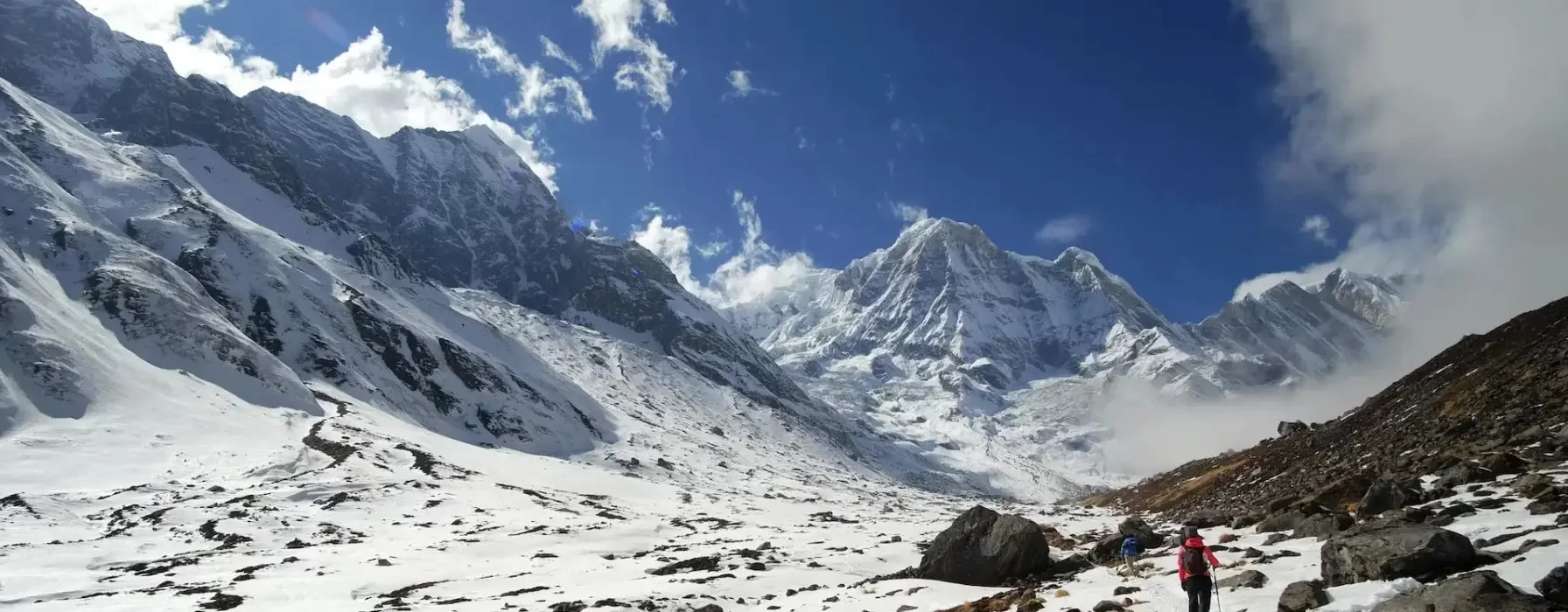
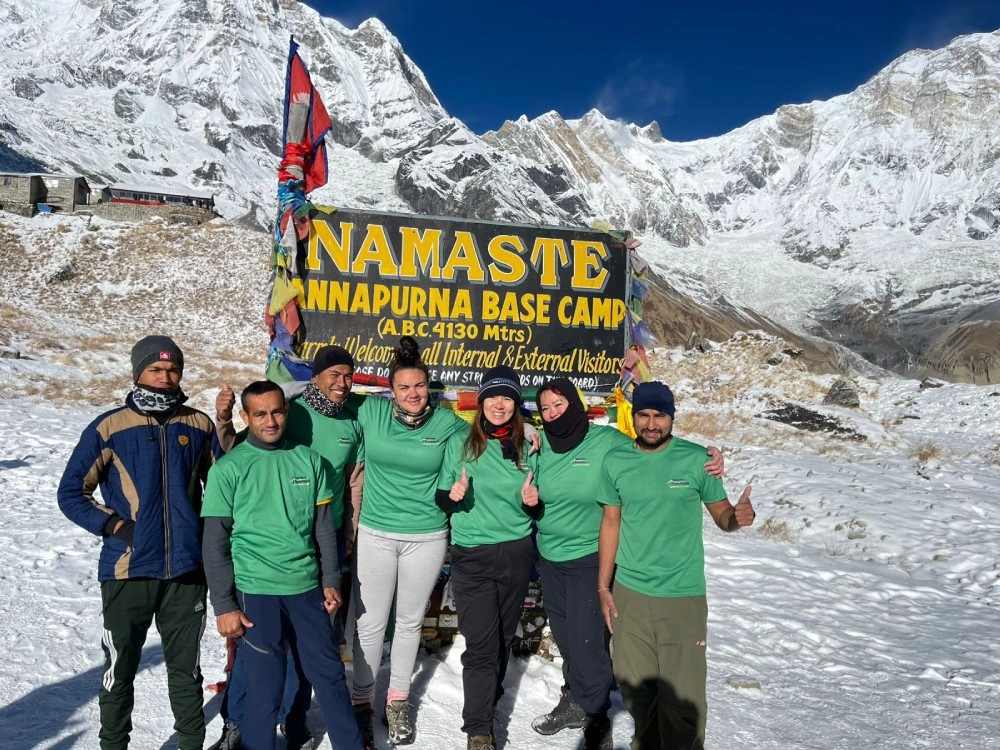
The Annapurna Base Camp Trek in December is a winter trekking adventure in Nepal that reaches 4,130 m (13,550 ft) inside the Annapurna Sanctuary. The trek combines clear Himalayan panoramas, snow-covered trails, quiet mountain villages, and views of Annapurna I, Annapurna South, and Machhapuchhre. Temperatures drop to -10°C to -20°C at night near base camp, making winter clothing, proper acclimatization, and careful route planning essential.
December trekking requires more than choosing the right season. Snowfall, icy trails, avalanche exposure, short daylight hours, and limited high-altitude lodge services can affect the itinerary. This guide explains the best time to trek in December, weather and temperatures, route and itinerary, safety precautions, packing essentials, permits, accommodation, and 2026 costs to help you plan a safe and rewarding Annapurna Base Camp trek.
What Makes the Annapurna Base Camp Trek in December Unique?
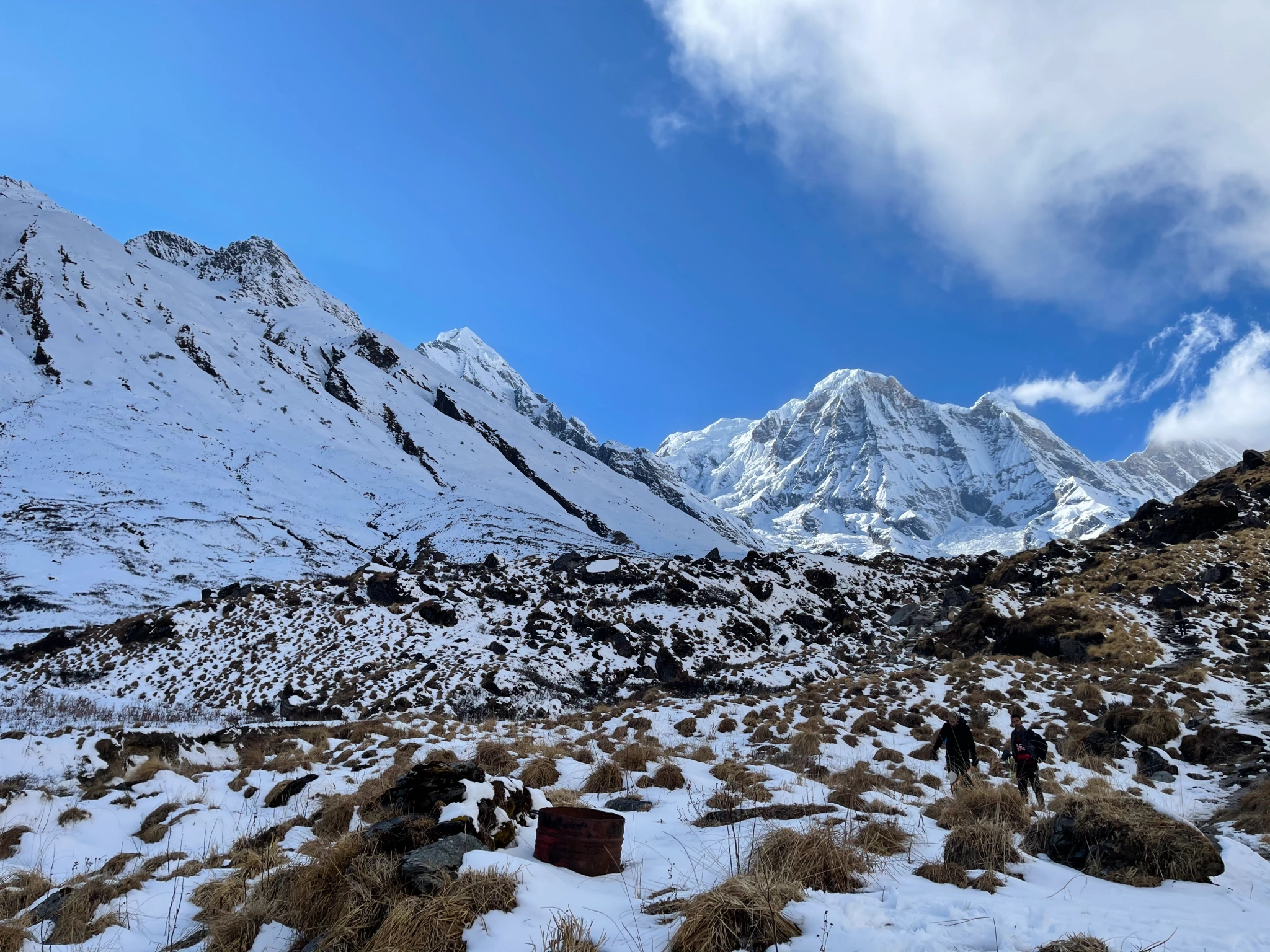
The December trek is unique because it pairs the clearest air of the year with snow-covered sanctuary scenery and near-empty trails, on the same 4,130 m route that autumn trekkers walk. Three attributes set it apart: visibility, transformation and solitude.
Visibility peaks in December. Monsoon dust has settled, regional rainfall stays under 25 mm for the month, and mornings start cloudless. Annapurna I (8,091 m, the 10th-highest mountain on Earth), Annapurna South (7,219 m), Hiunchuli (6,441 m) and Machhapuchhre (6,993 m) show every ridge line.
Transformation comes from snow. The Annapurna Sanctuary is the glacial basin at the head of the Modi Khola valley, enclosed by peaks on every side. Fresh snow whitens its moraines and meadows and sharpens the contrast with the rock faces above.
Solitude changes the experience most. Lodges that sleep 40 trekkers in October host a handful in mid-December, and the dining-room stove becomes the social center of the evening.
One detail most trekkers overlook: Deurali often records colder nights than the base camp itself. Local guides explain that cold air drains down the Modi Khola valley and pools in the narrow funnel at 3,200 m. A warmer sleeping bag matters more at Deurali than at the highest point.
Why Do Trekkers Choose Annapurna Base Camp in December?
Trekkers choose Annapurna Base Camp in December for 5 reasons: clear skies, quiet trails, snow scenery, holiday timing and easy lodge access.
Clear skies: Dry air gives the sharpest sunrise views of the year at Poon Hill and ABC.
Quiet trails: Crowds thin sharply after the first 10 days of the month.
Snow scenery: Photographers target the white sanctuary floor and the low-angle golden light on Annapurna I.
Holiday timing: Christmas and New Year leave fits the 15-day package.
Lodge access: Rooms stay available without the October pre-booking rush.
Photographers value the low sun angle, which stretches alpenglow across the south face. Repeat Nepal trekkers value the solitude. First-timers who have never slept in a cold room or walked on snow are better served by autumn or spring, covered later in this guide.
What Are the Main Highlights of the Annapurna Base Camp Trek?
The trek has 7 main highlights: the Poon Hill sunrise, Gurung and Magar villages, Machhapuchhre Base Camp, the 360-degree Sanctuary panorama, winter wildlife, snow forest trails and the Jhinu Danda hot springs. December adds a snow layer to each one.
Poon Hill sunrise (3,210 m): A pre-dawn climb of about 1 hour from Ghorepani reveals Dhaulagiri (8,167 m), Annapurna South and Machhapuchhre. Poon Hill is the viewpoint above Ghorepani village and the first acclimatization stop.
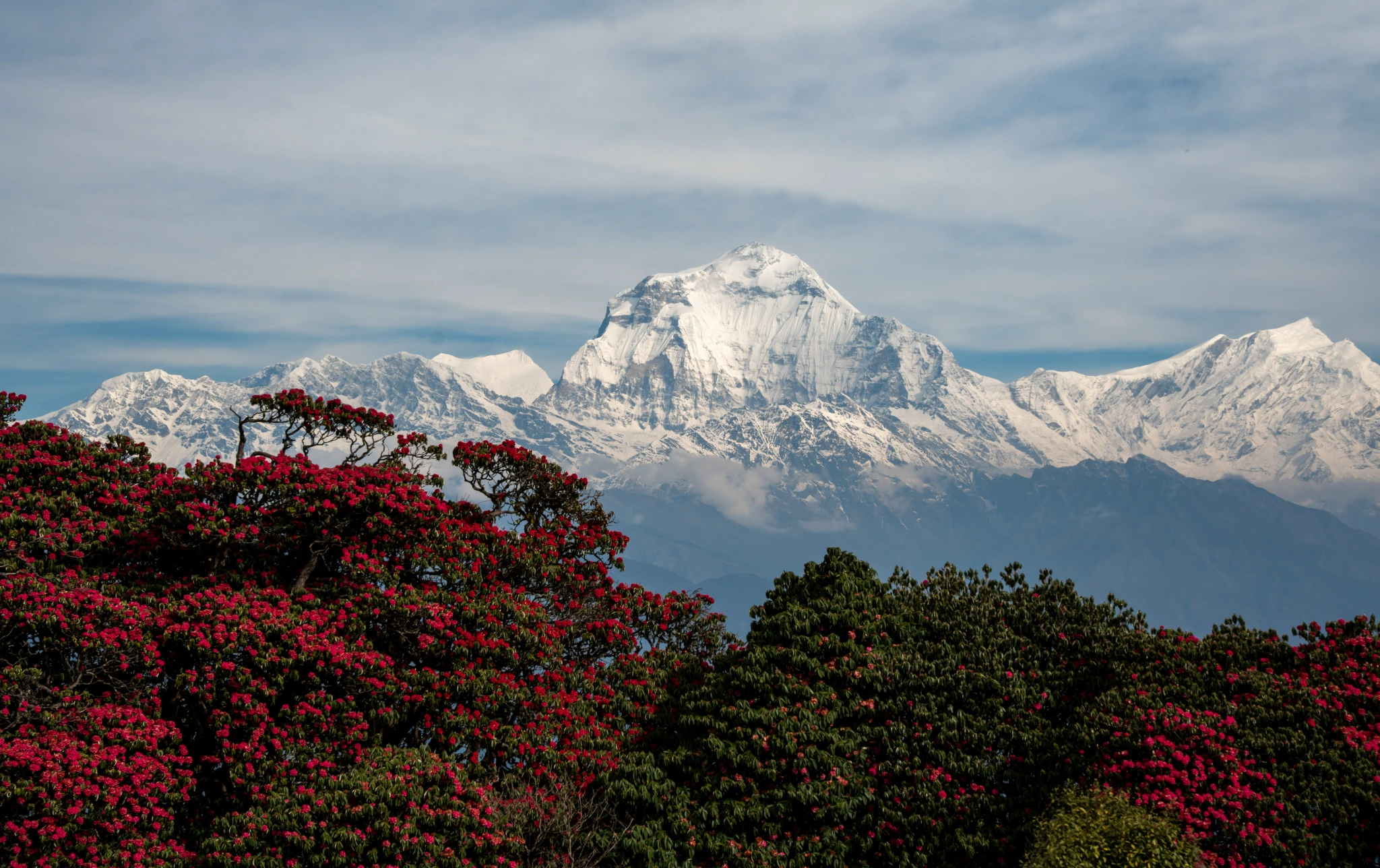
View of Mount Dhaulagiri along with Rhododendron forest as seen from Poon Hill Gurung and Magar villages: Ulleri, Ghorepani, Tadapani and Chhomrong keep stone-paved lanes and family-run lodges. Chhomrong (2,170 m) is the last permanent settlement on the route.
Machhapuchhre Base Camp (3,700 m): MBC lies below the north-west face of Machhapuchhre, also called Fishtail, a peak closed to climbers.
Sanctuary panorama: At ABC, Annapurna I, Annapurna III (7,555 m), Gangapurna (7,454 m), Tare Kang (7,069 m) and Singu Chuli (6,501 m) form a continuous wall.
Winter wildlife: The conservation area holds more than 100 mammal and 450 bird species, including the Himalayan monal (Nepal's national bird), langurs and blue sheep.
Snow forest trails: Rhododendron and oak forest between Ghorepani and Tadapani look different under snow.
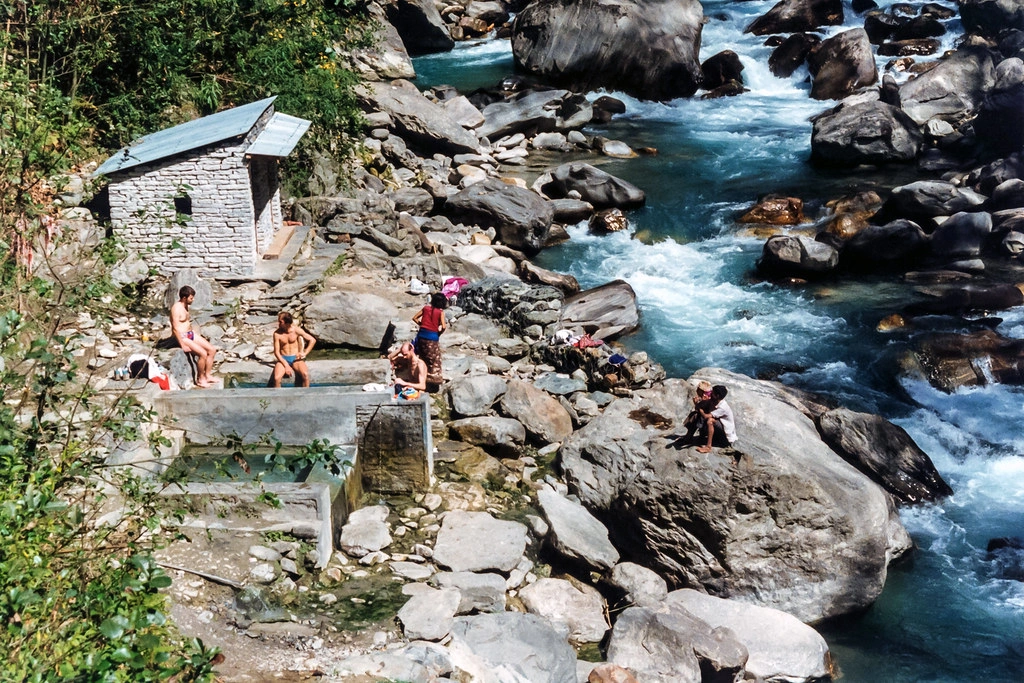
Jhinu Danda hot springs (1,780 m): Natural pools beside the Modi Khola reward the final descent after 10 cold nights.
Is December a Good Time to Visit Annapurna Base Camp?
December is a good time to visit Annapurna Base Camp for prepared trekkers, with December 1-15 rated best, December 11-20 rated good and the last 10 days rated demanding. The departure date matters more than the month.
The table below divides December into 3 windows and compares night temperature, snow above MBC, lodge availability and the right trekker profile.
Window | ABC night temperature | Snow above MBC | Lodges at Deurali, MBC, ABC | Best for |
December 1-10 | -8°C to -12°C | Light to moderate | Fully operating | First-time winter trekkers |
December 11-20 | -10°C to -16°C | Moderate | Mostly operating | Photographers, experienced trekkers |
December 21-31 | -12°C to -20°C | Moderate to heavy | Some closures at the highest stops | Experienced cold-weather trekkers |
Each week adds cold, snow and uncertainty and removes crowds. Trekkers tied to the holiday calendar choose a guided departure with a built-in buffer day.
What Is the Weather Like on the Annapurna Base Camp Trek in December?
December weather on the trek is cold, dry and mostly clear, with sunny mornings, afternoon cloud above 3,000 m, rare rain and snow limited to the upper sanctuary. Altitude controls temperature far more than the calendar.
Weather follows a daily rhythm. Mornings are crisp and cloudless. Cloud builds up the Modi Khola valley after noon, wind rises on the exposed traverse near MBC, and temperatures collapse once the sun leaves the sanctuary floor. Trekkers who reach ABC before 1:00 p.m. catch the clearest views and avoid the afternoon chill.
Snow arrives with western disturbances. A western disturbance is a low-pressure system that moves in from the Mediterranean and Central Asia and brings winter snow to the Himalaya. A typical December sees 1 or 2, each lasting 1-3 days. The guide's daily forecast check becomes the key decision tool of the trek.
Lower sections stay pleasant. Pokhara, Nayapul and Tikhedhunga feel like early spring at midday, so the first 5 trekking days double as a gradual adjustment to winter.
What Temperatures Can You Expect During the December Annapurna Base Camp Trek?
Expect December temperatures to range from 19-23°C by day in Pokhara down to -20°C at night at Annapurna Base Camp, a drop of about 6-7°C for every 1,000 m gained.
The table below gives indicative day and night temperatures at each overnight stop, based on ranges reported by Nepal trekking operators. A cold snap pushes every value about 5°C lower.
Stop | Altitude | Daytime | Night |
Pokhara | 822 m | 19°C to 23°C | 7°C to 10°C |
Tikhedhunga | 1,540 m | 12°C to 17°C | 3°C to 6°C |
Chhomrong | 2,170 m | 8°C to 14°C | 0°C to 4°C |
Dovan | 2,600 m | 4°C to 9°C | -3°C to 1°C |
Ghorepani | 2,850 m | 5°C to 10°C | -4°C to 0°C |
Deurali | 3,200 m | 0°C to 6°C | -10°C to -5°C |
Machhapuchhre Base Camp | 3,700 m | -2°C to 4°C | -12°C to -8°C |
Annapurna Base Camp | 4,130 m | -5°C to 3°C | -20°C to -10°C |
Night values fall about 25°C between the trailhead and the base camp. Packing decisions follow the lowest column, not the average.
How Cold Does It Get at Annapurna Base Camp in December?
Annapurna Base Camp reaches -10°C to -20°C at night in December, and wind chill pushes the felt temperature 5-10°C lower. Daytime in direct sun stays between -5°C and 3°C.
Lodge rooms at ABC have no heating. A twin room stays only a few degrees warmer than the outside air, so the sleeping bag carries the full thermal load. Dining halls run a central stove from late afternoon, and most trekkers retreat to bed by 7:30-8:00 p.m.
Cold behaves predictably, and each effect has a countermeasure:
Water freezes overnight. Store bottles upside down in the sleeping bag or fill them with hot water before bed.
Batteries drain fast. Keep phones, power banks and headlamp cells inside your jacket.
Fingers lose dexterity first. Wear liner gloves under mitts.
Cold suppresses thirst. Drink 3-4 liters daily on a schedule, because dehydration accelerates altitude sickness.
Does It Snow on the Annapurna Base Camp Trek in December?
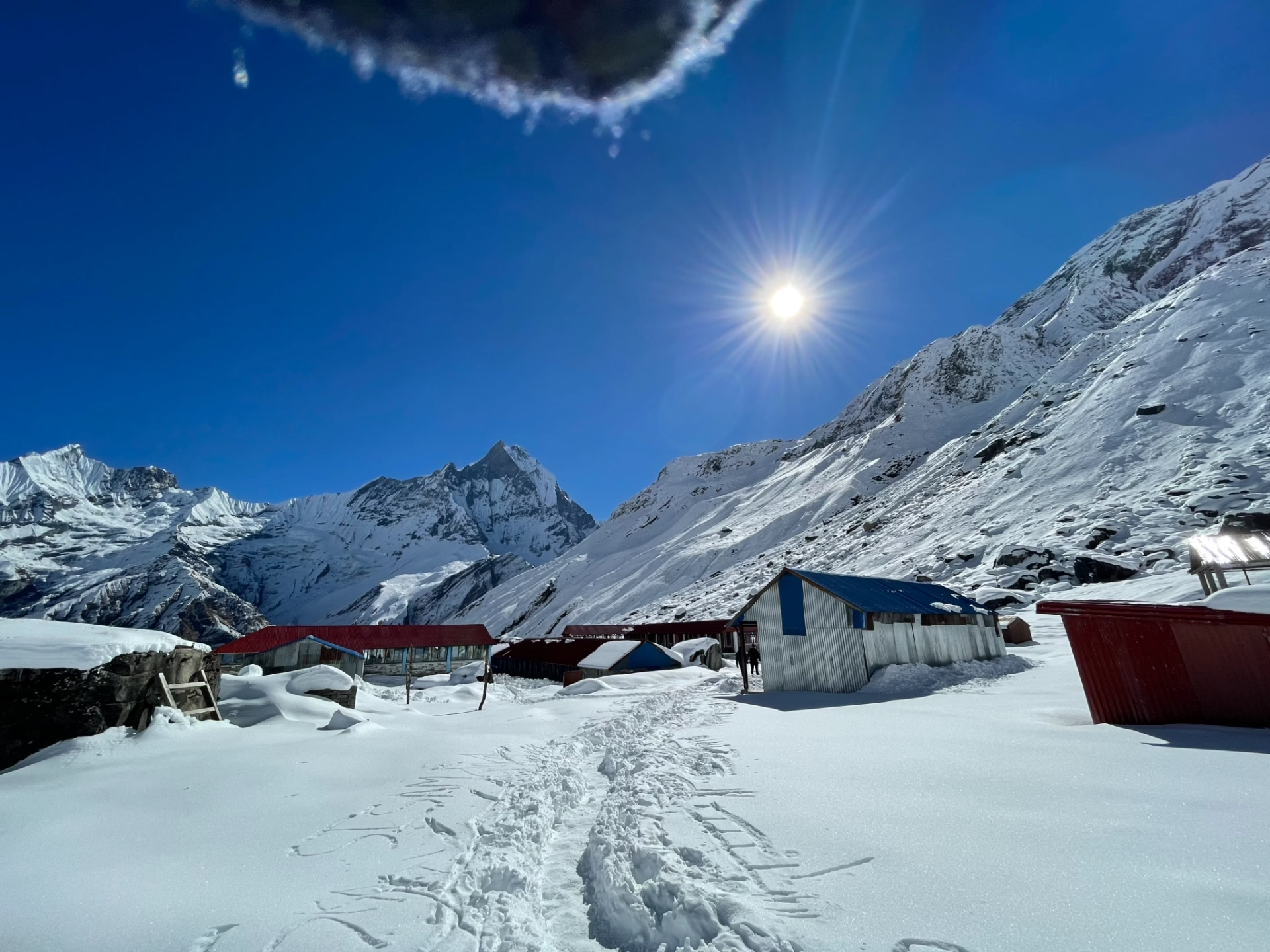
Yes, it snows on the trek in December above roughly 3,000 m, with the snowline starting near Deurali and snow cover reaching the base camp in most years. Lower villages see snow only after major storms.
Snow behavior follows 3 zones:
Below Chhomrong (under 2,200 m): Dry trails and mild days.
Chhomrong to Deurali (2,200-3,200 m): Patchy snow and icy shaded steps, especially between Sinuwa and Bamboo.
Deurali to ABC (3,200-4,130 m): Consistent snow cover, a packed trail in busy weeks and drifts after storms.
A single storm leaves tens of centimeters on the upper trail. Poles, waterproof gaiters and insulated boots handle most conditions. After a heavy system, guides hold the group at the last safe lodge for 24-48 hours while the snowpack settles. This is routine winter practice, not an emergency. Poon Hill and Ghorepani (2,850 m) catch snow in some Decembers and turn into the most photogenic spots on the route.
How Many Hours of Daylight Are Available for Trekking in December?
Pokhara receives about 10 hours 30 minutes of daylight on December 1 and about 10 hours 20 minutes on December 21, but the usable window inside the Sanctuary is closer to 8 hours. Mountain walls delay sunrise and bring sunset forward.
Inside the Modi Khola valley, direct sun reaches the trail around 8:00 a.m. and leaves the base camp around 4:00 p.m., according to typical guide schedules. Four rules follow:
Start by 6:30 a.m. on the Deurali-to-ABC day.
Reach the next lodge by 2:00-3:00 p.m., before cloud and cold arrive.
Carry a headlamp every day, plus spare lithium batteries.
Plan lunch stops in the sun, because shaded porches stay cold.
Is the Annapurna Base Camp Trek Safe in December?
The trek is safe in December for fit, acclimatized trekkers who walk with a licensed guide, keep a flexible schedule and carry cold-weather gear; its 2 main hazards are avalanche terrain between Himalaya and MBC and altitude sickness above 3,200 m. Most incidents trace back to rushed itineraries, not the season itself.
Two events anchor the risk picture. In January 2020, an avalanche between Deurali and MBC killed 7 people, among them 4 South Korean trekkers and 3 Nepali guides. In late October 2025, following unseasonable weather and localized snow sliding in the upper sanctuary, timely communication and swift guide decisions ensured all trekking groups remained safe and unharmed. Both events show that the upper sanctuary is active avalanche terrain where guide decisions on timing change outcomes.
What Are the Main Risks of Trekking to Annapurna Base Camp in December?
The 6 main risks are avalanche, altitude sickness, hypothermia and frostbite, icy footing, short daylight and delayed evacuation.
Avalanche: Slopes between Himalaya, Hinko Cave and Deurali, and the MBC-to-ABC traverse, release snow after storms.
Altitude sickness: Symptoms start above 2,500 m and intensify beyond 3,200 m.
Hypothermia and frostbite: Hypothermia is a core temperature below 35°C. Frostbite is tissue freezing in fingers, toes, nose and ears. Layers, dry socks and a warm sleeping system prevent both.
Icy footing: Shaded stone steps at Chhomrong and Sinuwa glaze over. Microspikes and poles reduce falls.
Short daylight: About 8 usable hours inside the Sanctuary.
Delayed evacuation: Heavy cloud grounds helicopters, and winter fog delays flights at Pokhara and Kathmandu. Insurance must cover helicopter rescue to 4,500 m, and the itinerary needs 1 spare day.
How Can You Prevent Altitude Sickness During the Winter Annapurna Base Camp Trek?
To prevent altitude sickness on the winter trek, limit sleeping-altitude gains to about 500 m per day above 3,000 m, drink 3-4 liters daily, avoid alcohol, measure oxygen saturation twice daily and descend at the first red-flag symptom. The CDC Yellow Book gives the same ascent guideline.
Altitude sickness has 3 forms. Acute mountain sickness (AMS) causes headache, nausea, dizziness and poor sleep. High-altitude pulmonary edema (HAPE) fills the lungs with fluid and causes breathlessness at rest. High-altitude cerebral edema (HACE) swells the brain and causes confusion and loss of balance. HAPE and HACE demand immediate descent.
Follow these 7 steps:
Sleep low: Gain no more than 500 m of sleeping elevation per day above 3,000 m.
Split the Deurali day: Sleep at Deurali (3,200 m), then MBC (3,700 m), then ABC (4,130 m). The standard 15-day plan climbs 930 m from Deurali to ABC in one day, which exceeds the guideline.
Drink on schedule: Include hot lemon, ginger and garlic soup.
Skip alcohol and sleeping pills: Both suppress breathing at night.
Measure SpO2 daily: Readings in the high 80s are common near 4,000 m. A reading below 80% with symptoms triggers descent.
Discuss acetazolamide with a doctor: The Wilderness Medical Society lists 125 mg twice daily as a preventive dose.
Descend immediately: Any HAPE or HACE sign means going down at once, even at night.
The Poon Hill loop on Days 5-6 gives the body an early acclimatization boost before the Sanctuary.
Can Heavy Snowfall or Ice Affect the Annapurna Base Camp Trekking Route?
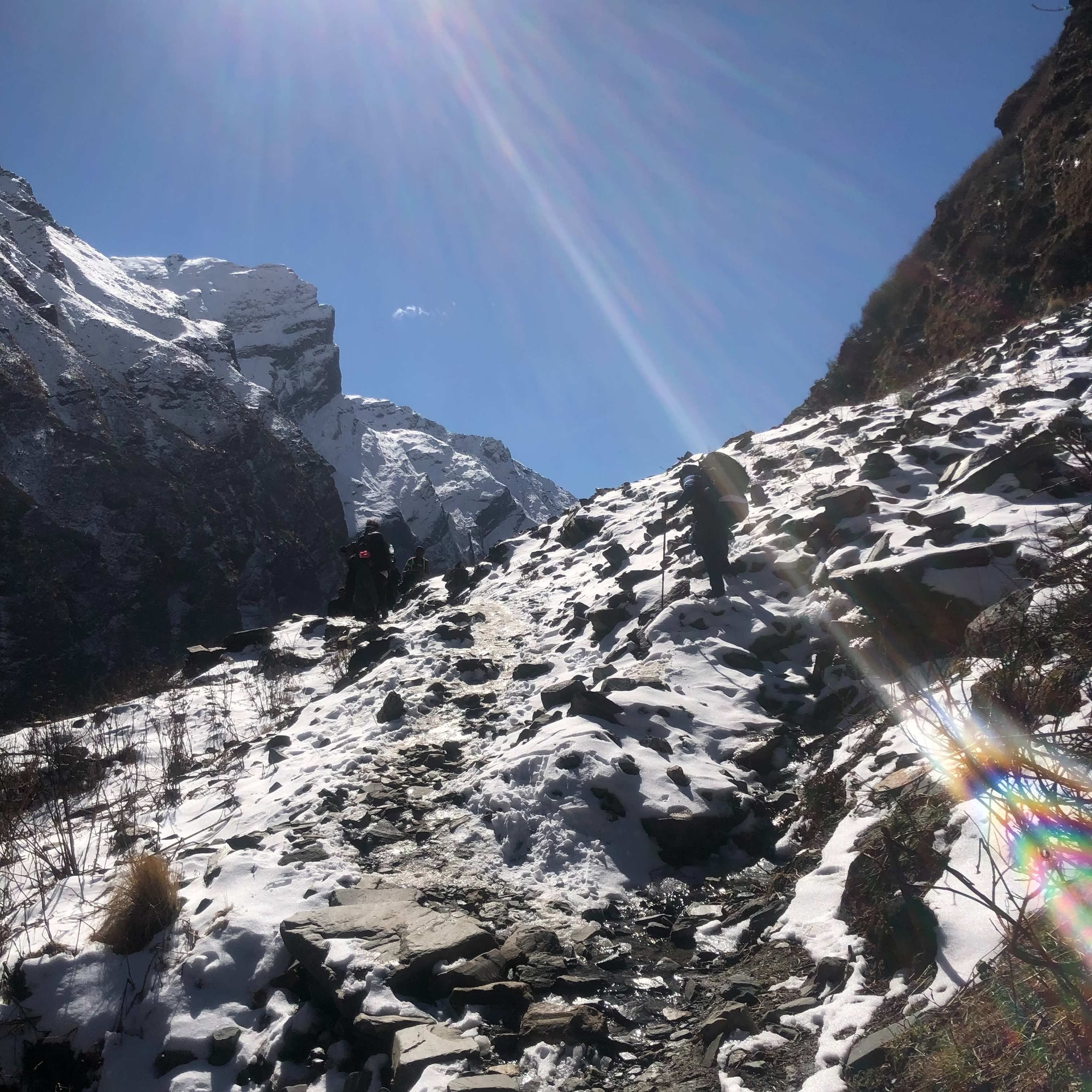
Yes, heavy snowfall and ice slow progress, close sections temporarily and raise avalanche hazard, but the trail stays open through most of winter. Pauses of 24-48 hours after major storms are normal.
Avalanche hazard peaks 24-72 hours after heavy snowfall and again on sunny afternoons when the snowpack warms. Guides apply 4 working rules: cross exposed slopes before 10:00 a.m., never cross during snowfall, space trekkers out one at a time, and turn around when conditions change.
Ice forms on the stone staircases between Chhomrong and Sinuwa, at stream crossings near Bamboo and on the traverse beyond Deurali. Lightweight microspikes turn a slippery descent into a controlled one.
The most common mistake we see is treating the buffer day as wasted time. In winter it is the safety margin.
Do You Need a Guide for the Annapurna Base Camp Trek in December?
Yes, a licensed guide is the right choice in December, because winter adds avalanche decisions, ice, reduced lodge options and fast-changing weather. Rules on independent trekking in the Annapurna Conservation Area have changed repeatedly since 2023, and agencies publish conflicting summaries. Confirm the current rule with the Nepal Tourism Board or a TAAN-registered agency. The December answer does not depend on the legal position.
A winter guide does 5 jobs a map cannot:
Read snow and avalanche conditions on the Himalaya-Deurali-MBC stretch.
Decide when to start, wait or turn back.
Monitor oxygen saturation and symptoms for the whole group.
Secure rooms at the few lodges still operating at altitude.
Coordinate evacuation and insurance contact in an emergency.
What Is the Annapurna Base Camp Trek Route in December?
The December route follows the classic path: Nayapul, Tikhedhunga, Ghorepani and Poon Hill, Tadapani, Chhomrong, Dovan, Deurali, MBC and ABC, then back via Bamboo, Jhinu Danda and Nayapul. The loop covers about 110-115 km.
The route enters the Sanctuary through the Modi Khola gorge, a narrow valley between Hiunchuli and Machhapuchhre. Beyond Chhomrong there is one trail and no villages, only lodges at Sinuwa, Bamboo, Dovan, Himalaya, Deurali, MBC and ABC. Conservation rules limit new construction there, which keeps capacity small.
The Poon Hill section is the December advantage. Sleeping at Ghorepani (2,850 m) on Day 5 and climbing Poon Hill (3,210 m) on Day 6 builds acclimatization before the Sanctuary. Trekkers who skip it for speed lose that buffer.
How Many Days Does the Annapurna Base Camp Trek Take in December?
The trek takes 15 days in Heaven Himalaya's standard plan, including 10 trekking days, and runs from 7 days (customized short route) to 16 days (with an extra acclimatization or weather night). Winter favors the longer end.
Duration | Trekking days | Route | December fit |
7-9 days | 5-6 | Shortened route to Chhomrong | Fast, but compresses acclimatization |
11 days | 7 | Short ABC trek | Works only in early December |
15 days | 10 | Standard route with Poon Hill | Recommended, includes recovery |
16 days | 11 | Standard route plus MBC night or weather buffer | Best for late December |
A spare day costs about $60–$100 in lodging and meals and protects the whole itinerary.
What Is the Day-by-Day Annapurna Base Camp Trek Itinerary?
The 15-day itinerary has 2 arrival and sightseeing days, 1 driving day to Pokhara, 10 trekking days and 2 return days, with walking times of 4-7 hours.
Day 1: Arrive in Kathmandu (1,400 m). Meet your guide and rest. Winter fog occasionally delays inbound flights.
Day 2: Tour Kathmandu Valley. Visit Pashupatinath, Boudhanath, Swayambhunath and Durbar Square, then attend the trek briefing. Rent winter gear in Thamel.
Day 3: Drive to Pokhara (822 m). The Prithivi Highway takes 6-7 hours.
Day 4: Drive to Nayapul and trek to Tikhedhunga (1,540 m). Register at the Birethanti permit checkpost.
Day 5: Trek to Ghorepani (2,850 m). Climb the Ulleri stone staircase into rhododendron forest. Expect the first cold night.
Day 6: Hike Poon Hill (3,210 m), then trek to Tadapani (2,630 m). Start at 5:00 a.m. for sunrise, then walk 6-7 hours.
Day 7: Trek to Chhomrong (2,170 m). Cross the Kimrong Khola and climb the stone steps. Shaded steps ice over.
Day 8: Trek to Dovan (2,600 m). Pass Sinuwa and Bamboo through bamboo and oak forest.
Day 9: Trek to Deurali (3,200 m). Pass Himalaya and Hinko Cave and cross the avalanche-prone section early, on guide approval only.
Day 10: Trek to Annapurna Base Camp (4,130 m) via MBC (3,700 m). Start by 6:30 a.m. and arrive before 1:00 p.m. In late December, add an MBC night.
Day 11: Trek to Bamboo (2,310 m). Watch the sunrise, then descend 5-6 hours into warmer air.
Day 12: Trek to Jhinu Danda (1,780 m). Soak in the hot springs.
Day 13: Trek to Nayapul (1,070 m), then drive to Pokhara.
Day 14: Drive to Kathmandu. The road takes 7-8 hours. Enjoy the farewell dinner.
Day 15: Depart Kathmandu. Transfer to the airport 3 hours before your flight.
What Is the Highest Altitude Reached During the Annapurna Base Camp Trek?
The highest altitude reached is 4,130 m (13,550 ft) at Annapurna Base Camp. Poon Hill (3,210 m) is the highest point before the Sanctuary, and Machhapuchhre Base Camp (3,700 m) is the last stop before ABC.
The trek crosses no pass, so altitude risk comes from steady gain. The table below shows sleeping altitude by night against the 500 m guideline, which applies above 3,000 m.
Night | Location | Sleeping altitude | Change from previous night |
4 | Tikhedhunga | 1,540 m | n/a |
5 | Ghorepani | 2,850 m | +1,310 m (below the 3,000 m threshold) |
6 | Tadapani | 2,630 m | -220 m |
7 | Chhomrong | 2,170 m | -460 m |
8 | Dovan | 2,600 m | +430 m |
9 | Deurali | 3,200 m | +600 m |
10 | ABC | 4,130 m | +930 m (standard) or +430 m (after an MBC night) |
Only the Deurali-to-ABC jump exceeds the guideline above 3,000 m, and an MBC night resolves it.
Which Villages and Attractions Can You Visit Along the Annapurna Base Camp Trek Route?
The route passes through 11 notable stops: Nayapul, Birethanti, Ulleri, Ghorepani, Chhomrong, Bamboo, Dovan, Himalaya, Deurali, MBC and Jhinu Danda.
Nayapul (1,070 m): The trailhead on the Pokhara-Baglung highway.
Birethanti: A riverside bazaar with the permit checkpost.
Ulleri: A Magar village known for its long stone staircase.
Ghorepani (2,850 m): A Gurung hill station named for "ghoda" (horse) and "pani" (water).
Chhomrong (2,170 m): The largest Gurung settlement and the last village before the Sanctuary.
Bamboo and Dovan: Forest lodges in bamboo, oak and rhododendron.
Himalaya and Hinko Cave: A rock overhang and lodge cluster below Hiunchuli, at the start of the avalanche zone.
Deurali (3,200 m): The gateway to the upper sanctuary.
Jhinu Danda (1,780 m): Hot springs beside the Modi Khola.
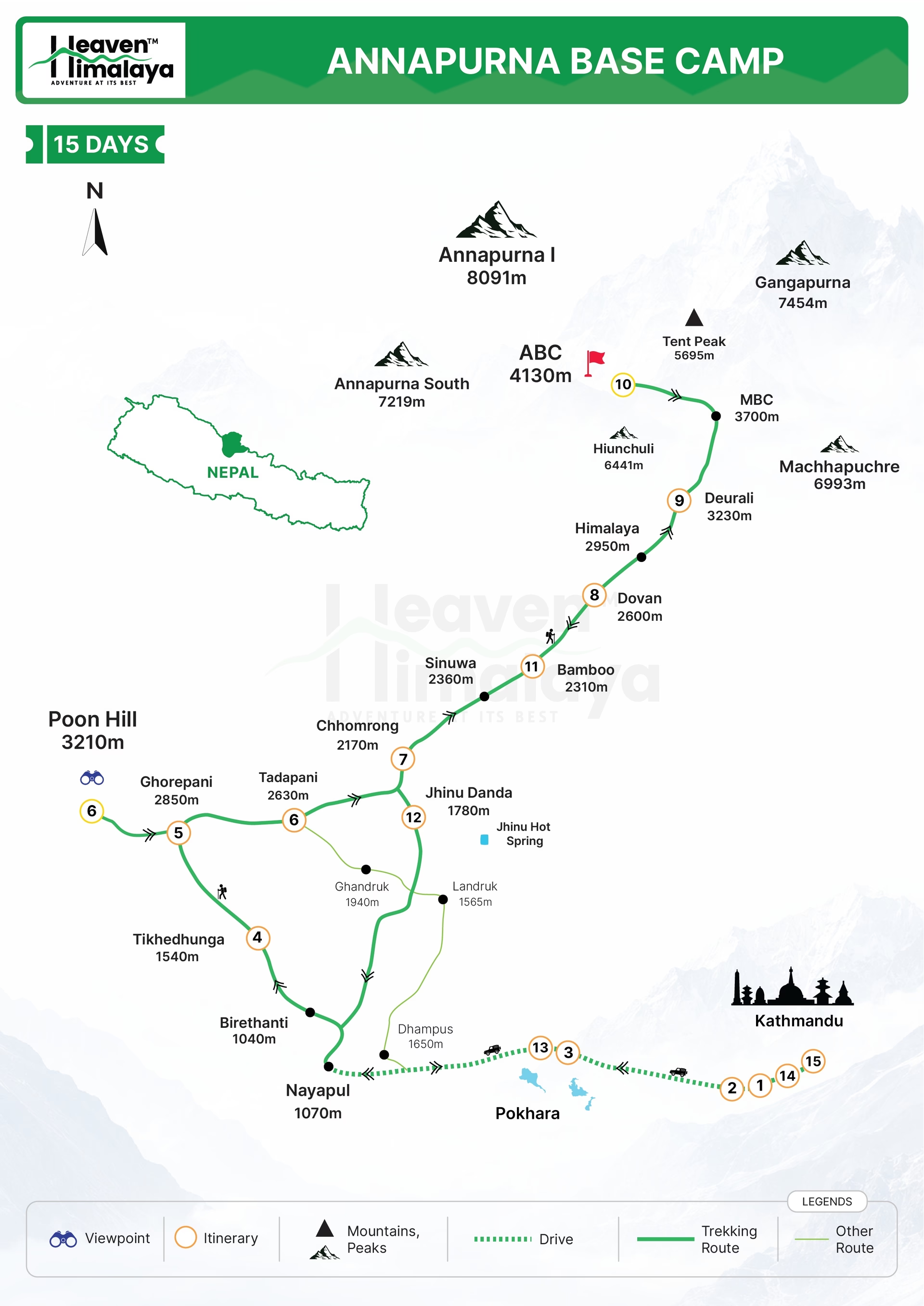
Annapurna Base Camp Trek route map
What Should You Pack for the Annapurna Base Camp Trek in December?
Pack for -20°C nights with a 4-layer system (base, mid, insulation, shell), insulated waterproof boots and a sleeping bag rated to -15°C or lower, keeping your load within the 10-12 kg porter allowance. Heaven Himalaya supplies a duffel bag, sleeping bag and down jacket, returned after the trek.
One porter carries the bags of 2 trekkers, so every extra kilogram lands on someone's back. For a full checklist, read the Heaven Himalaya Trekking Packing List.
Which Winter Trekking Clothes Are Essential for December?
The essential clothing is a 4-layer system: a merino base layer, a fleece mid-layer, a down jacket and a waterproof shell.
Base layer: 2 thermal tops and 2 bottoms. Keep one set dry for sleeping.
Mid layer: 1-2 fleece jackets.
Insulation: A down jacket with 700+ fill power.
Shell: A waterproof, breathable jacket and trousers.
Hands: Liner gloves plus heavyweight mitts.
Head and face: A wool beanie, balaclava, neck gaiter and category-4 glacier sunglasses.
Socks: 4 pairs of wool socks plus 1 dry pair for the sleeping bag.
Cotton is the one fabric to leave behind, because it holds sweat and loses heat.
What Trekking Boots and Equipment Do You Need?
You need waterproof, insulated, broken-in boots with ankle support, plus poles, gaiters, microspikes, a headlamp and insulated bottles. New boots cause blisters over 10 days, so wear them for 2-3 weeks of training walks first.
Gaiters: Waterproof gaiters keep snow out above 3,200 m.
Microspikes or crampons: Optional on Heaven Himalaya's list, valuable on icy steps.
Poles: Collapsible, with snow baskets.
Headlamp: Spare lithium batteries outperform alkaline in the cold.
Bottles: 2 wide-mouth 1-liter bottles. A hot-water fill doubles as a bed warmer.
Power: A solar charger or power bank kept inside your jacket.
Care items: SPF 50 sunscreen, lip balm, purification tablets, blister plasters.
Do You Need Sleeping Bags and Thermal Layers for the Annapurna Base Camp Trek?
Yes, you need both: a sleeping bag with a comfort rating of -15°C or lower and dry thermal layers for sleeping. Lodge rooms stay close to the outside temperature, and a lodge blanket adds little.
A silk or fleece liner adds roughly 3-5°C and keeps the shared bag clean. Sleep in dry thermals, not the clothes you walked in, and keep tomorrow's boots in the bag's foot box so they do not freeze. For late December, a comfort rating of -20°C is the safer bet.
How Much Does the Annapurna Base Camp Trek Cost in December?
The trek costs $799 to $1,299 per person for Heaven Himalaya's 15-day package in 2026, depending on group size, with a realistic all-in budget of $1,650–$1,850 per person for a small group.
Group size | Price per person (USD) |
1 traveler | $1,299 |
2-3 travelers | $1,250 |
4-6 travelers | $1,050 |
7-12 travelers | $947 |
13-16 travelers | $899 |
17-22 travelers | $799 |
Larger groups lower the per-person cost because guide and vehicle costs are shared. Independent private ABC treks typically run $1,000–$1,400 per person. Costs outside the package:
Nepal visa: $50 for 15 days, available on arrival at Kathmandu airport.
Travel insurance: Typically $60–$150 for 2 weeks, with helicopter evacuation
Tips: Commonly $10–$15 per day for the guide and $7–$10 per day per porter, shared by the group.
Personal spending: Drinks, snacks, showers, charging and gear rental, about $150–$250.
Cash: At least $400 in rupees, because lodges accept cash only.
What Is Included in the Annapurna Base Camp Trek Package?
The package includes ground transport, Kathmandu sightseeing, hotel nights in Kathmandu and Pokhara, trekking lodges, full-board meals on trek, permits, a licensed guide, porters, an oximeter and emergency rescue coordination. Insurance and the visa are separate.
Airport transfers and all ground transport
Kathmandu Valley sightseeing with guide and entrance fees
3-star hotels with breakfast in Kathmandu and Pokhara
Twin-share lodges, plus breakfast, lunch, dinner, snacks and evening fruit on trek
ACAP, TIMS and heritage entry fees
A licensed English-speaking guide, with an assistant guide for groups of 6 or more
1 porter for every 2 trekkers, with accident insurance
Duffel bag, sleeping bag and down jacket on loan
An oximeter, a first-aid kit and a farewell dinner
Exclusions are the visa, insurance, beverages, personal gear, extra nights and tips.
Are Accommodation and Food Available Along the ABC Trail in December?
Yes, lodges and meals operate along the whole trail in December, with full service below Chhomrong, good service to Deurali, and reduced menus and occasional closures at MBC and ABC in late December. Rooms are basic twins with a thin mattress and blankets.
Capacity matters at altitude. Conservation rules cap construction beyond Chhomrong, so the stop at Himalaya holds only 2-3 lodges, and a booking through a registered agency fixes your rooms in advance.
Food stays reliable. Breakfast offers porridge, eggs, chapati and Tibetan bread. Lunch and dinner center on dal bhat (rice, lentil soup, vegetables), with noodle soup, momo, fried rice and pasta as alternatives. Boiled water is free at lodges and costs $1–$2 at tea shops.". Winter adds 3 changes:
Hot showers disappear above Himalaya. Pack wet wipes from Deurali upward.
Charging costs more, because weak winter sun reduces solar output.
Menus shrink at MBC and ABC, so carry energy bars and chocolate.
Do You Need Trekking Permits for Annapurna Base Camp?
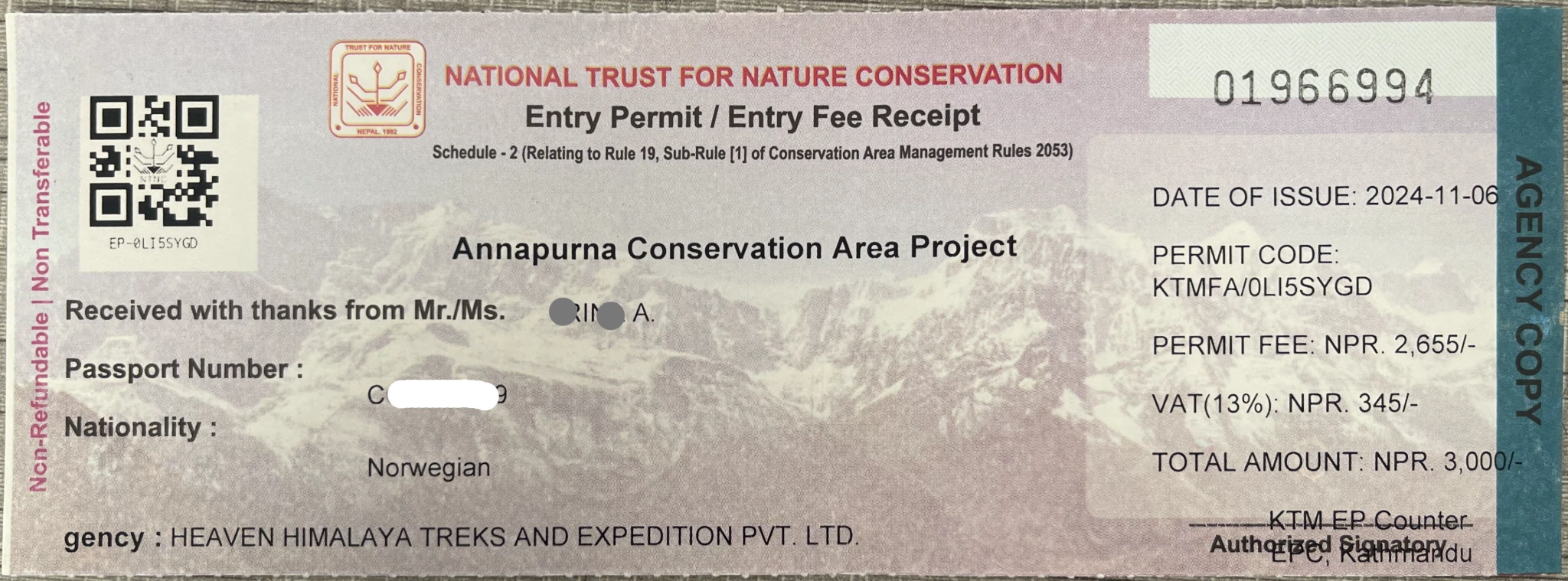
Yes, you need the Annapurna Conservation Area Permit (ACAP) at NPR 3,000 for foreign nationals and the TIMS card at NPR 2,000. Some sources quote ACAP at about NPR 3,390 including 13% VAT.
Permit | Foreign nationals | SAARC nationals | Purpose |
ACAP | NPR 3,000 (about $23) | Discounted rate | Entry to the conservation area, funds trail and conservation work |
TIMS card | NPR 2,000 (about $15) | NPR 1,000 | Trekker registration and rescue tracking |
Permit rules and fees change, so confirm them with a registered agency at booking. The ACAP is single-entry: leaving the conservation area ends its validity. Heaven Himalaya includes permits in its package. For a detailed breakdown, read Annapurna Trekking Permits Complete Guide.
What Are the Advantages and Disadvantages of Trekking to Annapurna Base Camp in December?
December offers 5 advantages (clear views, quiet trails, snow scenery, lodge availability, solitude) and 5 disadvantages (extreme cold, short days, avalanche risk, reduced services, weather delays). Early December tilts toward the advantages, and late December toward the disadvantages.
What Are the Benefits of ABC Trekking During the Winter Season?
The 5 main benefits are exceptional visibility, minimal crowds, snow scenery, flexible lodge choice and cultural access.
Exceptional visibility: Dry air reveals every ridge for photography at Poon Hill and ABC.
Minimal crowds: Narrow trails and small lodges feel spacious, and guides give each group more time.
Snow scenery: The Sanctuary looks nothing like its autumn self, which rewards repeat trekkers.
Flexible lodge choice: Trekkers choose rooms without competing with 100 other people.
Cultural access: Lodge families have time for tea and conversation in the slow season.
What Challenges Should You Expect on the December ABC Trek?
The 6 challenges are cold nights, short daylight, avalanche exposure, ice, reduced lodge services and weather delays. Preparation turns each one into a task.
Cold nights: Sleeping at -10°C to -20°C wears on morale. Choose the right bag and sleep in dry layers.
Short daylight: Plan early starts and mid-afternoon arrivals.
Avalanche exposure: Follow the guide's timing and spacing rules.
Ice: Use microspikes and poles on shaded stairs.
Reduced services: Carry snacks, cash, spare batteries and wet wipes.
Weather delays: Hold a buffer day and keep insurance details within reach.
Is Annapurna Base Camp in December Better Than in Spring or Autumn?
December is better than spring or autumn for solitude, snow scenery and clear winter light, and worse for warmth, comfort and lodge reliability. Autumn (September-November) and spring (March-May) remain the standard seasons.
The table below compares the 3 seasons on 8 factors.
Factor | December | Autumn | Spring |
ABC night temperature | -10°C to -20°C | -5°C to -10°C | -5°C to -12°C |
Snow on the upper trail | Likely | Limited | Moderate in March, light by May |
Visibility | Excellent | Excellent | Good, some haze |
Crowds | Low | Highest (October peak) | High |
Lodge reliability | Good early, thinner late | Full, crowded | Full |
Scenery | Snow-white sanctuary | Clear peaks | Rhododendron blooms |
Daylight (Pokhara) | About 10.4 h | About 11 h | About 12.5 h |
Overall difficulty | Moderate-to-challenging | Moderate | Moderate |
Photographers and solitude seekers lean toward December. First-timers who want comfort lean toward late October or November. Flower and wildlife enthusiasts lean toward April. The Heaven Himalaya guide to the Best Time to Trek in Nepal covers the full seasonal picture.
How Can Heaven Himalaya Help You Plan the Annapurna Base Camp Trek in December?
Heaven Himalaya helps you plan the trek through a customizable 7-15 day itinerary, licensed guides, loaned winter gear, an oximeter, permit handling and direct WhatsApp support. The company is based at Gitanjali Chowk, Dathu Sadak, Kathmandu.
Heaven Himalaya Treks & Expedition has operated in Nepal for 13+ years. Travelers rate its trips 5.0 out of 5 across 160 reviews, and it holds Tripadvisor Travelers' Choice awards for 2021 through 2025. It is affiliated with the Nepal Tourism Board, the Trekking Agencies' Association of Nepal (TAAN) and the Nepal Mountaineering Association. The full 15-day plan appears on the 15-Day Annapurna Base Camp Trek 2026 page.
Plan your December departure. Share your dates, group size and trekking experience, and a trip planner will reply with a day-by-day plan. Contact Heaven Himalaya at +977 985 1273867 (WhatsApp/Viber) or info@heavenhimalaya.com.
Can Heaven Himalaya Arrange a Guided Annapurna Base Camp Trek in December?
Yes, Heaven Himalaya arranges guided treks in December on private and custom dates, with a licensed English-speaking guide, porters and winter-specific adjustments. Travelers choose their own start dates by contacting the team.
A guided December trek includes a licensed guide trained for altitude illness, 1 porter per 2 trekkers, an oximeter and first-aid kit, and a sleeping bag and down jacket on loan. The itinerary flexes to conditions: a possible MBC night, a weather-day hold or a revised start time. Past travelers describe guides adjusting the plan on the trail when conditions required it.
For other styles, Heaven Himalaya runs the Annapurna Base Camp Helicopter Return, which skips the long descent, and the Annapurna Panorama Trek, a 10-day lower-altitude alternative that avoids the avalanche zone. The Customize Trip form handles special requests.
What Should You Know Before Booking the Annapurna Base Camp Trek in December?
Before booking, confirm 8 items: dates, buffer day, insurance, gear, fitness, visa and passport, cash and lodge status.
Dates: Prefer December 1-15. Late December demands more cold-weather experience.
Buffer day: Add 1 spare day to the 15-day plan.
Insurance: Confirm cover for trekking to 4,500 m and helicopter evacuation.
Gear: Check what the package lends and what you bring (boots, gloves, thermals).
Fitness: Train 8-12 weeks with 3-4 cardio sessions weekly and weighted stair or hill walks.
Visa and passport: The visa costs $50. The passport needs 6 months of validity, plus 4-5 passport photos.
Cash: Carry at least $400 in rupees.
Lodge status: Ask your agency about services at MBC and ABC on your dates.
The Heaven Himalaya guides to the Nepal Tourist Visa and Essential Travel Preparation cover document details.
The Annapurna Base Camp trek in December rewards trekkers who respect its cold and its short days. Early-month dates, a licensed guide, a spare day and a proper sleeping system turn a demanding winter trek into one of the most memorable walks in the Himalaya.
Ready to start planning? Message the Heaven Himalaya team on WhatsApp at +977 985 1273867 to check December availability and request a custom itinerary.