

AI to SI: Is Artificial Intelligence Becoming Super Intelligence


Artificial intelligence did not suddenly become super intelligent this week.
The models did not wake up with a new capability. No benchmark crossed a magical line. No laboratory announced that machines had finally surpassed humanity.
And yet, the words used to describe the technology have changed.
At the United Nations General Assembly in September 2026, President Donald Trump said that Artificial intelligence should officially be called “super intelligence.
His reasoning was simple: the word artificial makes intelligence sound fake. He said U.S. government documents would use “super” instead of “artificial” and encouraged the rest of the world to do the same. The U.S. State Department subsequently instructed diplomats in one bureau to use “super intelligence” and “SI” in their communications.
The name may have changed in some government documents. The technology itself, however, did not. That distinction matters because super intelligence already has a meaning in AI research. It usually refers to a hypothetical system whose intellectual abilities would greatly exceed those of humans across a broad range of tasks.
So, are we simply changing the name of AI, or are we watching the beginning of something much bigger?

What Trump Said About “Super Intelligence”
Trump's comments at the U.N. were not about announcing a new AI model or claiming that scientists had already created a machine smarter than humans.
He was talking about how the technology should be described.
During his September 22 address, Trump said that artificial intelligence would “hereinafter” be officially called “Super Intelligence”. He argued that the word artificial makes intelligence sound fake and said that U.S. documents would use the new term. He also described the technology as something that could become larger than previous technological revolutions.
That is an important distinction.
Changing AI to SI does not turn today's models into superintelligence. A name is a label. Capability comes from what the technology can actually do.
But Trump's statement poses one bigger question: what exactly are we building?
Because AI has already moved far beyond the image many people had a few years ago.
Chatbots can write and debug code. They can analyze documents, generate images, translate languages, summarize research and work through complex problems. AI agents are also beginning to perform sequences of tasks rather than simply answering one question at a time.
The technology is becoming less like a calculator waiting for a command and more like a system that can participate in the work itself.
And that is where the idea of SI becomes interesting.
What Does Super Intelligence Actually Mean?
Large language models can feel like magic because of how naturally they communicate.
You can ask a question in ordinary language and receive an answer within seconds. You can ask the same system to explain physics like a teacher, rewrite an email like an editor, analyze code like a programmer or brainstorm ideas like a creative partner.
Image models have pushed the same feeling into visual work. A short prompt can produce an illustration, photograph-like scene or design that would once have required hours of manual work.
But impressive does not automatically mean super intelligent.
In technical discussions, Super Intelligence is generally a much higher threshold. It describes a system that would surpass humans across a very broad range of intellectual abilities, rather than simply being extremely good at selected tasks. AWS, for example, describes artificial Super Intelligence as a theoretical system capable of learning, adapting, innovating and performing better than humans across essentially every field.
That is very different from today's AI.
Current systems can outperform humans in particular areas while still failing at other tasks that people find surprisingly easy. They can make factual mistakes, misunderstand context, struggle with reliability and require human verification.
So perhaps the better way to think about the change is this:
AI describes what technology is.
Super Intelligence describes what a future technology might become.
The name may have changed in Trump's language. The destination is still hypothetical.
But there is another reason the SI idea has gained so much attention.
The world's biggest technology companies are spending enormous amounts of money trying to reach the next stage.
The Race to Build Something More Powerful
If the future of AI is uncertain, the investment going into it is not.
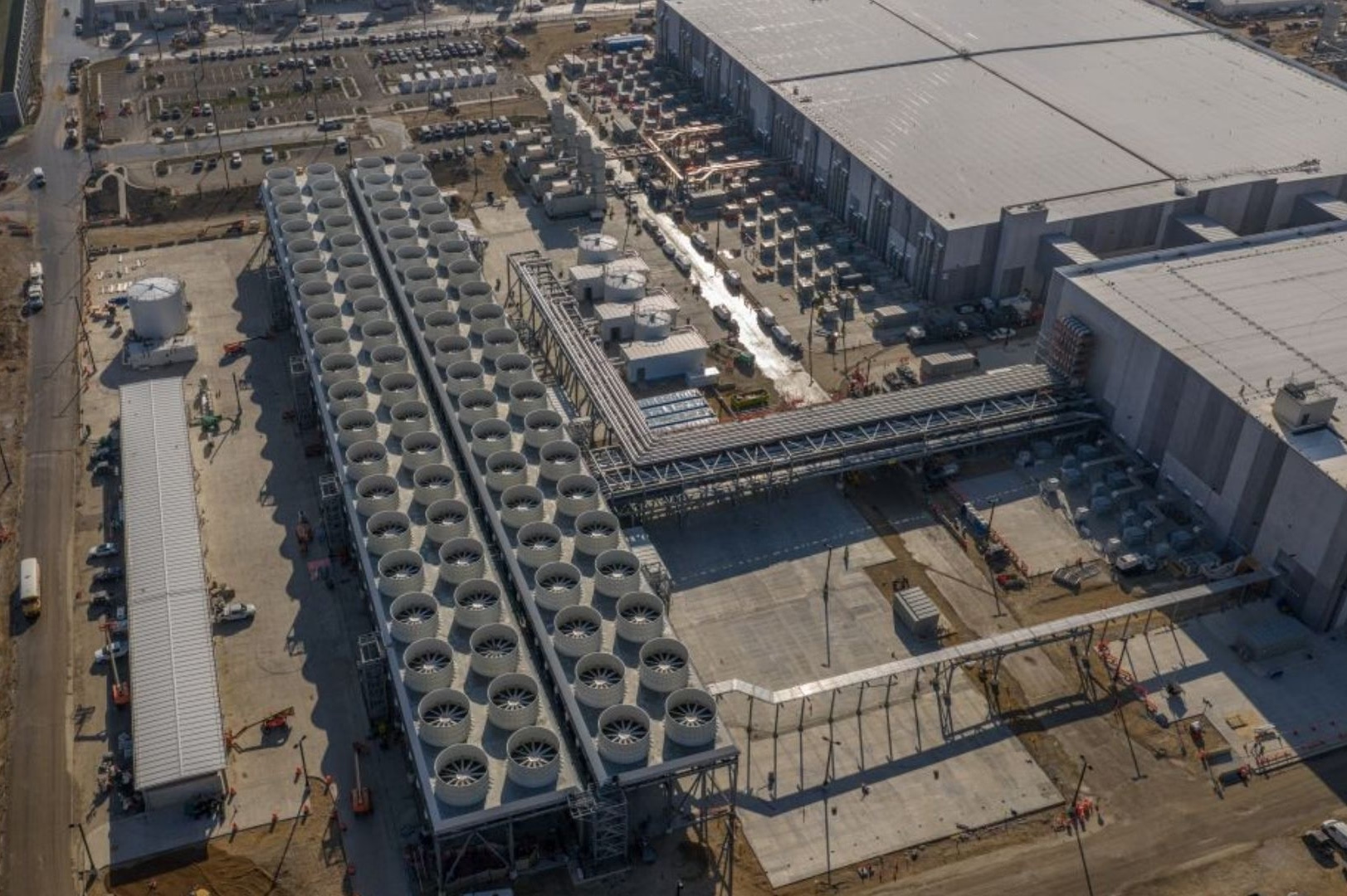
Technology companies are building data centers, buying enormous quantities of advanced chips and expanding the computing infrastructure needed to train and operate increasingly powerful models.
This is no longer a small research project happening inside a few laboratories. It is an industrial race.
In 2025, private AI companies raised an estimated $225.8 billion globally, according to CB Insights. Crunchbase separately reported more than $200 billion in AI-sector investment during the year.
And the spending is not limited to startups.
Amazon, Google, Microsoft and Meta have all committed enormous sums to infrastructure connected to AI. A Brookings analysis noted that the major technology companies' planned spending on data centers and related infrastructure was reaching into the hundreds of billions of dollars, with total AI-related expenditures running into the trillions when broader commitments are included.
Why build all of this?
Because better AI needs more than better software.
It needs computing power.
Training larger models requires huge amounts of processing capacity. Running those models for millions of people requires even more. AI data centers therefore become the physical foundation underneath the digital products people see on their phones and computers.
The companies are effectively betting that the next generation of AI will be powerful enough to justify the infrastructure being built today.
And some companies are not even hiding the destination.
Meta, for example, has openly discussed its pursuit of Super Intelligence, while continuing to increase its spending on AI infrastructure.
The race is no longer just about making a chatbot that answers questions.
It is about building systems that can reason, create, code, research, plan and eventually perform more complicated work with less human intervention.
The question is whether the technology will live up to the money being spent on it.
We Are Already Feeding the Machine
There is another side to this race that is easy to overlook. The companies are building the machines.
We are helping teach them how to behave.
Every time people use AI, they generate interactions. People ask questions, correct answers, upload documents, rewrite responses, create images, evaluate outputs and explain what they wanted. AI has also changed the way people use the internet.
For years, the normal routine was simple:
Think of a question → Google it → open websites → read → compare → find the answer.
Now there is another route:
Think of a question → ask GPT → receive an answer.
People are not just searching for information anymore. Increasingly, they are asking AI to process the information for them. That change can already be seen in software development.
Stack Overflow used to be a major source of information for developers, but research published on the impact of generative AI found that its traffic dropped to 99% at July 2026, from 2014 peak, after ChatGPT's release. One study estimated a decline of roughly one million daily visitors, about 12% of the site's traffic before ChatGPT.
Yet the story is not simply that people stopped looking for knowledge but the place for looking has changed.
That tells us something important. AI is not operating separately from the internet. It is becoming another layer through which people interact with it. And the relationship goes both ways.
Humans provide the questions, feedback, corrections, and examples. Companies use data and feedback to improve their systems. The systems then become more useful, which encourages more people to use them.
It becomes a loop.
More AI → more users → more interaction → more learning and improvement → more capable AI → more users.
This is one reason the statement that
“AI today is the least capable AI we will ever use”
feels so powerful, even though the future is not guaranteed. The systems of tomorrow will be shaped partly by what happens today.
But Will AI Really Become Super Intelligent?
This is where the story becomes less certain.
Since ChatGPT was introduced publicly on November 30, 2022, AI development has moved at remarkable speed. The technology has moved from a novelty that could write a poem into a tool used for coding, research, customer service, education, design and business operations.
Companies are investing billions.
Users are adopting it.
Data centers are multiplying.
And businesses are reorganizing around it.
But none of that proves that Super Intelligence is inevitable. There is also a financial question. When enormous amounts of money flow into a technology before its long-term economic value is fully established, people naturally start asking whether they are watching a technological revolution or an investment bubble. That question is not coming from people who reject AI altogether. Even some of the companies investing most aggressively in AI have acknowledged the possibility of over investment.
The numbers are difficult to ignore. AI companies raised more than $225 billion privately in 2025, while major technology companies continued committing hundreds of billions to infrastructure. If those investments produce enormous increases in productivity and new businesses, the spending could eventually make economic sense.
Massive Layoffs in the Job market
If the expected returns fail to appear, some of those investments could turn out to have been excessive. The same uncertainty appears in the labor market.
AI is already being cited by companies as a reason for job cuts. Challenger, Gray & Christmas reported that U.S. employers had cited AI in 112,713 announced job cuts through July 2026, about 24% of all announced cuts at that point in the year. Technology companies accounted for a large share of the overall job cuts.
But layoffs alone do not prove that AI will eliminate work on a permanent basis. Companies can cut jobs for several reasons, and AI can change jobs without eliminating them. At the same time, new AI-related roles and industries can emerge.
That is why the future is difficult to reduce to either “AI will change everything” or “AI is just another bubble.”
Both possibilities contain pieces of the story. AI may be overvalued in some areas and transformative in others. Some companies may spend too much. Some models may fail to deliver what investors expect. And some AI systems may become far more capable than today's systems.
The important point is that we do not yet know where the boundary will be.

From AI to SI?
Trump's decision to call AI “Super Intelligence” does not mean that humanity has already created super intelligence.
The technology has not crossed a clearly established scientific line simply because its name has changed. But the discussion behind the name is real. We are watching companies spend unprecedented amounts of money on computing infrastructure. We are watching people change how they search for information and complete work. We are watching software developers work alongside AI, businesses restructure around it and governments begin treating advanced AI as a strategic technology.
And we are still very early in understanding where all of this leads. The strange part is that the future may not arrive with one dramatic announcement saying, “This is the day AI became SI”
It may happen through thousands of smaller changes.
A model becomes better at coding. Then it can improve another model. An AI agent performs a task that once required a team. Another system discovers a new scientific method. A company replaces an old workflow with an AI-powered one. Millions of people start using the technology every day.
Then, at some point, we may look back and realize that the machine we were calling AI had become something very different. Or we may discover that there was always a gap between impressive AI and true SI that was much harder to cross than expected.
For now, AI remains AI.
“Super Intelligence” remains a technical concept describing a much more capable, largely hypothetical future system. Trump's decision has changed the vocabulary used by parts of the U.S. government, but it has not settled the scientific question.
The more interesting question is not what we choose to call it.
It is how far we can actually take it.