

Annapurna Base Camp Trek in Winter 2026–27 Guide

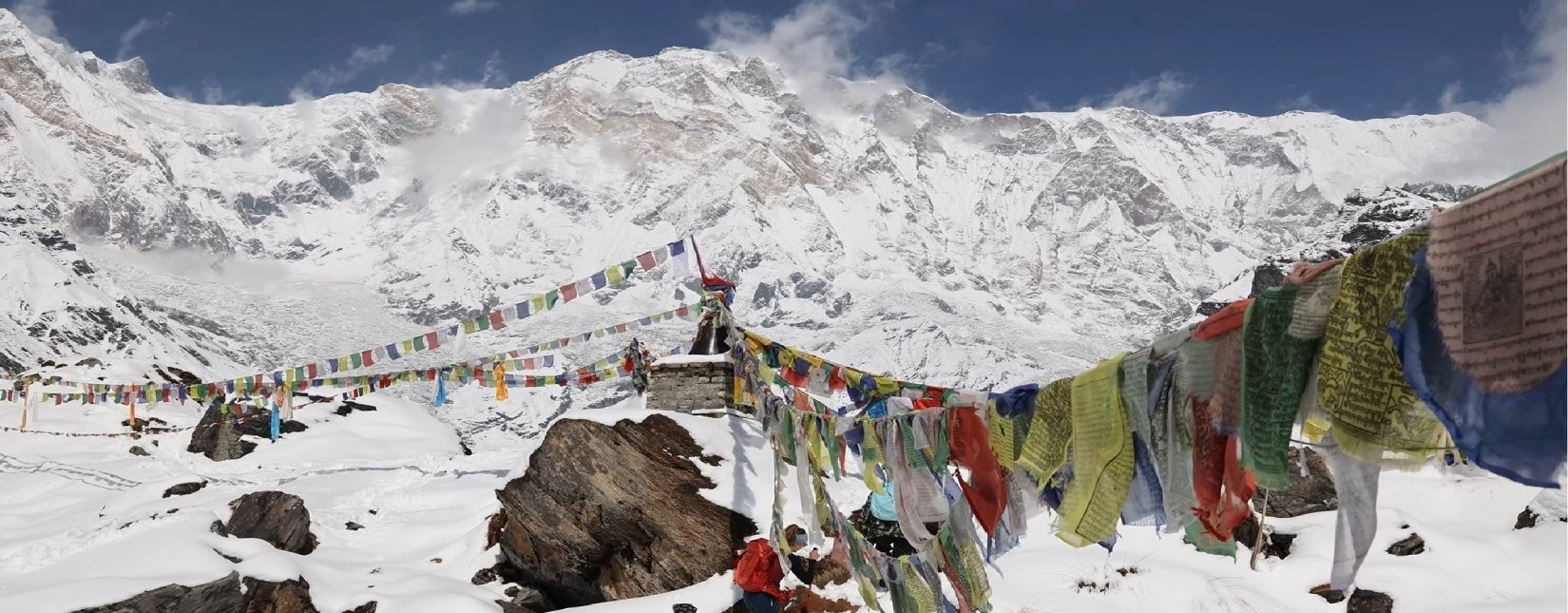
The Annapurna Base Camp Trek in Winter is a high-altitude Himalayan adventure in Nepal that takes trekkers through snow-covered forests, traditional Gurung villages and the spectacular Annapurna Sanctuary to an elevation of 4,130 m. From December to February, the trail offers breathtaking views of Annapurna I (8,091 m), Machhapuchhre (6,993 m) and surrounding Himalayan peaks, along with quieter trekking paths and crisp mountain scenery.
Winter trekking in the Annapurna region brings freezing temperatures, heavy snowfall, icy trails and potential avalanche risks, making proper preparation essential. Choosing the best month, understanding weather conditions, planning the itinerary, arranging suitable accommodation and carrying appropriate winter gear are important for a safe journey. Explore everything about the winter ABC trek, including difficulty, temperatures, route, permits, costs and essential safety precautions for the 2026–27 season.
What Is the Annapurna Base Camp Trek Like in Winter?
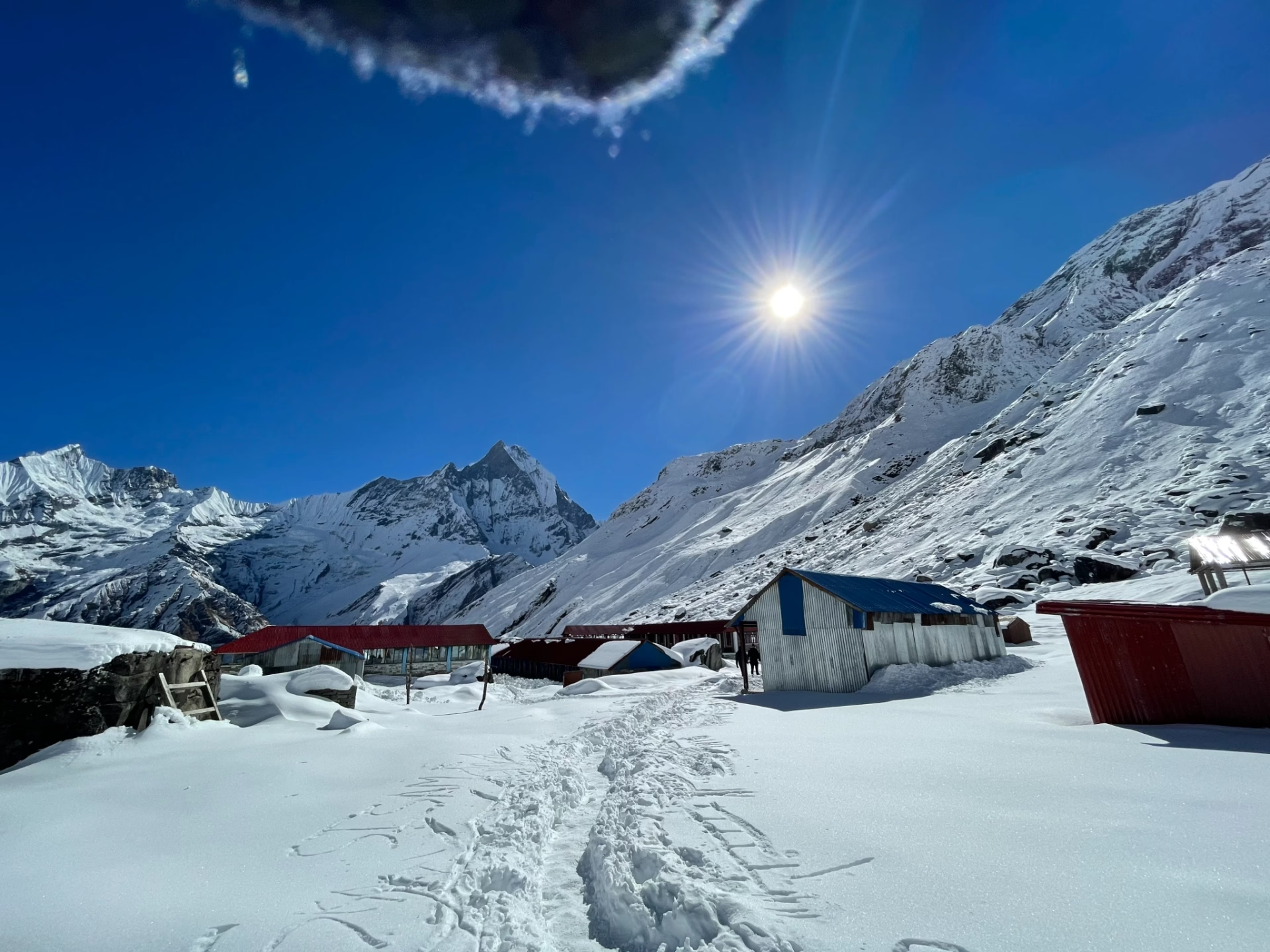
The winter ABC trek is a cold, quiet and snow-covered walk where frozen waterfalls, empty trails and crisp morning views replace autumn's crowds, and where ice, snow and short daylight set the daily pace. Most trekkers finish between 7:00 and 15:30.
A typical winter day follows a fixed rhythm. Guides wake the group at 5:30, serve breakfast at 6:15, and start walking by 7:00. The group reaches the next lodge between 14:30 and 16:00, before the sun drops behind the ridgeline. The dining-room stove stays lit from 17:00, and most trekkers are asleep by 20:00.
In real-world use, the biggest change from autumn is the schedule, not the cold. Winter trekkers use 7–8 hours of daylight above 3,000 m, so a 60-minute late start removes 12% of the walking day.
Annapurna Base Camp Trek
View detailsWhat Makes Annapurna Base Camp a Unique Winter Trekking Destination?
Annapurna Base Camp is unique in winter because 5 features combine in one trek: a 360° mountain amphitheatre, dependable dry-season skies, deep snow cover, low crowds, and Gurung hill culture that stays active in the cold months.
Amphitheatre geometry: The Sanctuary walls rise 3,000–4,000 m above the basin floor, so every sunrise lights the peaks in sequence.
Snow cover: Fresh snow turns the upper Modi Khola valley into a white corridor from Deurali to base camp.
Solitude: Lodges that fill every bed in October host a handful of trekkers in January.
Culture: Gurung villages such as Ghandruk and Chhomrong celebrate Tamu Lhosar, the Gurung New Year, on 30 December.
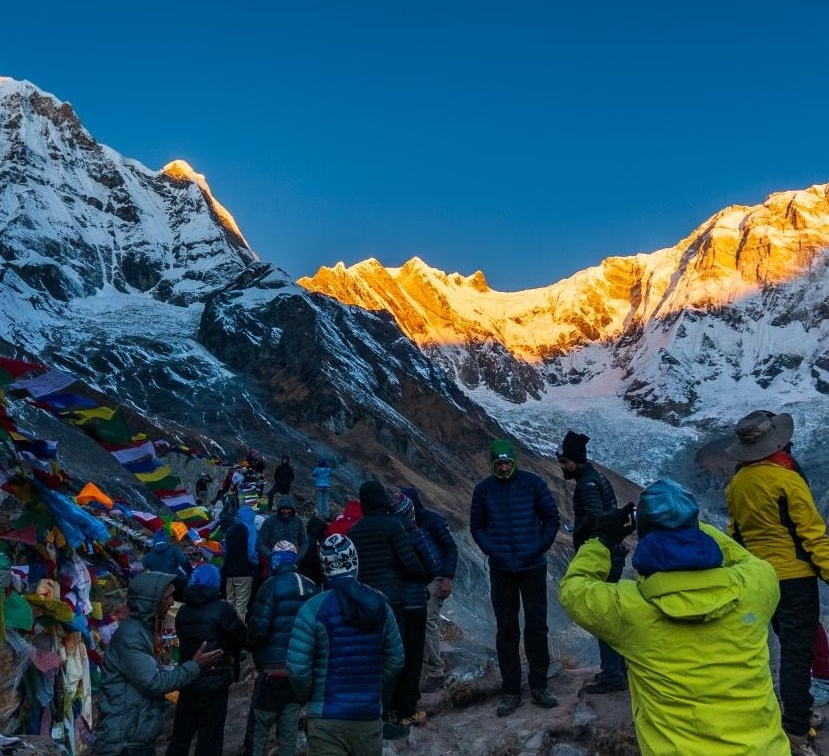
Light: Low winter sun gives long, gold-and-blue shadows on Annapurna I and Machhapuchhre.
Mountaineering history adds depth to the view. Maurice Herzog and Louis Lachenal summited Annapurna I in 1950, the first ascent of any 8,000 m peak. Machhapuchhre (the "Fishtail") remains unsummited, because Nepal closed it to climbers after a 1957 British attempt stopped 50 m below the top.
How Does the Annapurna Region Look During Winter?
The Annapurna region in winter shows bare oak-rhododendron forest below 2,700 m, snow-covered ridges above it, frozen waterfalls in shaded gullies, and a sharp blue sky that gives 80–100 km of visibility on clear mornings.
Below 2,000 m, the trail passes brown terraced fields, stone-wall villages and leafless forest. The snow line sits near 2,700 m in December and drops to 2,000 m after a major storm in January or February.
Above Chhomrong, the Modi Khola gorge narrows. Ice lines the cliffs and snow loads the bamboo. Between Himalaya (2,920 m) and Deurali (3,200 m), the forest ends and open snow slopes begin.
Valley inversion surprises first-time winter trekkers. Cold air traps fog on the Pokhara valley floor until 9:00 or 10:00, while Ghorepani and Poon Hill stand in full sunshine above the cloud. A grey morning in Pokhara does not predict a grey morning on the trail.
What Is the Annapurna Base Camp Winter Temperature?
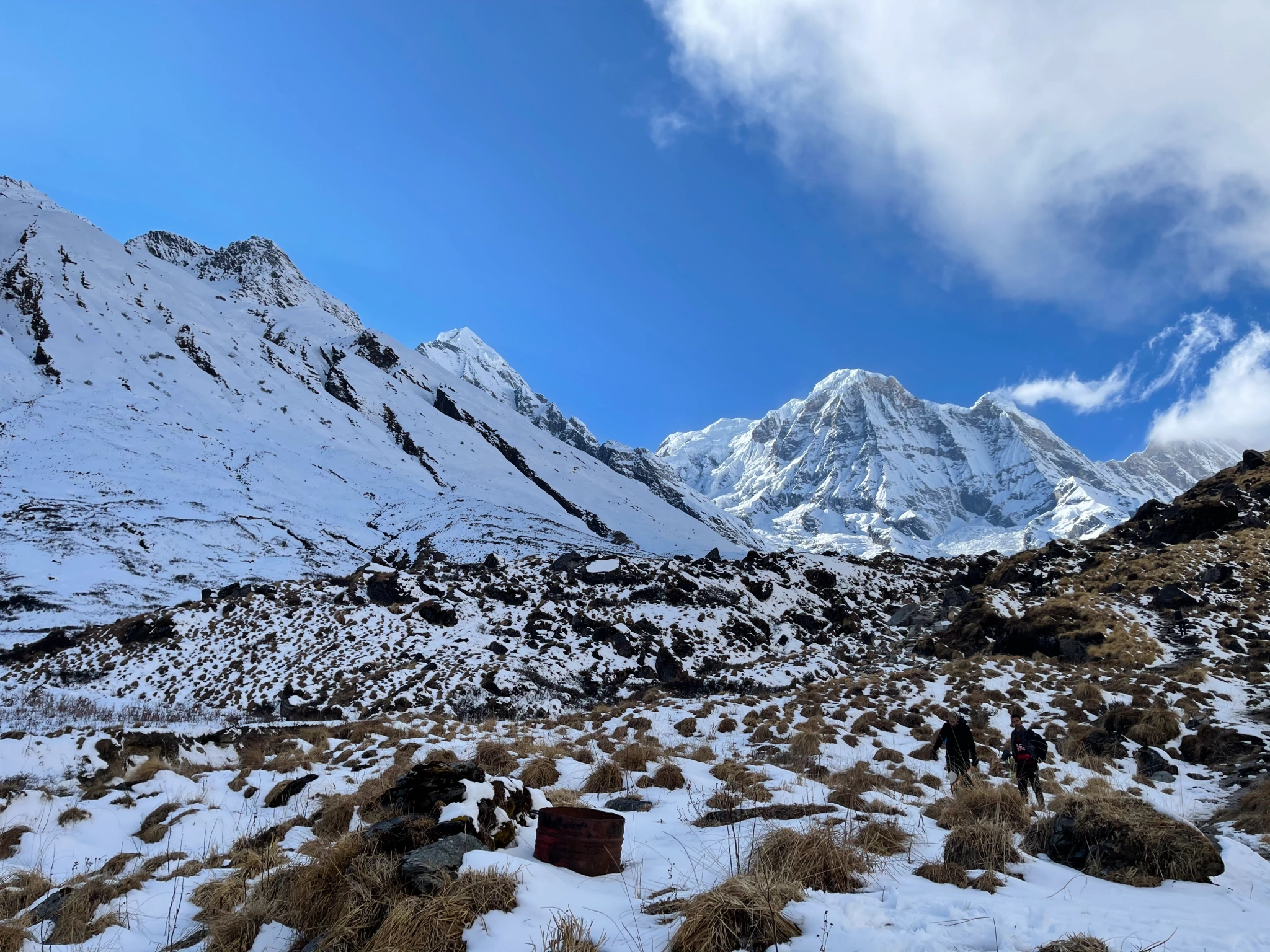
Annapurna Base Camp winter temperature falls between -8°C and -2°C in daylight and between -15°C and -22°C at night in January. Lower villages such as Chhomrong stay between 8°C and 12°C by day and 0°C to -3°C overnight.
The following table shows typical temperatures by stop from December to February, with altitude as the main driver. According to the International Standard Atmosphere, temperature drops about 6.5°C per 1,000 m of altitude gained.
Stop | Altitude | Daytime (°C) | Night (°C) |
Pokhara | 822 m | 14 to 21 | 5 to 9 |
Chhomrong | 2,170 m | 8 to 12 | 0 to -3 |
Ghorepani | 2,850 m | 2 to 8 | -6 to -10 |
Deurali | 3,200 m | -2 to 4 | -10 to -14 |
Machhapuchhre Base Camp (MBC) | 3,700 m | -5 to 1 | -12 to -18 |
Annapurna Base Camp | 4,130 m | -8 to -2 | -15 to -22 |
January records the lowest readings in every row. December and February run 2–3°C warmer. Wind adds the second layer of cold: a 30 km/h afternoon wind at base camp lowers the felt temperature by 8–10°C.
Lodge bedrooms stay unheated, so a sleeping bag rated to -20°C is a safety item.
How Much Snowfall Can You Expect at Annapurna Base Camp in Winter?
Annapurna Base Camp receives 2–4 significant snowfalls between December and February, each leaving 30–120 cm on the upper trail. Ghorepani receives 10–40 cm per storm, and the villages below 2,000 m seldom hold snow beyond 24 hours.
Winter snow in the Annapurna range comes from western disturbances. A western disturbance is a mid-latitude weather system that travels from the Mediterranean region across Iran, Pakistan and northern India, then delivers moisture to the Himalaya. Nepal receives about 80% of its annual rainfall during the June–September monsoon, according to the Department of Hydrology and Meteorology, so winter storms are rare but intense.
Snow depth follows altitude and aspect:
Below 2,000 m: Light dustings that melt within 1–2 days.
2,000–3,000 m: 10–40 cm after a storm, packed hard by lodge traffic within 48 hours.
3,000–3,700 m: 30–80 cm, with drifts deeper in gullies near Deurali.
3,700–4,130 m: 50–120 cm, with the deepest accumulation in February.
Most storms last 12–36 hours and clear to bright, cold skies. The 48 hours after a storm give the best photography and the highest avalanche exposure, so guides hold trekkers at Himalaya or Deurali during that window.
When Is the Best Time to Trek to Annapurna Base Camp in Winter?
The best time for the winter ABC trek is early-to-mid December for mild weather and stable trails, and mid-January to early February for the clearest skies. February brings the deepest snow and the highest avalanche exposure.
Each winter month has a distinct profile. The table below compares December, January and February across 5 variables, and the sections after it explain how each month behaves on the trail.
Variable | December | January | February |
ABC night low | -12°C to -16°C | -15°C to -22°C | -13°C to -19°C |
Snow depth at ABC | 20–60 cm | 50–100 cm | 60–120 cm |
Sky clarity | High | Highest | Moderate to high |
Lodge availability | High | Moderate | Moderate |
Avalanche exposure | Low to moderate | Moderate | Moderate to high |
Winter trades comfort for clarity and solitude when compared with October–November and March–May, the standard peak seasons. The Best Time to Trek in Nepal guide covers the 4-season comparison.
Is December a Good Month for Annapurna Base Camp Trek?
December is a good month for the Annapurna Base Camp trek because it combines the mildest winter temperatures, stable post-monsoon skies, open lodges and 10 hours 25 minutes of daylight at the solstice, with only light snow before mid-month.
The first two weeks of December behave like late autumn with a cold edge. Skies stay clear, the trail stays mostly snow-free below Deurali, and every lodge from Chhomrong to ABC operates. Night lows at base camp sit between -12°C and -16°C.
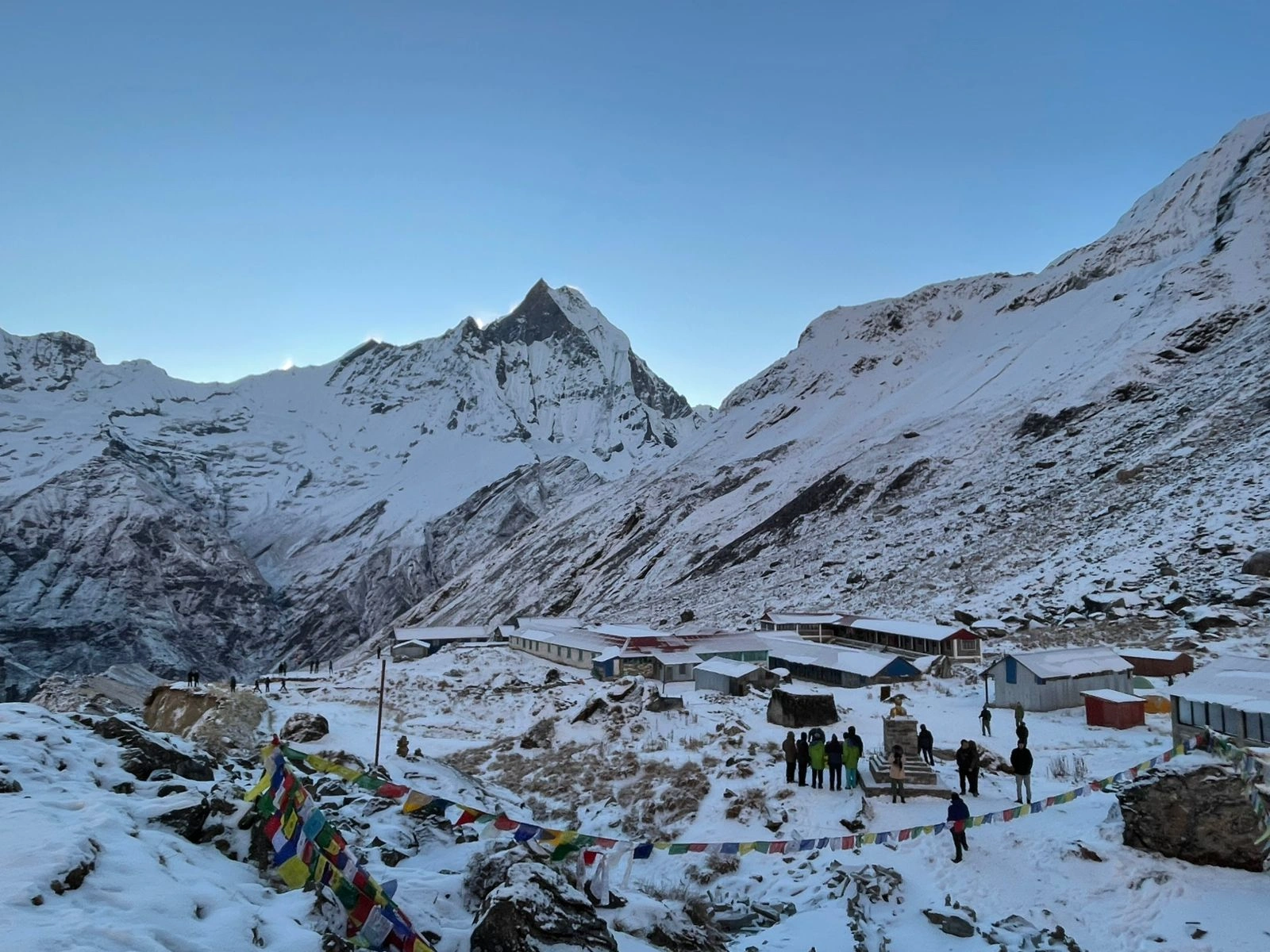
The last 10 days of December are busier. Christmas and New Year bring a surge of trekkers, and Tamu Lhosar (30 December) brings festival activity to the Gurung villages. Lodges at Ghorepani and Chhomrong fill early in this window, so confirm rooms 7 days before departure. December suits first-time winter trekkers best.
Can You Trek to Annapurna Base Camp in January?
You can trek to Annapurna Base Camp in January with a licensed guide and winter equipment. January is the coldest month, with night lows of -15°C to -22°C at base camp, and it delivers the clearest and driest skies of the year.
January air holds the least moisture of any month. Mountain edges look sharper, and sunrise on Annapurna I and Machhapuchhre produces strong colour from 6:50 at base camp.
The cost is cold and closures. Water pipes freeze in the lodges, so taps run dry at higher stops. A small number of lodges at Deurali and MBC close during the coldest 1–2 weeks, which makes advance confirmation a requirement. January works for trekkers with prior cold-weather experience, a -20°C sleeping bag, and 1–2 buffer days in the schedule.
Is February Suitable for the Annapurna Base Camp Trek?
February is suitable for the Annapurna Base Camp trek for fit, flexible trekkers. Temperatures rise 2–3°C above January, skies stay mostly clear, and snow reaches its deepest point of 60–120 cm at base camp, which raises avalanche exposure.
Early February behaves like late January: dry, cold and bright. By the last 10 days, afternoon cloud builds over the Sanctuary and snow events become more frequent. Lodge availability improves as the coldest weeks end, and the trail grows quieter than December.
Snow-loaded slopes between Hinko Cave and MBC require daily assessment by the guide. February rewards trekkers who accept schedule changes and penalises trekkers who book flights home with less than 2 days of slack.
Which Winter Month Offers the Best Weather and Visibility in Annapurna Base Camp Trek?
January offers the best visibility on the Annapurna Base Camp trek, with the driest air and sharpest peaks. Early-to-mid December offers the best overall weather, with warmer nights, stable trails and fewer closures.
The choice depends on the trekker's priority:
Maximum visibility: Choose January, between 8 and 28 January.
Balanced comfort and clarity: Choose 1–15 December.
Quiet trails with deep snow: Choose 1–15 February.
First winter trek: Choose December.
Moving the start date by 3 weeks shifts the same trek from comfortable to demanding, and the gear changes with it.
Planning your dates? Send your departure window to info@heavenhimalaya.com, and the Heaven Himalaya team replies with a route suggestion that includes buffer days, a gear list and a lodge plan.
What Is the Annapurna Base Camp Winter Trek Route?
The winter ABC route runs from Nayapul through Ghorepani, Chhomrong, Dovan, Deurali and Machhapuchhre Base Camp to Annapurna Base Camp at 4,130 m, then returns via Bamboo and Jhinu Danda to Nayapul over about 110–115 km.
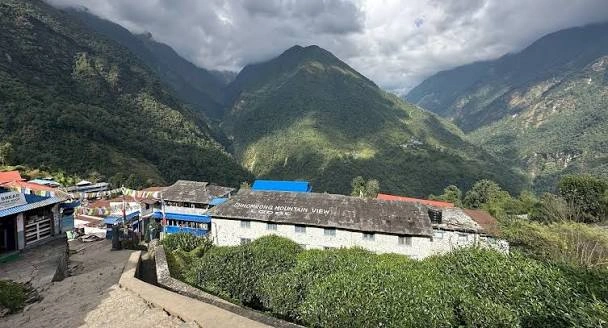
The route is a single out-and-back corridor inside the Annapurna Conservation Area. The trail climbs through Gurung villages to a 3,210 m viewpoint at Poon Hill, crosses the Modi Khola valley, and enters the Sanctuary. The winter version keeps the standard line and adds 1–2 buffer days.
Where Does the Annapurna Base Camp Winter Trek Start?
The Annapurna Base Camp winter trek starts at Nayapul (1,070 m), a roadhead 42 km from Pokhara, with a 1.5–2 hour drive from Pokhara (822 m) and a first-day walk to Tikhedhunga (1,540 m).
Most trekkers drive or fly from Kathmandu to Pokhara first. The drive takes 6–7 hours, and the domestic flight takes 25–30 minutes. Winter flights run in the morning, because fog and afternoon wind delay departures.
Some operators start at Kimche (near Ghandruk) by jeep to shorten the first day. The Nayapul start remains the standard because it builds acclimatisation gradually and includes the Ulleri stone staircase of more than 3,000 steps.
What Are the Major Stops Along the Winter ABC Trekking Route?
The 10 major stops on the winter ABC route are Tikhedhunga, Ghorepani, Tadapani, Chhomrong, Dovan, Deurali, Machhapuchhre Base Camp, Annapurna Base Camp, Bamboo, and Jhinu Danda, with Poon Hill as the optional sunrise summit.
The table below lists each stop with altitude and typical winter walking time. The figures follow Heaven Himalaya's 15-day standard itinerary, with snow adding 1–2 hours on days 9–11.
Day | Route | Sleeps at | Altitude | Walking time |
4 | Nayapul to Tikhedhunga | Tikhedhunga | 1,540 m | 4–5 hrs |
5 | Tikhedhunga to Ghorepani | Ghorepani | 2,850 m | 6–7 hrs |
6 | Poon Hill, then Tadapani | Tadapani | 2,630 m | 5–6 hrs |
7 | Tadapani to Chhomrong | Chhomrong | 2,170 m | 5–6 hrs |
8 | Chhomrong to Dovan | Dovan | 2,600 m | 5–6 hrs |
9 | Dovan to Deurali | Deurali | 3,200 m | 5–6 hrs |
10 | Deurali to MBC, then ABC | Annapurna Base Camp | 4,130 m | 6–7 hrs |
11 | ABC to Bamboo | Bamboo | 2,310 m | 6–7 hrs |
12 | Bamboo to Jhinu Danda | Jhinu Danda | 1,780 m | 4–5 hrs |
13 | Jhinu Danda to Nayapul, drive to Pokhara | Pokhara | 822 m | 4–5 hrs |
Day 10 contains the single largest sleeping-altitude jump: Deurali (3,200 m) to ABC (4,130 m) adds 930 m. According to the Wilderness Medical Society's 2024 Clinical Practice Guidelines for Acute Altitude Illness, sleeping-altitude gain above 3,000 m stays at or below 500 m per day. Splitting the climb with a night at MBC (3,700 m) turns 930 m into 500 m plus 430 m, and trekkers who want the lowest altitude risk request that option.
How Many Days Does the Annapurna Base Camp Winter Trek Take?
The Annapurna Base Camp winter trek takes 10 trekking days inside a 15-day Nepal package, or 7–8 days on a fast-paced schedule. Winter adds 1–2 buffer days for snow holds, giving 16–17 days door to door.
Heaven Himalaya's standard package runs 15 days: 2 days in Kathmandu, 1 driving day to Pokhara, 10 trekking days, and 2 days for the return and departure. Shorter itineraries of 7–9 days skip Poon Hill or compress acclimatisation.
Each snow hold at Deurali consumes 1 day, so trekkers book flights home at least 2 days after the planned return to Kathmandu.
Short Annapurna Base Camp Trek
View detailsWhat Is the Highest Altitude Reached During the Annapurna Base Camp Trek?
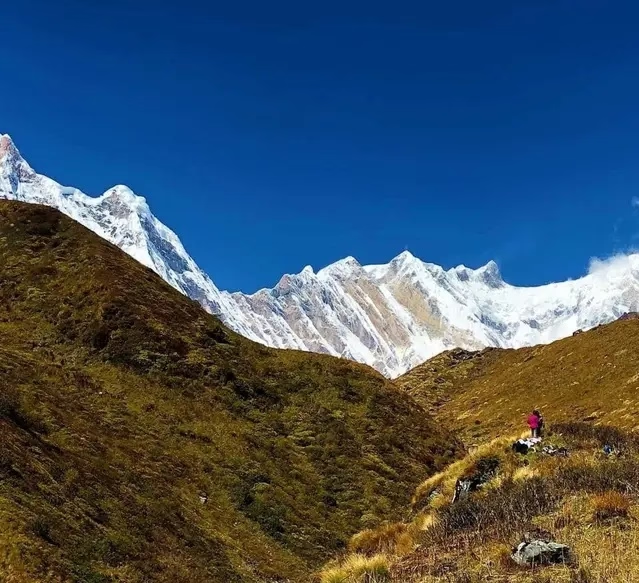
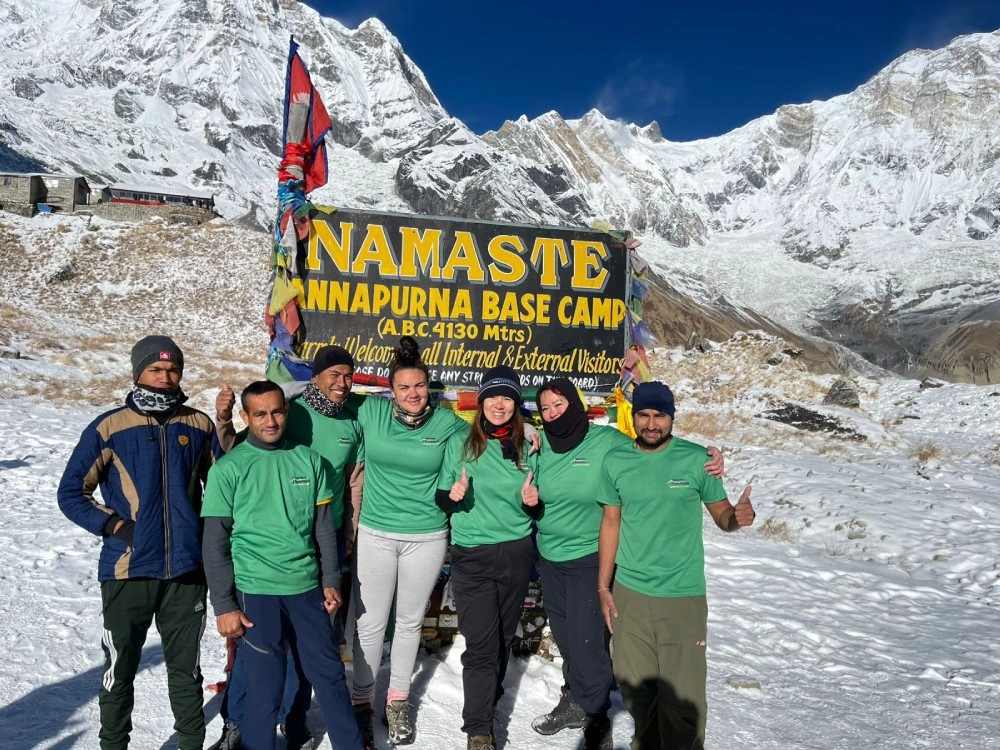
The highest altitude reached during the Annapurna Base Camp trek is 4,130 m (13,550 ft) at Annapurna Base Camp itself, where trekkers sleep. Poon Hill (3,210 m) is the highest point on the first half of the route.
Four altitude milestones define the route: Poon Hill at 3,210 m, Deurali at 3,200 m, MBC at 3,700 m and ABC at 4,130 m. ABC sits high enough for acute mountain sickness (AMS), because the climb from 3,200 m to 4,130 m happens in 1 day.
At 4,130 m, air pressure is about 61% of the sea-level value, so each breath delivers 39% less oxygen. Healthy, acclimatised trekkers record pulse-oximeter readings (SpO2) of 80–90% at base camp, against 95–99% in Pokhara. Cold adds a second load: the body burns more calories to stay warm, and dehydration develops faster in dry winter air.
What Are the Main Attractions Along the Winter Annapurna Trail?
The 6 main attractions on the winter Annapurna trail are Poon Hill sunrise, Ghandruk and Chhomrong Gurung villages, Tadapani's snow forest, Machhapuchhre Base Camp, the Annapurna Sanctuary sunrise, and the Jhinu Danda hot springs.
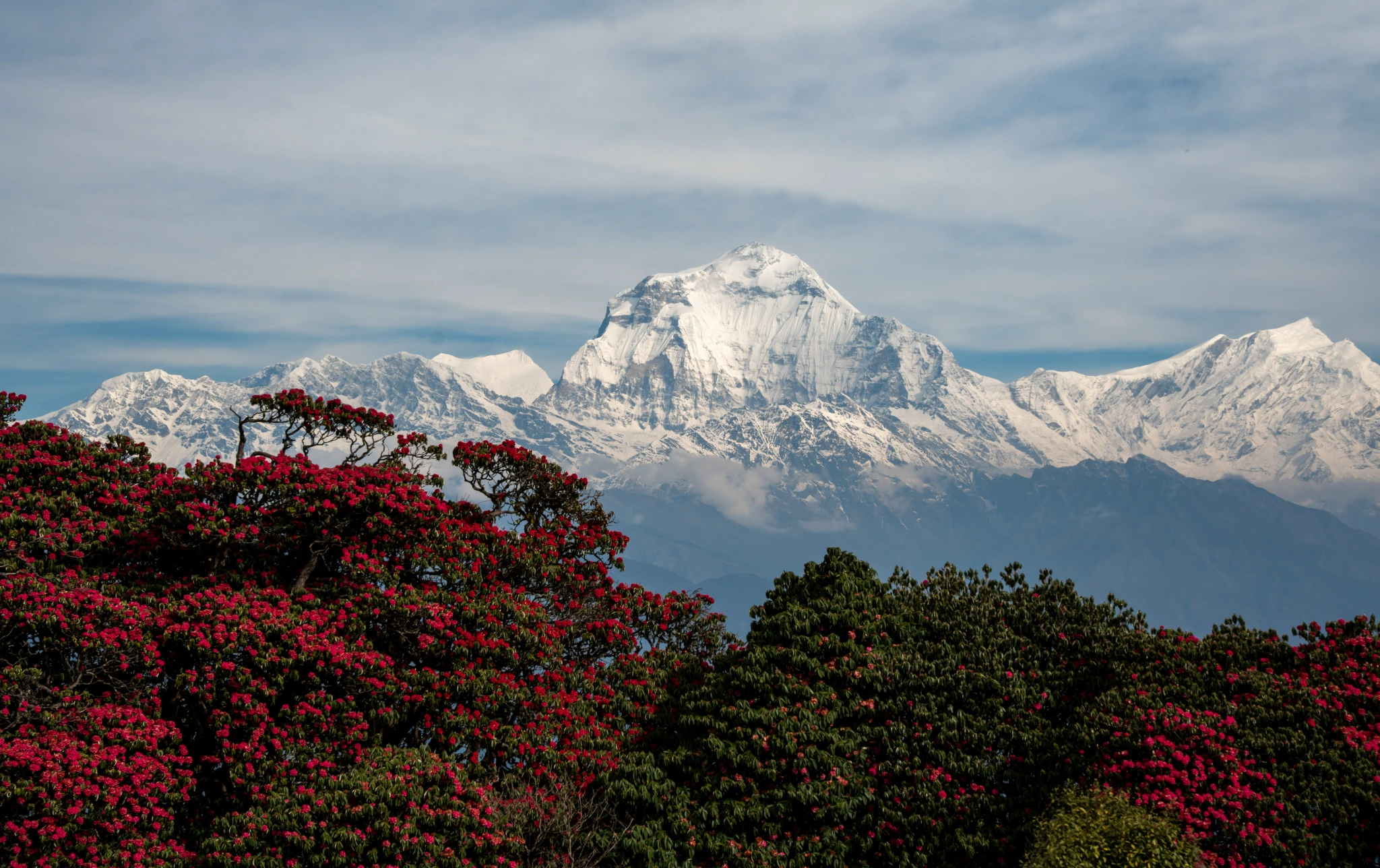
Poon Hill (3,210 m): Sunrise lights Dhaulagiri (8,167 m), Annapurna I and Machhapuchhre in one panorama. Winter sunrise arrives near 6:50. The Ghorepani Poon Hill Trekking route is the short-trek version of this view.
Ghandruk and Chhomrong: Stone-and-slate Gurung villages with terraces, prayer walls and warm tea houses.
Tadapani forest: Rhododendron and oak forest draped in snow, with Himalayan monal (the Himalayan pheasant, Nepal's national bird) feeding at the snowline.
Machhapuchhre Base Camp (3,700 m): A stop below the sacred Fishtail peak, with views of the Sanctuary opening ahead.
Annapurna Sanctuary: A 360° view from ABC at sunrise, with the sun reaching the basin floor around 8:30.
Jhinu Danda hot springs (1,780 m): Natural hot pools on the Modi Khola, 25–30 minutes below the village, which soothe legs after 8 days of walking.
What Are the Biggest Challenges of Annapurna Base Camp Trek in Winter?
The 5 biggest challenges of the Annapurna Base Camp trek in winter are sub-zero nights, avalanche exposure above Deurali, altitude sickness at 4,130 m, icy trail sections, and reduced lodge services such as heating, hot water and charging.
Each challenge has a specific location and a specific countermeasure. The sections below name the stretches of trail where each hazard concentrates and the practice that controls it.
How Difficult Is the Annapurna Base Camp Trek During Winter?
The Annapurna Base Camp trek in winter rates moderate-to-strenuous. Trekkers walk 9–12 km per day for 5–7 hours, climb up to 1,310 m in a single day, and face snow, ice and -20°C nights, though the route needs no technical climbing skills.
The trail has no ropes, ladders or glacier travel. Autumn difficulty is moderate. Winter lifts the rating for 3 reasons: cold drains energy, snow slows pace by 15–25%, and short daylight leaves no room for slow days.
Two days carry the most physical load. Day 5 climbs 1,310 m from Tikhedhunga to Ghorepani, including the Ulleri staircase. Day 10 climbs 930 m from Deurali to ABC through the avalanche corridor. Trekkers who finish comfortably share 3 traits: 8+ weeks of leg and cardio training, a correct layering system, and a flexible schedule.
Is There a Risk of Avalanches and Heavy Snowfall?
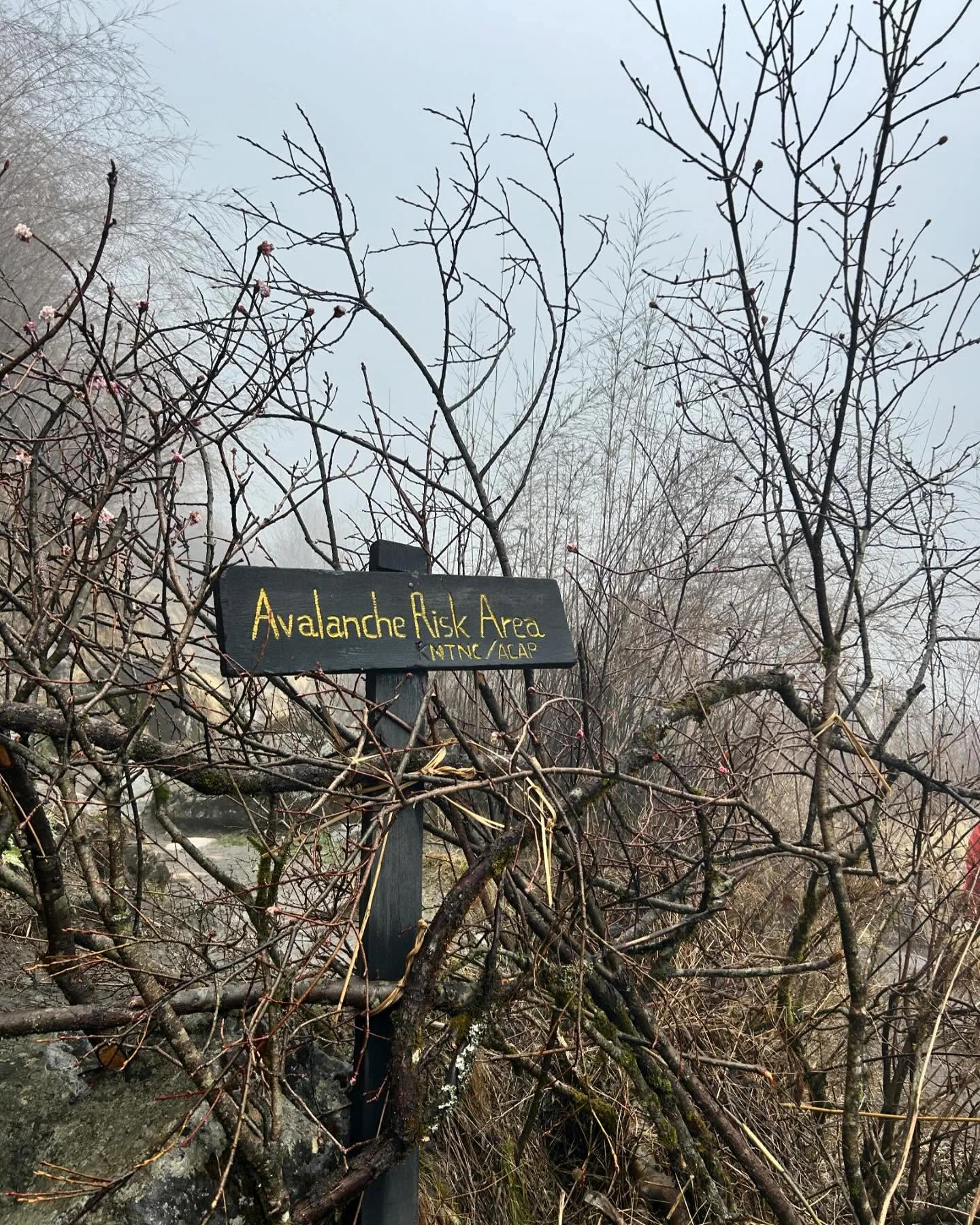
Yes. Avalanche risk is real on 2 stretches of the winter ABC route: Hinko Cave to Deurali, and Deurali to Machhapuchhre Base Camp. Risk peaks within 48 hours after heavy snowfall and drops as slopes settle.
An avalanche is a mass of snow that detaches and slides down a slope. According to the American Avalanche Association, most slab avalanches release on slopes of 30–45°. The Sanctuary's steep side-walls match that range, and the trail crosses the run-out zones.
Nepal publishes no public avalanche bulletin comparable to the Alpine services, so route decisions rest on guide observation. Guides read 4 signals: new snow above 30 cm in 24 hours, recent slide debris, cracks that shoot across the surface, and "whumpf" sounds as the snowpack settles.
Standard winter practice follows 5 steps:
Hold at Himalaya or Deurali for 24–48 hours after a heavy storm.
Cross exposed sections before 10:00, when the snow stays frozen and stable.
Space trekkers 30–50 m apart on any avalanche path.
Cross one person at a time, with the guide watching from a safe point.
Turn back when new snow, wind loading or warming makes the slope unreadable.
Heaven Himalaya builds buffer days into winter itineraries for exactly this reason.
How Can You Prevent Altitude Sickness During the Winter ABC Trek?
To prevent altitude sickness on the winter ABC trek, ascend slowly, sleep no more than 500 m higher each night above 3,000 m, drink 3–4 litres of fluid daily, rest after hard days, and descend at the first sign of worsening symptoms.
Acute mountain sickness (AMS) is a cluster of symptoms that appears 6–24 hours after reaching a higher altitude. Headache, nausea, dizziness, poor sleep and fatigue are the common signs. According to the Wilderness Medical Society's 2024 guidelines, trekkers at higher risk take acetazolamide, 125 mg every 12 hours, as prophylaxis, and a travel-medicine doctor prescribes the dose.
Cold suppresses thirst, and short days push groups to ascend quickly, so winter raises the risk. Prevention works through 5 habits:
Ascend in steps: Ghorepani 2,850 m, Chhomrong 2,170 m, Deurali 3,200 m, ABC 4,130 m.
Sleep at MBC (3,700 m) before ABC to split the 930 m jump.
Hydrate with 3–4 litres of warm fluids per day.
Monitor with a pulse oximeter every morning and evening.
Descend 300–1,000 m when symptoms worsen.
Severe signs demand immediate descent. These include loss of balance, confusion, breathlessness at rest, and a wet cough. High-altitude cerebral oedema (HACE) and high-altitude pulmonary oedema (HAPE) both begin as AMS and progress within hours. Descent is the treatment, and helicopter evacuation follows when walking is unsafe.
Are Winter Annapurna Trails Slippery or Difficult to Navigate?
Winter Annapurna trails are slippery in shaded sections, on stone staircases and above Deurali, and easy to navigate in clear weather because the route follows one obvious valley. Whiteout and fresh snow are the 2 navigation risks.
Ice forms where the sun does not reach. The 4 coldest spots on the route are the Ulleri staircase in morning shade, the forest between Bamboo and Sinuwa, the stream crossings near Dovan, and the snow slopes above Deurali. Frozen waterfalls cross the path in some gullies.
Microspikes (small chain-and-spike traction devices that fit over boots) handle 95% of these conditions. Full crampons rarely apply on this route. Trekking poles, gaiters and a steady heel-down gait add stability.
Navigation stays simple until a storm hits. In whiteout, the trail vanishes and the valley walls look identical, so the guide leads from the front. Offline maps such as Organic Maps work as a backup.
Can Teahouses and Accommodation Remain Open During Winter Annapurna Base Camp Trek?
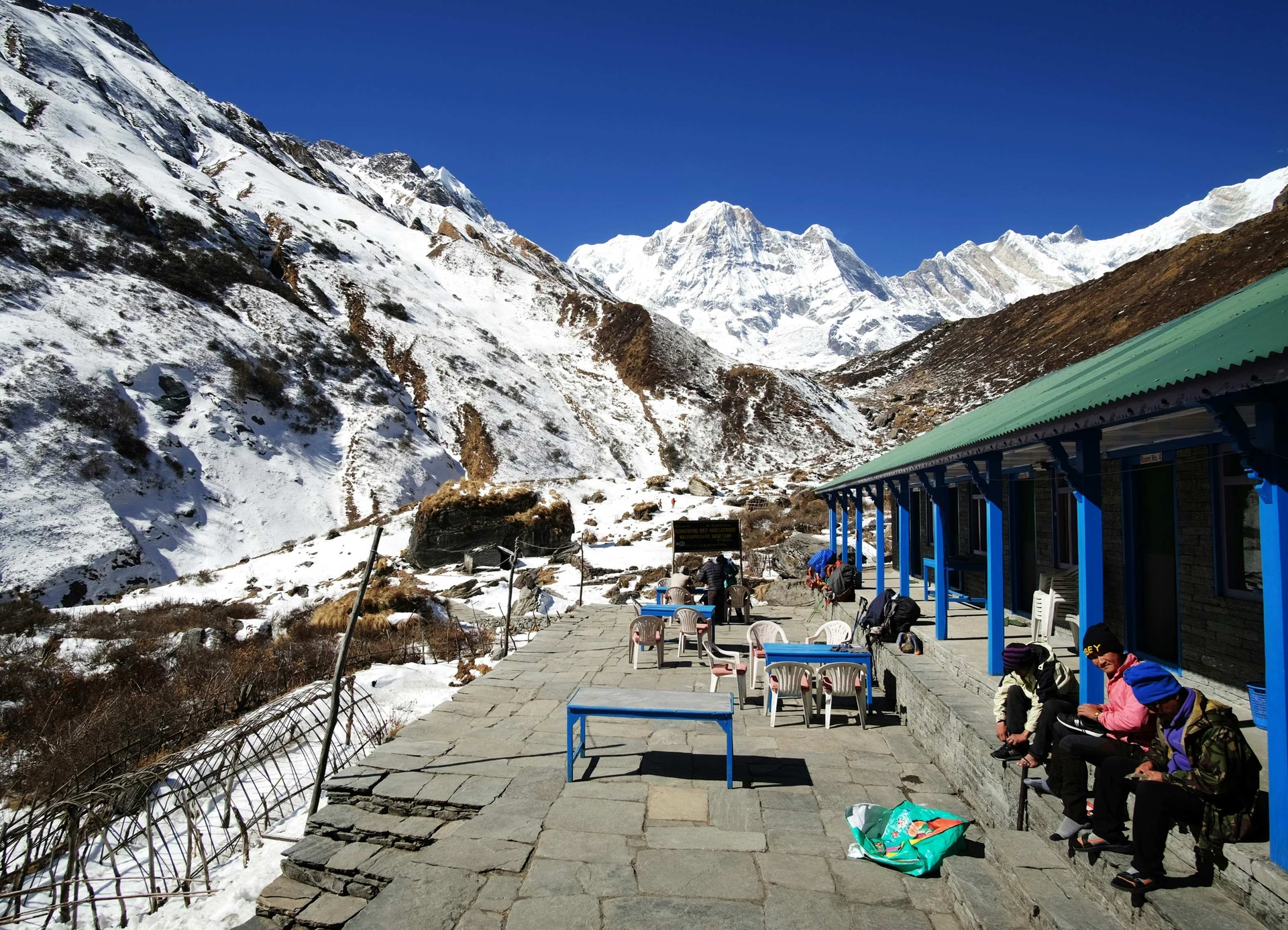
Yes. Most teahouses between Nayapul and Annapurna Base Camp stay open from December to February, though a few at Deurali and MBC close in the coldest 1–2 weeks of January. Services run at a reduced level, with unheated bedrooms and frozen water pipes.
A teahouse is a family-run mountain lodge that provides a bed, meals and a heated dining room. ABC holds more than 10 lodges, and Chhomrong and Ghorepani hold the largest clusters. Winter occupancy runs low, so beds are rarely scarce, except during 20 December–5 January.
Winter service differs from autumn in 5 ways:
Heating: The dining room has a stove, and bedrooms stay unheated.
Water: Pipes freeze, so lodges sell boiled water at NPR 200–500 per litre.
Charging: Solar power drops, so device charging costs more.
Hot showers: Gas or solar showers run at NPR 400–800 or are unavailable at upper stops.
Connectivity: Wi-Fi and mobile data are slow or absent above Chhomrong.
Operators phone each lodge 5–7 days before departure to confirm opening status. Your trekking agency will do the same to ensure your accommodation is secured.
What Should You Pack for Annapurna Base Camp Trek in Winter?
Pack a 3-layer clothing system, insulated waterproof boots, microspikes, a sleeping bag rated to -20°C, a headlamp with spare lithium batteries, and 4 pairs of wool socks. Winter packing weight runs 8–10 kg for the daypack and duffel combined.
What Winter Clothing Is Essential for the Annapurna Base Camp Trek?
Essential winter clothing for the Annapurna Base Camp trek is a merino base layer, a fleece mid-layer, an 800-fill down jacket rated to -15°C, a waterproof shell, insulated gloves with liners, a balaclava, and 4 pairs of wool socks.
The layering system works because each layer has one job:
Base layer: Merino or synthetic tops and leggings, 150–200 g/m², wick sweat away from skin.
Mid-layer: A fleece or synthetic-insulated jacket traps warm air.
Insulation: A down jacket with 700–800 fill power holds heat during stops and at night.
Shell: A waterproof, windproof jacket and trousers block wind chill.
Accessories: Insulated gloves with thin liners, a warm beanie, a balaclava, a neck buff, and glacier sunglasses (category 4) protect extremities and eyes.
Snow glare causes snowblindness within hours, so SPF 50+ sunscreen and lip balm matter as much in January as in July.
Which Trekking Boots and Snow Gear Should You Bring?
Bring insulated, waterproof, stiff-soled trekking boots with ankle support, microspikes, gaiters, and two trekking poles with snow baskets. Boots rated B1–B2 handle the route, and crampons stay optional for deep-ice conditions.
Boots decide foot warmth. A half-size larger than normal fits thick socks without squeezing the toes, because tight boots restrict circulation and invite frostnip, the mildest stage of frostbite. Gaiters keep snow out on the 50–120 cm drifts above Deurali, and microspikes give grip on ice-packed stone steps. Rental shops in Pokhara and Kathmandu supply microspikes, down jackets and poles for US$1–4 per day.
What Sleeping Bag and Personal Equipment Do You Need?
A winter sleeping bag with a comfort rating of -15°C to -20°C, a fleece liner, a 1-litre insulated bottle, a headlamp, a power bank and a personal first-aid kit form the core personal equipment for the winter ABC trek.
Heaven Himalaya supplies a sleeping bag and a duffel, both returned after the trek. Trekkers add a liner for 3–5°C of extra warmth and confirm the bag's comfort rating for their dates. The rest of the personal kit includes:
Water: Two 1-litre bottles with insulated sleeves, stored upside down so the lid does not freeze first.
Light: A headlamp with spare lithium batteries, because cold drains alkaline batteries in minutes.
Power: A 10,000–20,000 mAh power bank kept inside the sleeping bag overnight.
Health: Blister plasters, painkillers, rehydration salts, hand warmers and prescription medicines.
Hygiene: Hand sanitiser, wet wipes and a quick-dry towel, because showers are rare above 3,000 m.
How Much Does Annapurna Base Camp Trek Cost in Winter?
A guided Annapurna Base Camp winter trek costs US$799–1,299 per person on Heaven Himalaya's 15-day package, depending on group size, while a budget-focused guided trek costs roughly US$550–900 for 10 trekking days, before flights and insurance.
The table below shows Heaven Himalaya's listed package prices by group size, per person, on a twin-share basis. The price includes airport transfers, hotels in Kathmandu and Pokhara, teahouse accommodation, meals on trek days, permits, a licensed guide and porters.
Group size | Price per person (US$) |
1 trekker | 1,299 |
2–3 trekkers | 1,250 |
4–6 trekkers | 1,050 |
7–12 trekkers | 947 |
13–16 trekkers | 899 |
17–22 trekkers | 799 |
Larger groups lower the per-person price because guide, vehicle and logistics costs spread across more trekkers. Visa fees, international flights and travel insurance sit outside the price, and the team issues quotes for December–February departures on request.
What Factors Affect the Winter Annapurna Base Camp Trekking Cost?
Seven factors set the winter ABC trekking cost: group size, trip length, transport mode, accommodation tier, guide and porter staffing, winter extras such as heating and hot water, and gear rental or purchase.
Group size: Solo trekkers pay US$1,299, and 17-person groups pay US$799.
Trip length: Each buffer day adds lodging, meals and guide wages.
Transport: A Kathmandu–Pokhara flight costs more than the 6–7 hour drive.
Accommodation: 3-star Kathmandu hotels cost more than budget guesthouses.
Staffing: An assistant guide joins groups of 6+, and extra porters raise the total.
Winter extras: Hot showers, charging and boiled water add US$5–15 per day at upper stops.
Gear: Renting a down jacket, poles and microspikes costs US$1–4 per day per item.
Three items sit outside the package: tips (commonly US$8–12 per day for the guide and US$5–8 per day for a porter), travel insurance with evacuation cover, and a reserve for 1–2 buffer days.
Are Permits Required for Annapurna Base Camp Trek?
Yes. The Annapurna Conservation Area Project (ACAP) permit is required for the Annapurna Base Camp trek and costs NPR 3,000 (about US$22) per foreign trekker, paid in Nepali rupees. A TIMS registration accompanies it on guided treks.
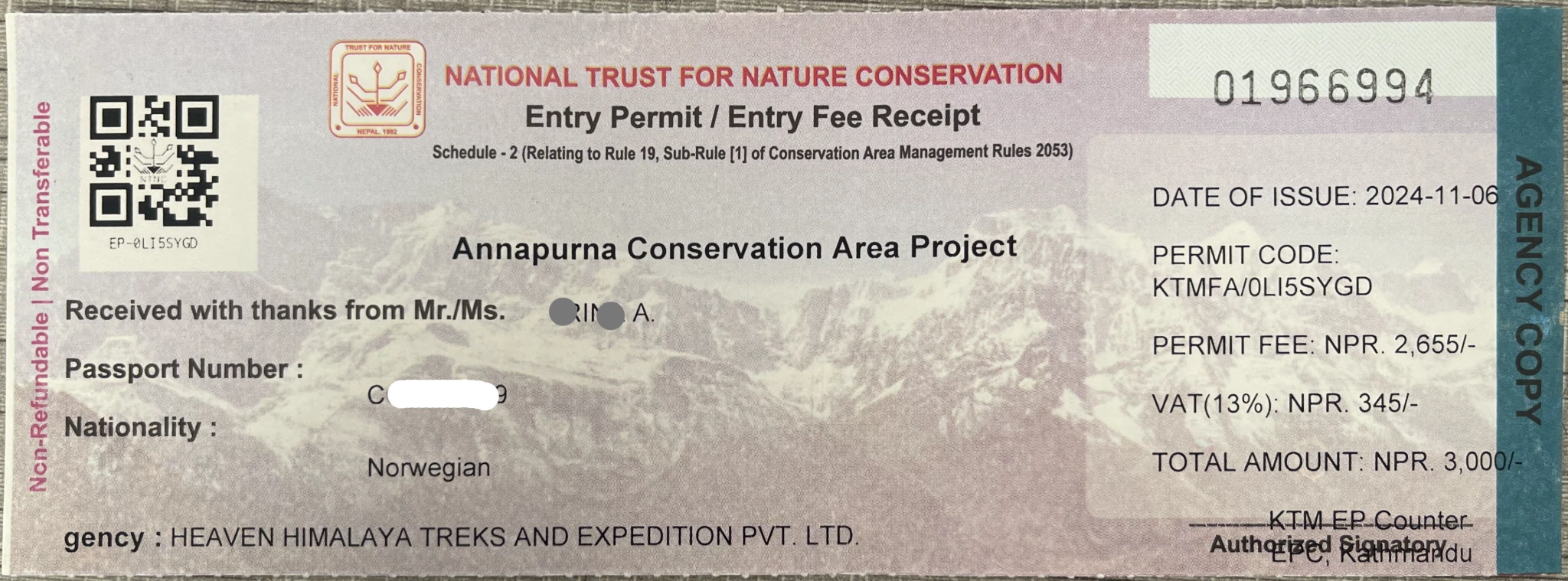
ACAP is the entry permit for the Annapurna Conservation Area, which the National Trust for Nature Conservation manages. TIMS (Trekkers' Information Management System) is a registration card that records a trekker's route and identity for safety tracking, administered through the Nepal Tourism Board and the Trekking Agencies' Association of Nepal.
Your registered trekking agency must secure your TIMS card and ACAP permit on your behalf prior to departure, as individual FIT permits are no longer issued to solo trekkers at government counters. A trekker without a valid ACAP is turned back at a checkpoint and pays the fee again. Heaven Himalaya's package includes ACAP, TIMS and park entry.
Is Hiring a Guide and Porter Necessary in Winter?
Nepal's regulations strictly require all foreign trekkers to hire a licensed guide through a government-registered agency in the Annapurna Conservation Area as of 2026, making a guide mandatory for avalanche assessment, trail finding in snow, altitude monitoring, and rescue coordination.
A licensed guide contributes 5 winter-specific skills:
Reading snow and slope conditions on avalanche paths.
Breaking trail after storms.
Monitoring each trekker's oxygen saturation and symptoms.
Confirming lodges and rooms ahead of the group.
Coordinating helicopter evacuation with the insurer.
A porter carries the duffel, which holds the extra winter kit that adds 3–5 kg. The International Porter Protection Group advises a 30 kg maximum per porter, and Heaven Himalaya assigns 1 porter to every 2 trekkers. Responsible operators also supply porters with winter clothing and shelter.
How Can You Prepare for a Safe Annapurna Base Camp Winter Trek?
Prepare for a safe winter ABC trek with 8–12 weeks of fitness training, medical clearance, insurance covering helicopter evacuation up to 4,500 m or higher, a tested gear set, and a flexible 16–17 day schedule that absorbs snow delays.
What Level of Fitness Is Required for the Winter ABC Trek?
The winter ABC trek requires good cardiovascular fitness and strong legs: the ability to walk 5–7 hours daily for 10 days, carrying a 5–7 kg daypack, with climbs of 800–1,300 m on the hardest days.
A 10-week plan builds the base:
Walk 2 hours with a loaded 6 kg pack on hills, twice a week.
Run or cycle 30–45 minutes, 3 times a week.
Climb stairs for 30 minutes with a pack, once a week.
Strengthen quads, glutes and calves with squats, lunges and step-ups, twice a week.
Taper in the final week to arrive rested.
Trekkers with heart, lung or blood-pressure conditions consult a doctor before booking, since altitude strains these systems.
What Safety Precautions Should You Follow in Snowy Conditions?
Follow 6 safety precautions in snowy conditions: start by 7:00, keep layers dry, stay hydrated, stay with the guide, avoid slopes after heavy snow, and report symptoms immediately. Frostnip, hypothermia and AMS all start quietly.
Start early, to finish walking by 15:30 before the temperature drops.
Dry damp socks and gloves overnight beside the dining-room stove, never on it.
Drink warm fluids every hour, because thirst disappears in the cold.
Stay inside sight of the guide on snow slopes.
Avoid closed rooms with charcoal or gas burners, which release carbon monoxide.
Report numb fingers, shivering, headache or nausea to the guide at once.
Frostnip is the first stage of frostbite: skin turns white and numb but stays soft. Hard, waxy skin signals frostbite and calls for descent and medical care.
What Should You Do if Weather Conditions Become Dangerous?
When weather conditions become dangerous, stop at the nearest lodge, follow the guide's decision, wait 24–48 hours for slopes to settle, and call for evacuation if anyone shows severe symptoms. Never push on in whiteout or after heavy new snow.
The response plan has 4 stages:
Stop: Reach shelter before conditions worsen. A lodge beats a viewpoint.
Wait: Hold for 24–48 hours after storms. Use the delay to rest and hydrate.
Reroute: Descend by the same trail or shorten the itinerary. The guide decides.
Evacuate: Call the guide, the agency and the insurer. Helicopters fly only in clear weather, usually between 8:00 and 14:00.
A helicopter evacuation from the Sanctuary typically costs US$3,000–5,000 without cover, and most insurers pre-authorise the flight. Heaven Himalaya requires cover that includes high-altitude evacuation up to 6,000 m.
How Can Heaven Himalaya Make Your Annapurna Base Camp Winter Trek Easier?
Heaven Himalaya makes the Annapurna Base Camp winter trek easier by planning around snow, daylight and lodge status, handling permits and logistics, staffing licensed guides and porters, and building buffer days into the route.
Heaven Himalaya is a Kathmandu-based trekking company with 13+ years of operating experience, a 5.0 rating from 160 Tripadvisor reviews, and Tripadvisor Travelers' Choice awards for 2021, 2022, 2023, 2024 and 2025. It holds affiliations with the Nepal Government, the Nepal Tourism Board (NTB), the Trekking Agencies' Association of Nepal (TAAN) and the Nepal Mountaineering Association (NMA).
On winter departures, the team shares route suggestions with buffer days, a gear list and a lodge plan matched to the trekker's dates, fitness and preferred region. The company also runs the Mardi Himal Trek and Langtang departures for trekkers who prefer a lower sleeping altitude in winter.
Can Heaven Himalaya Organize a Safe Annapurna Base Camp Winter Trek?
Yes. Heaven Himalaya organizes the 15-day Annapurna Base Camp trek with a licensed English-speaking guide, porters at 1 per 2 trekkers, permits, hotels, teahouses, meals on trek days, a first-aid kit, an oximeter and emergency rescue coordination.
The Annapurna Base Camp Trek package starts from US$1,250 per person for 2–3 trekkers, with a maximum altitude of 4,130 m. Groups of 6+ receive an assistant guide. Trekkers also receive a duffel, a sleeping bag, a route map and a completion certificate. Insurance, visa fees, drinks and tips stay outside the package.
Ready to plan your dates? Contact the Heaven Himalaya team on WhatsApp or Viber at +977 985 1273867, email info@heavenhimalaya.com, or visit the office at Gitanjali Chowk, Dathu Sadak, Kathmandu. Share your dates and experience, and the team replies with a winter-specific plan.
What Should You Know Before Planning Your Annapurna Base Camp Winter Adventure?
Before planning the Annapurna Base Camp trek in winter, know 6 facts: temperatures reach -20°C, snow peaks in February, avalanche risk concentrates above Deurali, lodges operate at reduced service, a guide is legally mandatory, and schedules need 1–2 buffer days.
December balances comfort and clarity, January delivers the sharpest views at the lowest temperatures, and February offers solitude with the deepest snow. Add buffer days, confirm lodge status 5–7 days ahead, and carry insurance that covers helicopter evacuation.
The Annapurna Base Camp trek in winter rewards trekkers who prepare for cold, respect avalanche timing and accept weather decisions. Those trekkers earn empty trails, 360° views of Annapurna I and Machhapuchhre, and a base camp sunrise that few autumn visitors see.