Embark on the Ama Dablam Expedition, a thrilling Himalayan adventure featuring technical climbing, breathtaking views, and an unforgettable summit.
DestinationNepal
Duration29 days
Trip DifficultyChallenging
ActivitiesTrek
Max. Elevation6,856 m
Group Size1-4
VehicleCar & Flight
AccommodationTeahouse & Camping
MealsB.L.D
Trip Overview of Ama Dablam Expedition
The Ama Dablam Expedition combines the thrill of climbing one of the world's most beautiful and iconic mountains with the challenge of a true Himalayan ascent. Renowned for its striking pyramid shape and technical climbing route, Ama Dablam offers an exciting mix of rock, ice, and mixed terrain for experienced mountaineers. The journey takes you through the heart of the Everest region, passing traditional Sherpa villages, ancient monasteries, and breathtaking mountain scenery. Standing on the 6,812m summit rewards climbers with spectacular views of Everest, Lhotse, Makalu, and the surrounding Himalayan giants, making every step of the expedition a remarkable achievement.
Ama Dablam Expedition: Nepal's Most Iconic Climb
At 6‚812 meters (22‚349 ft)‚ Ama Dablam is one of the most beautiful mountains in the Himalayas․ It is situated in the Khumbu region of eastern Nepal‚ southeast of Mount Everest‚ overlooking the customary Sherpa villages of Pangboche and Tengboche‚ and along the Everest Base Camp trekking route via the Khumbu Valley․ Its sharp pyramid-shaped summit‚ steep-crested ridges and steep‚ ice-covered faces have contributed to its being among the most coveted targets of experienced mountaineers worldwide․
The Sherpa name Ama Dablam translates to "Mother's Necklace"․ Ama is the Sherpa word for "mother"‚ and Dablam refers to the customary double-pendant type of necklace worn by Sherpa women‚ which often contains some sacred and protective artifacts inside the pendants․ The long ridges of the mountain‚ like a mother's arms raised up to cradle the head of her beloved child‚ and hanging glacier on the southwest face‚ like the pendant‚ have given the mountain its name․ The mountain has deeper cultural and spiritual associations for the Sherpas as well․
For many trekkers making the trek to Everest Base Camp‚ Ama Dablam becomes the highlight of their trek. The mountain can be seen from Namche Bazaar‚ Tengboche‚ and Pangboche‚ and the iconic shape of this mountain creates some of the most photographed views of the Everest region․ Ama Dablam is considered to be the most beautiful mountain in Nepal because of its symmetry and profile‚ despite being smaller than Everest‚ Lhotse or Makalu․
Summiting Ama Dablam rewards climbers with one of the most excellent panoramic views of the Himalayas. The top allows one to gaze across the sea of legendary peaks- Everest, Lhotse, Nuptse, Makalu, Cho Oyu, etc. Deep below lie the winding valleys of the Khumbu region, Sherpa settlements, glacial rivers, and enormous ice fields forming an impressive alpine landscape. The view from the summit ridge of the first sunlight on Everest and other neighboring giants is something few mountains on this Earth can rival and thus makes every single hardship of the climb worthwhile.
Highlights of Ama Dablam Expedition
Summit Ama Dablam (6,812m) – Climb one of the world's most beautiful and iconic Himalayan peaks.
Experience Technical Himalayan Climbing – Tackle challenging rock, ice, and mixed terrain along the famous Southwest Ridge.
Journey Through the Everest Region – Trek through Sherpa villages, Namche Bazaar, Tengboche, and Pangboche before reaching base camp.
Witness Spectacular Himalayan Views – Enjoy breathtaking panoramas of Everest, Lhotse, Makalu, Cho Oyu, Nuptse, and other surrounding peaks.
Achieve a Prestigious Mountaineering Milestone – Stand atop a world-renowned technical peak respected by climbers across the globe.
Southwest Ridge Route
The Southwest Ridge is the usual and most frequented route to Ama Dablam's summit. First climbed in 1961 by members of the Silver Hut Expedition, the route follows a spectacular ridge line from Base Camp through a series of high camps to the 6,812m summit. Even after six decades, it remains the preferred route for most Ama Dablam expeditions. This is a demanding mix of rock, ice, and mixed climbing, with exposed ridges and steep sections, including technical features like the Yellow Tower. Fixed ropes, high-altitude conditions, and continuous exposure make this one of the most respected technical climbs in the Himalayas.
Technical Difficulty of Ama Dablam Expedition
Ama Dablam is one of the finest technical alpine climbs in the Himalayas. Unlike trekking peaks that mainly require walking on snow and glaciers, real mountaineering skills are needed on exposed ridges, steep rock walls, and mixed terrain on Ama Dablam. The standard Southwest Ridge route is usually graded D (Difficult) on the Alpine grading scale and requires comfort with sustained technical climbing at high altitudes.
There are a number of demanding sections throughout the expedition, including steep rock climbing on the Yellow Tower, exposed traverses between Camps I and II, and snow and ice slopes leading to the summit above 6,500m. The combination of altitude, exposure, and technical terrain means climbers must be proficient in using crampons, ice axes, harnesses, ascenders, and fixed ropes. Previous experience in rock climbing, ice climbing, and high-altitude mountaineering is strongly recommended for a safe and successful ascent.
Outline Itinerary of the Ama Dablam Expedition
Day 01: Arrive in Kathmandu (1,400m)
Day 02: Official expedition briefing and permit formalities in Kathmandu
Day 03: Final expedition preparations in Kathmandu
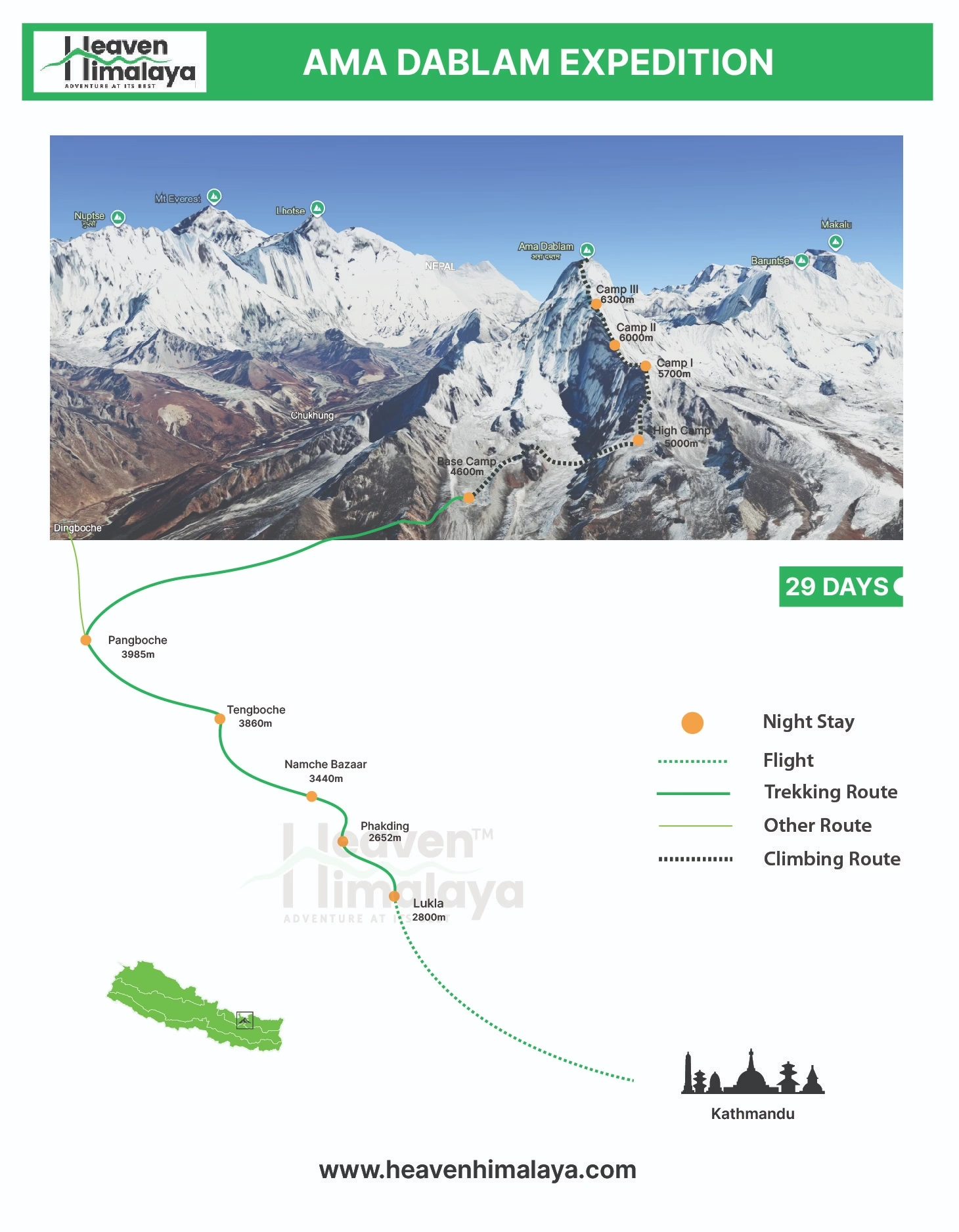
Day 04: Fly to Lukla (2,840m) and trek to Phakding (2,610m)
Day 05: Trek to Namche Bazaar (3,440m)
Day 06: Acclimatization day at Namche Bazaar
Day 07: Trek to Tengboche (3,860m)
Day 08: Trek to Pangboche (3,930m)
Day 09: Trek to Ama Dablam Base Camp (4,600m)
Day 10: Acclimatization at Base Camp
Day 11–25: Ama Dablam climbing period, including camp rotations, acclimatization climbs, and summit attempt (6,812m)
Day 26: Trek back to Namche Bazaar
Day 27: Trek to Lukla
Day 28: Fly to Kathmandu (or Manthali) and transfer to hotel
Twin-sharing/double accommodation in a 3-star hotel for 4 nights in Kathmandu, including breakfast (Private room accommodation can be organized at an extra cost)
Twin-sharing guesthouse accommodations during the trek for 7 nights in the Everest region with attached toilet in Lukla, Phakding & Namche
Tented camp accommodation and all meals during the 17-night stay at the Ama Dablam Base Camp and during the expedition (We will provide fully water/wind-proof twin-share tents, dining tents, kitchen gear, dining table, chairs, toilet tents, etc.)
Meals & Drinking Water
All your standard meals during the trek (Breakfast, Lunch, and Dinner), including one hot drink and seasonal fruits
A farewell dinner on the last night in Nepal
water purification tablets .....
Transportation & Domestic Flight
All (international and domestic) airport transfers on a tourist vehicle
Round-trip airfare between Kathmandu/Manthali and Lukla
Kathmandu – Manthali – Kathmandu transportation by shared tourist vehicle
Guide and Staff
Experienced, first-aid trained, government licensed, English speaking, and locally recruited Heaven Himalaya’s trekking guide (2 guides for group size more than 8 people)
Porters during the trek for carrying luggage (1 porter for every 2 clients)
Climbing Sherpas (3 members = 1 Sherpa Ratio on the climbing day)
Liaison officer and his round-trip flight, insurance, wages, expedition equipment, etc.
Wages, accommodation, meals, gear, insurance, and medications for all staff
Permits
Sagarmatha (Everest) National Park Permit
Pasang Lhamu Rural Municipality fee
Expedition permits
Benefits and Takeaways
1 Heaven Himalaya’s duffel/kit bag, trekking map, sun hat, Buff (Neck Gaiter)
A comprehensive first aid kit, including an Oximeter to check pulse and oxygen levels daily in the mountains
Trip completion certificate
Equipments
A well-stocked first aid and medical kit is sufficient to counter any possible mountaineering ailments, from headaches to serious injuries
Power supply at Base Camp for charging electronics such as phones, laptops, and cameras (solar backup)
Emergency communications on the mountain and a satellite communications link for helicopter evacuation.
Administrative & Taxes
All administrative expenses and government taxes
GARBAGE MANAGEMENT : Stool Shipment Transfer & Garbage Deposit fees.
Exclusions
Lunch and dinner in Kathmandu
International flight fare and airport departure tax
Nepal Entry Visa (Visa can be acquired easily after you arrive at Tribhuvan International Airport in Kathmandu with a fee of USD 30 for 15 15-day visa, USD 50 for 30 30-day visa, and USD 125 for 90 90-day visa)
Travel insurance, along with high-altitude emergency evacuation coverage
Any beverages, including bottled and boiled water
Tips for trekking staff and driver
PERSONAL CLIMBING EQUIPMENT: Clothing, Packing Items, Bags, Personal Medical Kit, and all kinds of Personal Trekking / Climbing Gear.
SUMMIT BONUS : Summit bonus for each climbing Sherpa
Any expenses other than the Price Include section
Dates & Availability
Select Departure Date
No fixed group departures right now — run Ama Dablam Expeditionprivately with your own group. Pick a preferred start date and we'll confirm availability.
Loading calendar…
Sold out dates
Group-size discounts will be applied in the next step.
Select a start date from the calendar.
All prices per person, twin share. Subject to availability — Ama Dablam Expedition dates fill quickly in peak season.
29 days Ama Dablam Expedition Itinerary
Day 01 :Arrive in Kathmandu
Elevation: 1,400m
Duration: 25 mins
Accommodation: Hotel
Our airport representative will be receiving you at Tribhuvan International Airport, Kathmandu, and s/he will be displaying a Heaven Himalaya signboard outside the airport terminal. You will then be transferred to your respective hotel in our private tourist vehicle.
Max. Altitude: Kathmandu (1,400 m)
Overnight in Kathmandu.
Meals not included
Day 02 :Official formalities in Kathmandu.
Elevation: 1,400m
Duration: 3-4 hrs
Accommodation: Hotel
Meals: B
Formal briefing at the Ministry of Tourism. The expedition leader will check that everyone’s equipment is in working order or not.
Overnight at a Hotel
Breakfast included
Day 03 :Final preparation day in Kathmandu.
Elevation: 1,400m
Duration: 3-4 hrs
Accommodation: Hotel
Meals: B
It is the Final opportunity for last-minute purchases.
Overnight at a Hotel
Breakfast included
Day 04 :Fly to Lukla from Kathmandu or Manthali (Ramechhap) and then trek to Phakding
Elevation: 2,610m
Duration: 4-5 hrs
Accommodation: Guesthouse
Meals: B / L/ D
After breakfast at the hotel, our guide will come to pick you up for an exciting flight to Lukla. All the flights to Lukla will either be from Kathmandu Airport or Ramechhap Airport and are scheduled in the morning. It’s because the wind picks up in the afternoon and it becomes hard to fly.
After a thrilling flight, you will start your trek to Everest Base Camp. Before the start, you will meet porters at the airport who will carry most of your loads.
After you make yourself ready, the tour guide will make his way along the busy street to the start of the trek down to Phakding. You will walk along the Dudh Koshi River and the alpine forest with the amazing sounds of nature. You will then cross the suspension bridge to reach Phakding. Walking above the swinging bridge will add a thrill to your journey.
Duration: 35 mins flight from KTM & 25 mins flight from Manthali, 3-4 hrs trek
Overnight at a Guesthouse
Breakfast, Lunch and Dinner
Day 05 :Trek to Namche Bazaar
Elevation: 3,440m
Duration: 5-6 hrs
Accommodation: Guesthouse
Meals: B / L/ D
We begin the five-hour trek along the banks of the Dudh Kosi, crossing this majestic river many times on exciting suspension bridges laden with prayer flags. After entering Sagamartha National Park, the trail climbs steeply with breathtaking views. Namche Bazaar, known as the “Gateway to Everest,” is home to many quality restaurants, hotels, lodges, shops, money exchange, an internet cafe and a bakery. Namche (3,440 m) is one of the biggest villages along the whole Everest trail.
Max. Altitude: Namche Bazaar (3,440 m)
Duration: 5-6 hrs trek
Overnight at a Guesthouse
Breakfast, Lunch and Dinner
Day 06 :Acclimatisation day at Namche.
Elevation: 3,440m
Duration: 3-4 hrs
Accommodation: Guesthouse
Meals: B / L/ D
A day will be spent in Namche in order to adjust to the high altitude. We’ll go on a short trek to a museum celebrating the traditional customs of the Sherpa people. We will also hike up to the Everest View Hotel. From this point can be seen rewarding views of Everest, Lhotse, Ama Dablam with a stunning sunrise and sunset over the panorama of Khumbu peaks.
Overnight at a Guesthouse
Breakfast, Lunch and Dinner
Day 07 :Trek to Tengboche Monastery
Elevation: 3,860m
Duration: 5-6 hrs
Accommodation: Guesthouse
Meals: B / L/ D
The trek continues along the rushing glacial waters of the Dudh Kosi, with magnificent views of the mountains. We trek to an altitude of 3,860 meters today. After five hours, we’ll reach Tengboche, where the local monastery can be seen. Inside the monastery are incredibly ornate wall hangings, a twenty-foot sculpture of Buddha, and the musical instruments and robes of the Lamas. The group will be taken to observe a prayer ceremony in either the evening or morning, depending on how the day’s trekking progresses.
Max. Altitude: Tengboche (3,860 m)
Duration: 5-6 hrs trek
Overnight at a Guesthouse
Breakfast, Lunch and Dinner
Day 08 :Trek to Pangboche
Elevation: 3,930m
Duration: 2-3 hrs
Accommodation: Guesthouse
Meals: B / L/ D
From Tengboche, the trail drops to Deboche (3820 m/12,532.81 ft), crosses another exciting suspension bridge on the Imja Khola and climbs to Pangboche village.
Max. Altitude: Pangboche (3,930 m)
Duration: 2-3 hrs trek
Overnight at a Guesthouse
Breakfast, Lunch and Dinner
Day 09 :Trek to Ama Dablam base camp
Elevation: 4,600m
Duration: 5-6 hrs
Accommodation: Tented Camp
Meals: B / L/ D
Base camp is located in an idyllic spot from which the majority of the route is visible. At an altitude of about 4,600 m, it provides a comfortable escape from the rigours of the climb. Our porters deposit their loads and leave us here for the next three weeks, with only our Sirdar, Sherpas and culinary staff remaining.
Max. Altitude: Ama Dablam Base Camp (4,600 m)
Duration: 5-6 hrs trek
Overnight at a tented camp
Breakfast, Lunch and Dinner
Day 10 :Acclimatisation day.
Elevation: 4,600m
Duration: 4-5 hrs
Accommodation: Tented Camp
Meals: B / L/ D
Today is another day for acclimatisation.
Overnight at a tented camp
Breakfast, Lunch and Dinner
Day 11 :Climbing period of Ama Dablam.
Elevation: 4,600m
Accommodation: Tented Camp
Meals: B / L/ D
We do not provide a day-to-day itinerary for the climb period, as this will be determined by the expedition leader and members. The preparation for the remainder of the expedition goes on like this,
Preparation at the Base Camp & Camp Rotations
Guides will take a flexible approach based on what fits with climbers’ and their own experience. Typically, the team will spend a few days at the base camp organising food, practising rope skills, and acclimatising before moving above the base camp.
To maximize acclimatization and increase the chances of a successful summit, the expedition follows a series of camp rotations. Climbers ascend to higher camps such as Camp I and Camp II, spending time at altitude before descending to Base Camp for recovery. These rotations help the body adapt to reduced oxygen levels while allowing climbers to familiarize themselves with the route and technical sections. Once acclimatization is complete and a favorable weather window is identified, the team begins its final summit push.
Base Camp to Camp 1
Ama Dablam climb via the southwest ridge After leaving the base camp, old grassy moraine ridges are followed roughly eastwards to a broad saddle at 5,150 m (16,896.33 ft), from where we can see the Mingbo La. From the saddle, we ascend easily northwards until the ground steepens at the start of a large boulder field. We may place an advanced base camp at 5,400 m (17,716.54 ft) below the boulder field. The route continues north around the base of the boulder field and then follows cairns upward to the toe of the southwest ridge. At the end of the boulder field, slabs are crossed, and then a short gully is ascended, allowing access to the ridge proper in a very exposed position. Easy scrambling on the east side of the ridge leads quickly to Camp 1. There are four or five tent platforms.
Camp 1 to Camp 2
From Camp 1, we contour around the snowy bowl (possible alternative site for Camp 1) until we are below two rock fingers. The east side of the ridge is followed, climbing easy mixed ground until a short pitch of “severe” standard leads to the ridge proper. The ridge is narrow in places, with difficult turns on the east side, until the second tension traverse leads to two pitches of “very severe” standard. The route continues on the crest of the ridge for a short distance until we are forced via an awkward step onto the west side of the ridge. The crest of the ridge is regained, and easily navigable roads are followed to the start of a traverse on the east face, which leads to the Yellow Tower. This 15-meter pitch, just below Camp 2, is one of the hardest pitches on the climb at HVS (5.8) standard. A short section of ridge now leads to Camp 2 (5,900m). Camp 2 has very limited tent space (three or four tent platforms) and is extremely exposed. It is sometimes only used to store equipment, with expeditions choosing to go from Camp 1 to Camp 3 in a single push.
Camp 2 to Camp 3
From Camp 2, the climb skirts a red rock bluff on the east and, after a step down, follows the snow ridge directly to a tricky traverse east. This leads to a gully between the Grey Tower and the lower rock buttress. We climb the gully until a very exposed traverse line is reached on the west side of the ridge. A short snow slope is ascended, allowing us to reach the start of the Mushroom Ridge. Following this typically involves negotiating some steep snow sections until Camp 3 (6,300m) is reached.
Summit Push and back to Camp I or Camp II
The route climbs the snow and ice slope directly above Camp 3 and to the right-hand side of Dablam. We continue to skirt Dablam on the right, then move west to gain a small snowfield below the Burgschrund. The Burgschrund is crossed, and then the climb heads directly to the ice crest above. This is followed by a magnificent climb to the summit.
After reaching the summit of Ama Dablam (6,812m), climbers begin their descent along the Southwest Ridge. Depending on weather conditions, team pace, and overall energy levels, the expedition team typically descends to Camp II or Camp I for an overnight stay. The descent requires the same level of focus as the ascent, as climbers must carefully negotiate technical sections such as the summit slopes, Mushroom Ridge Traverse, Grey Tower, and Yellow Tower using fixed ropes before continuing lower the following day.
Max. Altitude: Climb Amadablam (6,856 m)
Overnight at a camp
Breakfast, Lunch, and Dinner
Day 26 :Trek back to Namche Bazaar
Elevation: 3,440m
Duration: 6-7 hrs
Accommodation: Guesthouse
Meals: B / L/ D
We descend six hours to Namche Bazaar (3,440 m). If we are lucky, we’ll arrive at market time in Namche. Regardless, there is always fabulous food to be found, including delicious espresso, yak steaks, and chocolate cake with frosting! This market is where lowland porters bearing supplies meet the highland Sherpa and Tibetan people who have journeyed over high passes from many miles away to trade food and supplies for their houses and villages. Enjoy and celebrate your expedition.
Max. Altitude: Namche Bazaar (3,440 m)
Duration: 6-7 hrs trek
Overnight at a Guesthouse
Breakfast, Lunch, and Dinner
Day 27 :Trek to Lukla
Elevation: 2,840m
Duration: 6-7 hrs
Accommodation: Guesthouse
Meals: B / L/ D
We returned to Lukla (2,840 m), where the trip began, after a six-hour trek. We’ll take time to reflect on the trek as a group and the personal achievements of all who took part. You’ll also have plenty of time to explore the town.
Max. Altitude: Lukla (2,840 m)
Duration: 6-7 hrs trek
Overnight at a Guesthouse
Breakfast, Lunch, and Dinner
Day 28 :Fly back to Kathmandu or Manthali from Lukla
Elevation: 1,400m
Duration: 3-4 hrs
Accommodation: Hotel
Meals: B
The flight from Lukla to Manthali is a 20-minute flight. After that, it is about a 5 to 6-hour drive to Kathmandu. Please note that the driving hours may vary according to the highway traffic conditions. You’ll be transferred to the hotel in Kathmandu on a shared tourist vehicle. Helicopter Option
You have the option to book a direct helicopter flight from Lukla to Kathmandu for an extra charge of USD 550 per person. This price is quoted on a 5-person sharing basis. This is the best alternative to avoid the long drive from Manthali airport to Kathmandu during peak season (March, April, May, October, and November).
You might want to stay a little more in Nepal. If you are looking to extend your trip, there are options such as a visit to Chitwan National Park, known for wildlife viewing, and to Pokhara, considered one of the most beautiful cities of Nepal. You can also extend your trip to Tibet, India, or Bhutan.
Overnight at a Hotel
Breakfast and Farewell dinner included
Day 29 :Departure Day
Elevation: 1,400m
Duration: 25 mins
Accommodation: Hotel
Meals: B
Today, we conclude our trip. One of our airport representatives will accompany you to the International Airport for your flight back home. We bid you farewell and hope you’ll travel to Nepal again.
Altitude profileMax 4,600 m
Create a Bespoke Itinerary
Customize your Himalayan adventure with personalized itineraries for unforgettable experiences!
Excellent solo Nar Phu Valley Trek with Heaven Himalaya
Just completed the Nar Phu Valley Trek as a solo traveler and couldn't be happier with how it was organized.From the start, communication was clear. A proper pre-trip gear check meant I knew exactly what I needed and what the guide would provide. They arranged a sleeping bag and trekking poles for hire, which saved me carrying my own.Accommodation throughout felt genuine and welcoming rather than touristy, a real Nepalese experience rather than a tourist-trail one. Transport to and from the trailhead was reliable and comfortable.What really stood out was my guide Hari's ability to read my pace. Early on I struggled a bit with the altitude, and he slowed things right down without making it a big deal. Once I'd acclimatized, we picked up the pace significantly. Hari was genuinely flexible day to day depending on how I was feeling, rather than sticking rigidly to a fixed itinerary.I also picked up a stomach bug partway through the trek. Hari talked through the options with me calmly and…
Jojo Y
Second time in Nepal with Heaven Himalaya
This is my second time in Nepal with Heaven Himalaya & I am writing this with gratitude & appreciation for my guide Hari, my porter Arun, as well as the entire team.This was meant to be my birthday trip, I had requested to summit EBC on the actual day of my birthday (29/5/2026), and i made it happen with the help & support of Hari and Arun.Hari has been very thoughtful and attentive throughout the trip, making sure to constantly ask/check if I’m feeling okay as we ascended to higher altitudes.As it got colder higher up on the mountains, Hari thoughtfully delivered hot water to my room every night to help me deal with the extremely cold nights.On my birthday itself, Hari also resourcefully brought a “Happy Birthday” candle which he got from Namche to the summit, and we created our own birthday “cake” using the candle and an apple. That was a very beautiful memory & amazing experience.As I was traveling alone as a female, Hari also did his best to find me the most comfortable accommodat…
CCharlotte B
EBC Hike in May 2026
Last month in May 2026, I did the Everest Base Camp hike with Heaven Himalaya, and it was absolutely amazing. From the start they made everything easy . My guide Bishal, which he said meant thulo in nepali was so helpful and patient; he knew everything about the trail and mountains and also made us laugh all the time.Our porter Krishna was a star! He carried our bags without complaining and always had a smile, telling us funny stories in the evenings. I don't know what we would have done without him.The trek itself was so hard but so worth it. The views are just mindblowing; waking up every morning to see the mountains covered in snow is something I will never forget. Bishal and Krishna made sure we were safe and happy all the way.Reaching Kala Patthar at sunrise was unreal, seeing Everest in the golden light was like a dream. Bishal and Krishna were there with us every step, cheering us on and making it so special.I would absolutely recommend Heaven Himalaya for everyone. They are no…
Tina
Exceptional Service and a Birthday to Remember
They say the mountains humble you, but what I didn't expect was how deeply the people of Nepal would touch my heart.Couldn't have asked for a better crew for our Everest Base Camp - Cho La Pass - Gokyo adventure. From day one, Shankar, Ganesh, Dawa, and Prince treated us with so much kindness, patience, and care that it never felt like we were just another hiking group to them.They became our family in the mountains.Our guide, Shankar, was exceptional. Calm, knowledgeable, dependable, and always looking out for us every step of the way. He knew the mountains like the back of his hand and made us feel safe even during the toughest parts of the trek. When weather conditions in Lukla became unpredictable and visibility was poor, he immediately took action and arranged a helicopter to Kathmandu so we wouldn't miss our international flights. In moments of stress, that level of leadership and quick thinking means everything.It was my birthday during the trek, so I felt incredibly special wh…
Jarin Lam
Unforgettable First Trek to Annapurna Base Camp & Poon Hill
We had an amazing experience with Heaven Himalaya for our first trekking trip to Annapurna Base Camp and Poon Hill. We were actually recommended to them by a friend, and we’re incredibly thankful we chose to go with them. It was truly an unforgettable 2 weeks in Nepal.Our guide, Hari, was attentive, thoughtful, and always made sure we were comfortable and enjoying the journey. He was constantly on the ball, supporting us every step of the way and helping to adjust the itinerary whenever needed. Despite a few slight hiccups during the trip, he remained calm, flexible, and proactive in making arrangements to ensure everything went smoothly.Our porter, Anis, was also incredibly reliable and supportive throughout the trek. He consistently checked in on us and made sure our needs were always taken care of along the way.A special thank you as well to Ram, who was very helpful in coordinating everything behind the scenes and ensuring the trip ran smoothly from start to finish.Beyond the trek…
Dan
Truly Unforgettable!!!
My friend and I booked the 14 day Annapurna Circuit with Tilicho Lake trek. The whole experience was amazing. Ram made it easy to alter the trip to our specific needs. We added flights, cut off 2 days of trekking, requested single rooms, and he quickly got us a quote and booked! Hari was our guide on the trek and he was fantastic! He attended to all our needs and safely guided us for the entire time. He did an excellent job of getting us the best rooms, served our meals every day, and did everything in his power to make sure us old men(63 and 74) made it over the Pass! Our porter, Denise, was equally impressive! I still don't know how he carried our bags for 10 days! Clear blue skies, endless views, majestic mountains, deep river valleys, friendly people, a truly unforgettable trip!!!
Best Time for Ama Dablam Expedition
The best time for the Ama Dablam Expedition is during autumn (late September to November) and spring (April to May), the two main climbing seasons in the Everest region.
Autumn is widely considered the prime season for Ama Dablam, offering stable weather, minimal precipitation, and the clearest skies of the year, along with firmer, more predictable snow and ice conditions on the technical sections of the route — making it the most popular window for summit attempts.
Spring is the second major climbing season, bringing milder temperatures at lower camps and generally good weather, though conditions on the upper mountain can be slightly less stable than autumn due to increased snowfall.
Winter (December to February) is generally avoided due to extreme cold, high winds, and dangerous icy conditions on the exposed ridges. Monsoon (June to September) is also unsuitable, as heavy snowfall, poor visibility, and increased avalanche risk make technical climbing significantly more hazardous.
Since Ama Dablam is a technical climb requiring fixed ropes, ladders, and experience with steep ice/rock sections, most expedition operators schedule departures specifically within these two windows to align with optimal weather and route conditions.


.avif&w=1920&q=75)